|
|
Small fragment of casserole.
Gritty red clay blackened by fire on the outside. Cistern. Leica PD 349 ... 1932 ... Hesperia 3 (1934), no. C 75. |
A single fragment preserves the ring foot, with much of the floor and part of the rim. Plain ring foot; flat floor; rim flat on top. The resting surface reserved and the space inside the foot, decorated ... 1937 ... Hesperia 18 (1949), no. C 75, p. 330. |
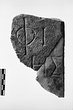
| Inscribed fragment.
The right side of the block is preserved and apparently has an anathyrosis with a smooth edge of ca. 0.02m. in width.
The marble shows no crystals and has a slightly glassy surface ... 8 April 1933 ... Agora XVIII, no. X739 c, pl. 75. |
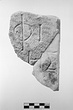
| Inscribed fragment.
Left side preserved; otherwise broken.
Two letters and part of another remain.
White marble.
ADDENDA Join to I 675. Found in disturbed filling of the south gate tower of the late Roman ... 15 June 1933 ... Agora XVIII, no. X739 c, pl. 75. |
About one-third of rim with one handle missing. Flat bottom and two vertical strap handles. Straight thickened lip.
Pinkish-buff clay with white grits, unglazed. Protoattic pit and well. Leica, 7-434 ... 10-16 March 1936 ... Hesperia Suppl. 2 (1939), no. C 75, p. 162, fig. 111. |
Rope handle from amphora (?).
Black paint on tan clay. Object not mentioned (crossed out) on page 78 of notebook Oscar Broneer, Nb. No. 5.
Sample taken 25/6/1979 by Richard Jones. Oscar Broneer, Nb ... 25 May 1938; 8 June 1938 ... Hesperia 8 (1939), p. 394, fig. 75,c. |
| Round terracotta seal.
Red clay, remains of black glaze.
On obverse, an eagle, standing left, with head turned back to right; in field an object. On reverse, plain, slightly depressed in center.
Series ... 30 July 1931 |
Kylix base, black glaze. Inscribed on bottom. Oscar Broneer, Nb. No. 4. 179 88-397 ... 31 May 1937 |
|
|