|
|
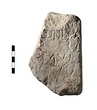
| Inscribed fragment.
Broken above, below, at left and behind.
Right side preserved with a set back just behind corner.
Bilingual: Greek and Hebrew.
Pentelic marble. Found in late wall. Leica ... 20 April 1959 ... Right side preserved with a set back just behind corner.
Bilingual: Greek and Hebrew.
|
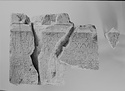
| Inscribed fragments of bilingual honorary monument.
Inscribed face and top preserved.
Above inscription a moulding.
Two lines of the inscription preserved.
Pentelic marble.
ADDENDA Joins I 5210. Found ... 30 March 1938 ... Inscribed fragments of bilingual honorary monument.
|
| Inscribed fragments of bilingual honorary monument.
Fragment ΙΙ 178 a), inscribed face, top and bottom preserved.
Part of base of dedication. Above inscription, traces of a moulding.
Two lines of the ... 12 February 1938
22 April 1959 ... Inscribed fragments of bilingual honorary monument.
|
| Fragments of an inscribed stele; Bilingual.
Fragment Ο 11 a), broken to right, behind, and below. Moulding above; acroterion at corner.
Latin inscription above; Greek translation below.
Fragment Ο 52 ... 15 October 1934 ... Fragments of an inscribed stele; Bilingual.
Fragment Ο 11 a), broken to right, behind, and below. |
Lip and bowl fragment. Reserved line on inside and outside just below rim. Glaze misfired greenish. Max. dim. 0.07; est. diam. at rim 0.31.
A, part of left eye and eyebrow. Contour of iris and pupil incised ... Ca. 510 B.C ... The best discussion of these is Cohen, Attic Bilingual Vases, pp. 385--397. |
Floor fragment with stem and start of fillet. Incision at edge of fillet. Max. dim. 0.069.
I, runner (head, upper part of right arm, right leg from the knee down and left foot missing) to right. In his ... Ca. 520 B.C ... Incision for anatomy occurs, for example, on the red-figured side of the bilingual amphora Type A in Munich, 2302 (ARV2 6, 1; Addenda 150; Lullies in CVA, München 4 [Deutschland 12], p. 8); another is the red-figured amphora Type A in Philadelphia 5399 (ARV2 7, 3); for the incision, see W. |
|
|