|
|
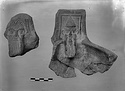
Broken at back and top.
Two nicely executed bare feet, the left advanced on high plinth.
Figure has long drapery. Chiton (worn under peplos) visible before feet.
Mold made.
Micaceous orange clay.
Cf ... 27 June-5 August 1972 |
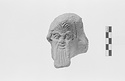
| Lug and rim fragment preserved. Head of satyr. The head projects from a rectangular panel which rises above the broad double rim of the brazier. The figure is wearing a pointed cap under which is visible ... 17 July 1931 |
| Head of satyr. Hair stands erect on the forehead in parallel curves; large ears; broad nose; heavy eyebrows; bulging eyes with heavy lids; mouth partially indicated; deep grooves indicate the beard, which ... 26 June 1931 ... Coarse red clay; unglazed.
Cf. BMC Terracottas, p. 292, fig. 62.
... Leica, 93-64-4, 1-87 |
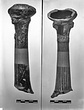
| Lamp is attached to a high standard of which the front is in the form of a column.
From the ridged necking spring two volutes; between them are raised loops, and below, above the necking, a band of raised ... 25 July 1931 ... BMC, p. 37, fig. 30 ... Hesperia 2 (1933), pp. 197, 202, fogs. 2, 4. |
Nine joining and non-joining fragments.
On a cubical base, the front of which was adorned with figures in relief, the tip of a cap of Attis (?) is all that remains, stands a nude figure of Eros (?) of ... 1937 |
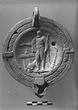
| Large relief lamp: Heracles (?) with trident, sacrificing.
Mended from several pieces. A small piece of the top of nozzle missing.
Panelled rim, bordered by plain narrow bands; within, small running spiral ... 11 April 1932 ... Type XXVII of Corinth collection.
Cf. BMC Lamps, no. 1222: different type of Heracles, also signed by this maker.
... PD 1375-4 |
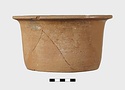
| Several pieces, including chunks from sides and rim, missing. Flat bottom; straight sides; flat-topped projecting rim.
Orange-buff clay. Light slip. Surface much worn.
On side wall, just below rim, a ... 9-12 February 1937 ... Athens New Style coin Head (1888), BMC Attica, pl. 12:8, dated ca. 90 B.C. ... Our seal is not an exact duplicate of either of the coin types known (cf. BMC Attica, pl. 12:8. ... On a red-figure chous illustrated by Deubner (Deubner (1932), Attische Feste, pp. 104-105, pl. 11:4) as a representation of the Anthesteria the figure of Dionysos, whether it be a statue or a man playing the part, is based obviously on the cult statue by Alkamenes. |
|
|