|
|
A: lion, right.
B: plain. Entered as coin no. 42, for the day. Sand in bottom of drain.
Coins nos. 1-108, two Athenian Imperial, rest New Style or earlier. Leica ... 15 June 1935 ... Coins nos. 1-108, two Athenian Imperial, rest New Style or earlier. |
Flat-bottomed bowl on ring foot with flaring lip, concave outside. Only a small part of the lip preserved. Stamped on the floor, off center, an owl standing on an amphora surrounded by an olive wreath ... 14 May 1935 ... Type of Athenian New Style coins, but cannot be associated with any single issue.
|
Most of rim and wall restored.
Small foot; flat resting surface; flat underside. Angular profile with groove below angle. Widely flaring rim. Flat floor meets wall at angle. Stamp on floor (not centered): ... 110-100 ... Stamp similar to reverse of Athenian New Style silver coins; see M. |
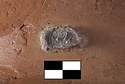
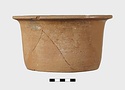
| The seal is attached to the wall of a plain flat bottomed bowl, P 14431 (X 988), rivetted through the clay just below the rim.
A seated figure (Dionysos ?) facing right; a high back to throne, and apparently ... 9-12 February 1937 ... See also same figure, seated left on Athenian New Style coin dated ca. 90 B.C., Head (1888), BMC Attica, p. 104, no. 758, pl. |
| Several pieces, including chunks from sides and rim, missing. Flat bottom; straight sides; flat-topped projecting rim.
Orange-buff clay. Light slip. Surface much worn.
On side wall, just below rim, a ... 9-12 February 1937 ... On Introd. p.L. Athens New Style coin Head (1888), BMC Attica, pl. 12:8, dated ca. 90 B.C. ... The seal is certainly a copy of the statue which appears on Athenian New Style and Imperial coins and which has been identified as the Dionysos by Alkamenes. ... B.C.; the cistern was perhaps abandoned and filled after the sack of Sulla (86 B.C.). The New Style coins on which the type appears are dated by Sundwall about 40 B.C., and so postdate the seal by some years (Head (1911), Hist. |
|
|