|
|
| Rebecca Wood Robinson ... Damaged Protogeometric grave (E.L. Smithson: Grave XL).
Small corner only preserved, cut in part into the filling of the Submycenaean Grave J 9:2. In this corner, and spilling into the disturbed upper ... Late Protogeometric |
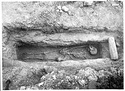
| Evelyn L. Smithson ... Submycenaean grave (E.L. Smithson: Grave XXXIV). The skeleton of a 30 year's old female ... Submycenaean |
A circular pit below Byzantine floor. It Is 1.28m deep and its bottom rests upon virgin soil, a gray clay formed by the disintegrated native rock. It is constructed for about 0.30m at the top with tiles, ... 12th c. A.D. |
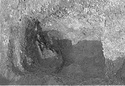
| Plundered Chamber Tomb. (Tomb XII). A few meters SE of the great white marble altar. The chamber is an irregular rectangle, oriented roughly N-S, with dromos leading in at a very gentle slope from the ... LH III A |
Irregular depression in bedrock (ca. 7x5m), ca. 2m deep; area south of E-W Late Roman wall. Dumped filling apparently intended to level off the area. Coins:
11 March 1952 #10
12 March 1952 #1-#5
13 March ... Ca. 400-325 B.C. |
Coins:
8 April 1936 #13
1 May 1936 #21 ... Byzantine-Turkish |
Fill to 6.50m., masses of stone, animal bones and coarse pottery with some unfinished poros sculpture at 6.50m. - a dump of early 3rd c. ... At 6.50m. begins use filling with numerous BHWJs and other water ... Late 1st c. to early 3rd cent. and of 4th and 5th cents |
Empty to 4.00m. From there to 9.20m. much coarse pottery, stucco fragments, animal bones, lead defixiones. ... The presence of fragments of stelae and architectural members near bottom point to dumped ... Late 2nd-early 3rd c. A.D. |
| Hole in bedrock; dumped filling used in leveling.
Probably a natural water line, tending to wash out, has been cut back for various purposes, and finally all filled in to make level bedding for 4th c., ... Ca. 350-270 B.C. |
Water deposit in Polygonal Drain (43-44/Γ-Ζ and martyra)immediately south of the south foundations of the Middle Stoa. Early branch of the original course of Great Drain. P 2248 added to this deposit by ... Ca. 420-390 B.C. |
| Late Geometric well ... Late Geometric |
A pit running E-W under Holy Apostle St., about 1.20m. square and 0.90m. deep. Built with stones about the size of a man's head. Coins:
24 April 1935 #12-#13 ... 18th c. |
Located just north of the stepped retaining wall between the Great Drain and the Poros Monument (Propylon).
Short period of use; dumped filling above, mostly cemetery debris ... Early Protogeometric |
Located in the NE corner of the early peribolos. Probably originally 1.00-1.50m. deeper, the bedrock above having been cut back in late times. Scanty pottery remains; some evidence for a period of use ... Ca. 600-570 B.C. |
One of two late wells [the other at 59/ΙΗ] cutting the line of the east wall of the peribolos and the line of the Byzantine enclosure. The shafts of the two were close together and in their upper parts ... Turkish |
Upper part collapsed (diameter 1.25m). Uniform fill with water jars. Sorted June 1956. 4 tins thrown out. Joins from all boxes, but pithos fragments and water jars mostly from boxes 6-16 ... 750-700 B.C. |
Pocket in bedrock behind stepped retaining wall ... 7th c. B.C. |
Apparently an unsuccessful well. P 37220-P 37224 (Κ 4519-Κ 4523) Catalogued on October 2012 (JPK, SS)
P 37741-P 37742 (Κ 4549-Κ 4550) Catalogued on April 2017 (BL) ... Protogeometric |
Well E (diameter 1.10-1.20m) just outside the northwest corner of the southwest Fountain House.
Dug initially as a pit (J 15:2) partially covered by an early Roman wall ... Early 7th c. B.C. |
Well on the north slope of the Areopagus. Unfinished, probably because of hardness of rock, and refilled at once, perhaps with sanctuary dump and with collapsed rock from the shaft itself.
Diameter 1.15m ... 3rd quarter of the 7th c. B.C. |
| Coins:
23 July 1992 #854
27 July 1992 #861-#864, #866, #868, #872
28 July 1992 #867, #874
29 July 1992 #869-#871, #873, #875
31 July 1992 #877-#884, #887-#888
3 August 1992 #890-#896
4 August 1992 #897-#900, ... Roman-Byzantine |
| The remains of a pyre disturbed by the construction of Wall 106. The compact, light brown soil contained some ash and bone and 5 nearly complete pots or saucers ... First half 3rd. c. B.C. |
Michael Laughy ... West and adjacent to Modern Wall 5, we excavated 12th-13th c. A.D. fill, in some places a half meter deep or more. The fill was remarkably uniform in content throughout. Typical pottery included: fine ... 12th-13th c. A.D. |
| James Artz Pirisino Daniele Kylindreas Miltiades ... Excavation in Room 3 of ΒΘ West revealed 5 ceramic vessels in a row against the eastern face of Wall 12. 3 complete vessels (ΒΘ 122, 124, and 125) were catalogued, along with the base of a plain glazed ... 9th-11th c. A.D. |
Well L: PG, ELS. Includes a displaced grave (K 12:2 bis). The pottery appears less consistent than that in the pit at 70/ΜΕ. Depth of well 6.25m. below the top of wall B. PD 2780 ... Protogeometric |
Dorothy B. Thompson A.W. Parsons ... Displaced grave in well K 12:2. Adult female inhumation (AA 290). As Deposit K 12:2a in Agora XXXVI ... "Submycenaean"/Early Protogeometric |
Small pocket with R.F. sherds and terracottas, perhaps thrown up by the diggers of a modern well nearby ... Ca. 375-350 B.C. |
Pottery Deposit at 57/ΙΔ (also 57/ΙΣΤ and 63-66/Κ-ΚΕ). Contents of pit range from Mycenaean to Turkish; apparently the dump of a modern antiquities dealer ... Modern Context |
"Iron Pit" beneath house 634/20 and in the upper part of a well. Coins:
22 April 1958 #1-#3 (illegible)
23 April 1958 #1
25 April 1958 #1 (illegible) ... 1st C. B.C. |
Scanty filling over bedrock ... Latest 6th c. B.C. |
In Southeast House, Room E. The inventoried material consisted entirely of loomweights, all of the 4th c. B.C ... 5th-4th c. B.C. |
Refuse pit in rock by heavy wall on West Street ... Ca. 500-480 B.C. |
Roman well re-used in Byzantine times. Subdivisions:
.1=0.00-13.80m.
.2=13.80-23.50m.
.3=23.50-25.00m ... Late 1st-early 2nd, 4th-5th, 11th centuries. |
Well 10: Neolithic.
Diameter, ca. 0.80-0.90m. No water ... Neolithic |
Well 16 Nothing catalogued, but presumably the 20th Neolithic well, see page 1. J Camp ... Neolithic |
Well 5: Late Neolithic. Diameter ca. 0.85m. No water ... Late Neolithic |
Well 6: archaic. Diameter 1.20m
Well on the northwest slope of the Acropolis, below the Klepsydra.
There are three fills, all thrown into the unfinished well at the same time (end of 6th- beginning of ... Last quarter of 6th c. B.C. |
Pithos in Turkish Pathway Coins
26 May 1937 #2-#7 ... Byzantine |
Well 1: 5th c.
Shallow irregular shaft, probably originally dug in the Neolithic or the Middle Helladic period,but cleaned out and refilled with a filling composed of loosely thrown in dug bedrock and ... 5th c. B.C. |
Washed-in filling at the base of the Acropolis cliffs, some 7m. east of the Klepsydra; the fill was characterized by teh fragments of a series of red-figured oinochoai of special shape, of the late 5th ... Late 3rd c. B.C. |
|
|