|
|
| White ground. Tripod. Tyrant-Slayers. Vambrace. Vari. Vase, representation of. Wine. Wineskin. Women's flesh left black. Vraona. Vulci. Wool. Workshop. Warping. Wash. Wreath: around head. Weathering. Wheat ... Agora 23 367 ... Vase, representation of |
Broken on all sides. Front, back preserved. Mended.
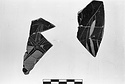
Subject uncertain: two series of radiating loops possibly from a schematic representation of animal hair. Fragment may in fact be the impression rather ... 29 June 1973 ... Subject uncertain: two series of radiating loops possibly from a schematic representation of animal hair. ... ADDENDA RVN: Wing fragment from statuette or plastic vase. |
Wall fragment. Max. dim. 0.058.
Wooly satyr (torso, start of arms, legs, and tail) to right. White: tufts of fur.
The satyr is dressed in the costume of Papposilenos and is closest to the satyrs on the ... Ca. 420 B.C ... Wooly satyr (torso, start of arms, legs, and tail) to right. ... For the most recent discussion of the meaning of the representation on the New York vase, see Froning, Dithyrambos, pp. 25--26, who opts for the scene reflecting a satyr play rather than a dithyrambos performance. ... Simon in The Eye of Greece: Studies in the Art of Athens, D. |
| Fragments a) and b) come from opposite sides of the vase, each showing the hind legs of the horses of a quadriga. The larger (a) shows also the edge of the wheel of the chariot and, behind the horses, ... August-September 1932 ... Fragments a) and b) come from opposite sides of the vase, each showing the hind legs of the horses of a quadriga. The larger (a) shows also the edge of the wheel of the chariot and, behind the horses, part of a draped female figure in embroidered chiton and peplos.
... The representation not entirely clear, not only on fragment e) but also on a) and c), on each of which is preserved part of a leg of a nude figure standing behind the chariot. |
| Seven fragments. Plain maeander, left, below figured zone. Inside unglazed.
a) Preserves the wall of the vase from the top of the lower cylindrical portion to near the top of the figured zone. Parts of ... 19-23 March 1936 ... a) Preserves the wall of the vase from the top of the lower cylindrical portion to near the top of the figured zone. ... Along the break at the right, traces of some representation.
e) Wall fragment (not certainly belonging). ... The sharply incurved wall of the vase, just below the maeander border, is much worn from use.
|
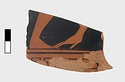
Five non-joining fragments of shoulder and wall. Glaze dull on outside. Surface of figures rather abraded. Max. dim. a) 0.089, b) 0.077, c) 0.147, d) 0.102, e) 0.092.
Athena and the Giant. Fragment a ... Ca. 490-480 B.C ... Five non-joining fragments of shoulder and wall. ... Fragment b comes from the other side of the vase from the lower right part of the panel and looks like it preserves the calf of a man. ... For a parallel, see Athena and her giant in the representation of ca. 470 by the Altamura Painter, London, B.M. |
Fragment of torus mouth, neck, and start of shoulder, part of body on each side. Neck glazed on inside. Glaze misfired reddish brown; abraded in places, especially on mouth and on Boreas. P.H. 0.14; diam ... Ca. 460 B.C ... Fragment of torus mouth, neck, and start of shoulder, part of body on each side. ... P.H. 0.14; diam. of mouth 0.155. N. ... E 59) simply calls her a companion of Oreithyia. The presence of the olive tree indicates that the representation on this side of the vase takes place on the Akropolis (Weil, p. 85; Kron, p. 81), and the position of Erechtheus' right hand with the palm outward suggests that he has already heard the bad news.
|
Two non-joining wall fragments. Max. dim. a) 0.055, b) 0.077. A. Ashmead, Hesperia 35, 1966, pl. 8.
Fragment a preserves most of the filleted head of an old man (Phoinix) to left, holding a spear or staff ... Ca. 490 B.C ... Fragment a preserves most of the filleted head of an old man (Phoinix) to left, holding a spear or staff (shaft). ... Dilute glaze: folds of chiton; iris of Phoinix' eye. ... Döhle (Klio 49, 1967 [ pp. 63--143], p. 105) thinks that 254 may come from a representation of the Mission to Achilleus, based in part by the presence of Phoinix in the same scene by the Kleophrades Painter on his hydria in Munich, inv. 8770 (Paralip. 341, 73 bis; Addenda 189). |
Fifteen non-joining fragments of wall, P 18278 b--c and P 19582 a--d of torus rim with zone of ornament below. Glaze mottled here and there; has a greenish cast in places; abraded in part on rim. Max ... Ca. 480 B.C ... Fifteen non-joining fragments of wall, P 18278 b--c and P 19582 a--d of torus rim with zone of ornament below. ... Occasionally, the Mission Scene is combined with a representation of the leading away of Briseis, as on the Louvre skyphos by Makron (G 146: ARV2 458, 2; Paralip. 377, 2; Addenda 243; Denoyelle, Chefs-d'oeuvre . . . Louvre, pp. 132--133, cat. no. 61), but there each subject appears on a different side of the vase. On the namepiece of the Briseis Painter (London, B.M. |
|
|
.png.icon.jpg)