|
|
Uncertain Sultan, Imitation ... "Sequins", Jeweler's Pieces.
Anomalous types with unintelligible Turkish characters. Coin no. 17.
GCM 1030.17. Demolition. 57 ... 19th-first half of 20th c. A.D ... Anomalous types with unintelligible Turkish characters. |
Maḥmūd II, Imitation ... "Sequins", Jeweler's Pieces.
North African types. Coin no. 10. GCM 855.10. Late black filling. 310, 312, 1572 ... 19th-first half of 20th c. A.D ... North African types. |
Athens ... The plemochoe counterstamping has completely obliterated the original types. Coin no. 9. Modern fill. Plemochoe in relief. Plemochoe in incuse circle. 1840 ... 229-ca. 224/223 B.C ... The plemochoe counterstamping has completely obliterated the original types. |
Uncertain Sultan, Imitation ... "Sequins", Jeweler's Pieces.
Anomalous types with unintelligible Turkish characters. Coin no. 25. GCM 927.25. Church of Christ; west end, debris on floor. 413 ... 19th-first half of 20th c. A.D ... Anomalous types with unintelligible Turkish characters. |
Constantinople ... Philippicus ... Struck over Justinian II (visible remains of the types of 1st striking: Obv., Left hand, bust and cross. - Rev., K, ANNO, X X). Coin no. 43. Gravelly Byzantine fill. ... My AN
Bust of Philippicus facing ... 711-713 A.D ... Struck over Justinian II (visible remains of the types of 1st striking: Obv., Left hand, bust and cross. - Rev., K, ANNO, X X). |
Philippicus ... Restruck.
1st striking:
There are certainly traces of restriking but types cannot be determined. Either this is a mule, the I type not having taken over the K of Justinian II or else it is a K denomination ... 711-713 A.D ... Restruck.
1st striking:
There are certainly traces of restriking but types cannot be determined. |
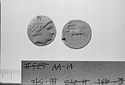
| Philip II, Forgery, Kings of Macedonia ... "I-56"
Forgery: apart from the fact that these types were not anciently struck in silver, the surface of the metal, especially on the reverse, has the pitted texture of a modern cast. The coin, drilled ... 359-336 B.C ... "I-56"
Forgery: apart from the fact that these types were not anciently struck in silver, the surface of the metal, especially on the reverse, has the pitted texture of a modern cast. |
|
|