|
|
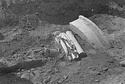
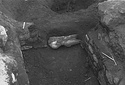
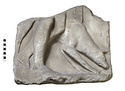
| The moulding Σ 2243 and the piece of sculpture Σ 2244, as found. From the southeast ... AMS Horizontal (normal) ... The moulding Σ 2243 and the piece of sculpture Σ 2244, as found. |
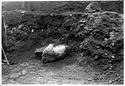
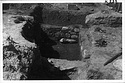
| Statue of Dionysos as found in wall ... 6 Mar 1935 |
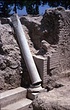
| East column at entrance to Room 3, as found ... =86-401/Roman House H in notebooks. (SD) east ... August 1970 |
Bookidis, Nancy ... American School of Classical Studies at Athens ... The fifth part of the Corinth volume dedicated to the Sanctuary of Demeter and Kore publishes the large-scale terracotta sculpture found in the sanctuary. Extending from the late 7th through the 4th century ... 2010 ... The fifth part of the Corinth volume dedicated to the Sanctuary of Demeter and Kore publishes the large-scale terracotta sculpture found in the sanctuary. Extending from the late 7th through the 4th century B.C., the sculpture consists of fragments from 132 to as many as 147 statues, from half- to nearly life-size. ... This volume greatly expands our knowledge of the history of Corinth, broadening our understanding both of cult practices at the site and of the manufacture of terracotta sculpture. |
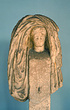
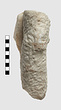
| Head of youth, set on a shaft; the whole framed by heavy drapery which covers the top of the head and falls down on both sides and at back. Lower part broken away. Face much worn: mouth and most of nose ... 10 March 1932 |
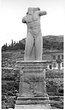
| Giant in easternmost position in the "Gymnasium" series. The Late Roman Complex was identified as a Gymasium because of its scheme and of an inscription found by Pittakis in 1848 alongside the colossal ... This is OD 181. The neg. was destroyed and replaced by one that is not 88-461 as mentioned on print.(SD) south |
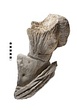
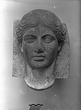
| Fragment of female head, hair in wavy locks drawn towards nape. Proper right side. Pentelic marble. Found in a pit between the Temple of Ares and the altar foundation. Possibly from the same series as ... 4 Aug 1950 |
| Fragment of female head, hair in wavy locks drawn towards nape. Proper right side. Pentelic marble. Found in a pit between the Temple of Ares and the altar foundation. Possibly from the same series as ... AMS Horizontal (normal) ... 4 Aug 1950 |
| Giant in easternmost position in "Gymnasium" series. The Late Roman Complex was identified as a Gymnasium because of its scheme and of an inscription found by Pittakis in 1848 alongside the colossal figures ... south Horizontal (normal) ... ca. 1946 |
| Broken in front at the right. On the sides, two holes for insertion of cross bars. The back is cut as though it stood against a wall, the top as though it carried something. The figure has a beard and ... 15 May 1933 |
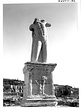
| Giant in easternmost position of the "Gymnasium" series. The Late Roman Complex was identified as a Gymasium because of its scheme and of an inscription found by Pittakis in 1848 alongside the colossal ... southwest ... 1949 |
| Giant in easternmost position of the "Gymnasium" series. The Late Roman Complex was identified as a Gymasium because of its scheme and of an inscription found by Pittakis in 1848 alongside the colossal ... AMS southwest Horizontal (normal) ... 1949 |
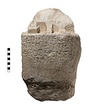
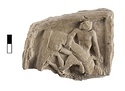
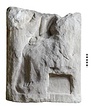
| Fragment of inscribed columnar base; relief on top; grave stone (?).
Part of a columnar base; broken away on either side and in back. On the sculpture above, two feet are preserved. The figure is broken ... 22 June 1933 ... On the sculpture above, two feet are preserved. The figure is broken away above the ankles, as is also a rectangular projection to the right of the figure which may have served as border to the relief.
... Found in modern foundation wall, north of the Temple of Ares. |
| Giant in easternmost position of the "Gymnasium" series. Proper right side. The Late Roman Complex was identified as a Gymasium because of its scheme and of an inscription found by Pittakis in 1848 alongside ... west ... July 1939 |
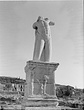
| Giant in easternmost position of the "Gymnasium" series. Front view. The Late Roman Complex was identified as a Gymasium because of its scheme and of an inscription found by Pittakis in 1848 alongside ... south ... 1949 |
| Giant in easternmost position of the "Gymnasium" series. Front view. The Late Roman Complex was identified as a Gymasium because of its scheme and of an inscription found by Pittakis in 1848 alongside ... AMS south Horizontal (normal) ... 1949 |
| Giant in easternmost position of the "Gymnasium" series. Proper right side. The Late Roman Complex was identified as a Gymasium because of its scheme and of an inscription found by Pittakis in 1848 alongside ... AMS west ... July 1939 |
| Tomb U, west of the Church of Elias and Charalambos: statue of Herakles from the East Pediment of the Hephaisteion, as found built face down into wall of tomb. Cf. Hesperia 18 (1949), p. 214.
DUPLICATE ... No deposit given yet. Horizontal (normal) ... 19 Mar 1948 ... Site | By Area | South | Miscellaneous | Objects as Found ... Site | By Area | West | Temple of Hephaistos | Sculpture | East Pediment | Standing Male Torso (S 1313) |
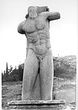
| Tomb U, west of the Church of Elias and Charalambos: statue of Herakles from the East Pediment of the Hephaisteion, as found built face down into the wall of the tomb. Cf. Hesperia 18 (1949), p. 214 ... Horizontal (normal) ... 19 Mar 1948 ... Site | By Area | South | Miscellaneous | Objects as Found ... Site | By Area | West | Temple of Hephaistos | Sculpture | East Pediment | Standing Male Torso (S 1313) |
| Tomb U, west of the Church of Elias and Charalambos: statue of Herakles from the East Pediment of the Hephaisteion, as found built face down into the wall of the tomb. Cf. Hesperia 18 (1949), p. 214 ... Horizontal (normal) ... 19 Mar 1948 ... Site | By Area | South | Miscellaneous | Objects as Found ... Site | By Area | West | Temple of Hephaistos | Sculpture | East Pediment | Standing Male Torso (S 1313) |
| Giant in easternmost position of the "Gymnasium" series, front view. The Late Roman Complex was identified as a Gymasium because of its scheme and of an inscription found by Pittakis in 1848 alongside ... south ... 1949 |
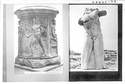
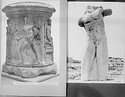
| On the left, representation of Hephaistos on the Madrid puteal (Einzelaufnahme 1729) and at right the easternmost Giant in the "Gymnasium" series. The Late Roman Complex was identified as a Gymasium because ... ca. 1948 |
| On the left, representation of Hephaistos on the Madrid puteal (Einzelaufnahme 1729) and at right the easternmost Giant in the "Gymnasium" series. The Late Roman Complex was identified as a Gymasium because ... AMS Horizontal (normal) ... ca. 1948 |
| Camp, J ... The American School of Classical Studies at Athens ... This concise and beautifully illustrated book demonstrates the many roles played by the horse in the lives of the Greeks, from its place in myth and early history to its significance as a marker of social ... 1998 ... This concise and beautifully illustrated book demonstrates the many roles played by the horse in the lives of the Greeks, from its place in myth and early history to its significance as a marker of social status and its use in warfare, transportation, games, and festivals. ... Bridles and other horse trappings are often found in graves, alongside vases depicting horses grazing, racing, and parading. ... As well as presenting many examples of horse imagery found in the Agora, the author reports on recent finds near the ancient hipparcheion, the stables of the Athenian cavalry. |
| Upper part of a woman somewhat under life-size.
Preserved are left shoulder, breast and part of upper arm. Head and neck insets, missing. The woman wears a thin, clinging chiton, highly girded, cf. S 462, ... 11 April 1934, February 1954 |
| Aphrodite Pandemos seated on goat.
Preserved: rear part of goat and part of goddess from below waist to below knees. Part of original edge of plaque at left. Background of plaque curves slightly with high ... 1933 |
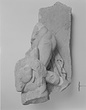
| Lower part preserved, broken at top only.
From narrow relief; legs of a man, half life-size, walking toward the right; behind him a dog, nose to ground; end of garment in front of man's left knee.
Left ... February 1949 |
| Small head of Aphrodite type.
The hair is bound by a fillet and gathered into a large knot behind; a sakkos covers the hair and knot behind the fillet.
Granular, white marble, perhaps Parian or Turkish ... 17 May 1935 |
| Broken above knee and above ankle.
This piece was intended for insertion as a patch in a high relief. The surface worked with the single point; a measuring point on the inside of the knee.
Pentelic marble ... 28 June 1950 |
| From mid part of nude male figure, apparently in the round. Right leg held up, or forward as is seated. Small hole for peg just to left of broken right leg.
Much weathered, especially at front.
Island ... 10 April 1952 |
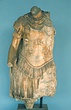
| Lacks head, left arm, right hand, left leg in toto and right leg below knee.
Standing female figure wearing cuirass, cloak and girdle, with a remnant of a sword by her right side.
The surface when not ... 1869 |
| Water Channels. Large Channel to East of Great Drain. Round Terracotta Pipe and Settling Basin at Northeast Corner of South Wing of Stoa. Round Terracotta Pipe and Settling Basin at Northeast Corner of ... Η'-12 2259, 2260 S 313 S 314 S 339 ... Sculpture As Found ... Female Standing Figure Found in Great Drain to West of Ares Temple |
| Broken at right side. Rough parallel chisel marks at the back.
Within a raised border, the relief shows two men pushing and pulling at an object, which resembles a statue. They may be setting it on a ... 15 June 1933 |
| Head, feet, right arm and lower drapery to right are missing. The man stands with his weight on his left leg and with his right knee bent. His himation leaves his chest and his right arm and shoulder free ... 10 May 1933 |
| Broken off at the top, at the shoulders of both figures; back and bottom rough-picked; sides fine-picked. Surface very much worn.
The figure to the right, seated on a stool, faces left, her left hand resting ... 3 April 1933 |
| Back and front surfaces of background preserved, but no original edge.
Parts of two male figures preserved. The first, preserved from chest to ankles, nude save for cloak hanging in folds along his right ... January-February 1949 |
| The head is broken away in back. Both ears missing. The front is well preserved, except for the tip of the nose. Stained. The hair parted in the middle and drawn back in loose waves.
On the top of the ... 15 April 1935, 30 May 1935 |
| Peleus and Thetis. Repairs to sculpture in antiquity. Peplos in archaistic sculpture. Perirrhanteria in the form of archaistic korai. Retrograde inscriptions. Persephone. Re-use of sculpture in antiquity ... Agora 11 184 ... Repairs to sculpture in antiquity ... Peplos in archaistic sculpture ... Re-use of sculpture in antiquity |
| Lacks head, both arms and both legs.
Female figure wearing cuirass, cloak and girdle.
On front of cuirass in relief, Scylla; on lappets of upper row from left to right, Aiolos, three sirens, Polyphemos; ... 1869 |
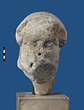
| Bearded herm head of Archaic type. Back of head broken away above, hair around brow damaged, nose and chin broken away, surface damaged. Full height preserved. Front of neck forms a tongue (width broken), ... Early 5th century B.C. |
|
|



.jpg.icon.jpg)

.png.icon.jpg)