|
|
Inscribed fragment.
Roughly made, but very nearly all edges preserved.
Somewhat careless lettering.
White marble. Found in Room I of Philosophical School C. 2035 Leica ... 15 July 1969 ... Found in Room I of Philosophical School C. |
Center of floor missing.
Recessed underside. Almost straight wall. Reserved: underside.
Quite close, Athens, British School of Archaeology, with glazed circle in center of reserved underside ... 500-480 B.C ... Quite close, Athens, British School of Archaeology, with glazed circle in center of reserved underside. |
Wall fragment from point of juncture with base.
Tips of two small leaves, part of a larger leaf and tendrils.
Exterior probably wheel made. Surface find 1953. Picked up by Mr. John Boardman, British School, ... 1953 ... John Boardman, British School, in area of assembly place. |
A. Upper part of a cloaked youth, left.
Reserved line at rim outside.
No relief contour. The glaze of the eye and folds mostly flaked away. Careful work. Rim fragment.
School of Penthesilea painter.
ARV, ... 5 March 1931 ... Rim fragment.
School of Penthesilea painter.
|
Part of a female figure seated three-quarters left, and leaning on her left hand. She wears a thin, girdled chiton and a necklace.
Relief contour. White for the beads of the necklace. Light brown wash ... 1931 ... Light brown wash inside.
School of Meidias painter. |
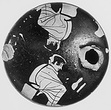
Two non-joining floor fragments. Max. dim. a) 0.043, b) 0.037; est. diam. of tondo 0.11.
I, youth to right, looking back. Fragment a (illustrated) preserves his wreathed head and chest, the start of his ... Ca. 440-430 B.C ... White (flaked): wreath.
School of Makron, VIII: the Painter of Louvre G 456 (ARV2 one 547, 12); the Painter of Louvre G 456 (ARV2 826, 27). |
Floor fragment. Glaze fired red on inside. Surface rather worn.
Max. dim. 0.059; est. outer diam. of tondo 0.11.
I, two males, probably youths (feet of each) facing. Around tondo, stopped-maeander pattern ... Ca. 450-440 B.C ... Below, two reserved lines.
School of the Penthesilea Painter (Addenda and Corrigenda, p. 1944; not in ARV2). |
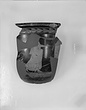
| Handle and spout missing; otherwise intact. Substantial raised base, flat beneath. The walls flare considerably to meet the gently domed top; spout set well in from shoulder. On the top, two school boys, ... 26 May 1939 ... On the top, two school boys, huddled in mantles, each sitting on a small rectangular stool or bench. |
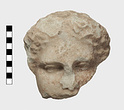
| Fragment preserving front part of top of head with both eyes, the right cheek and part of the mouth. Nose broken (fresh break). The break in the proper left side of the head old, that on the right fresh ... 27 February 1954 ... -S. wall behind school that fronts on Vrysaki Street (east of Stoa of Attalos). |
| Many fragments, giving essential parts of the walls but nothing of the foot. On each side, four figures grouped in twos.
A) Warrior to left holding shield in the left hand; Attic helmet, chiton, corselet ... 25 May 1951 ... Cup, Siena, School of the Penthesilea Painter, ARV, p. 626, no. 31. |
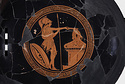
| Repaired from many fragments; both handles, about two-thirds of the rim and a bit of the base missing.
Interior: medallion complete except for a bit of the maeander on the left side. Double maeander broken ... 2 July 1931 ... The style and arrangement of the figures, the details of the maeander, the armour, the drapery with borders, the stool, the lyre, the vases, and the character of the heads would seem to connect the workmanship with Douris or his school. Further, the medallion contains, above the figure, indistinct painted letters, the first of which is an open Λ (Δ), the last a (Σ), both characteristic of the signature of Douris, the central letter, however, appears to be a Λ. |
|
|