|
|
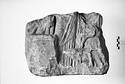
| Broken at top. Some chips missing from sides.
At left a rectangular altar behind which stands a draped figure, her left hand and the folds of her garment are visible. Beside her, in the middle of the relief, ... 17 May 1971 ... Relief Fragment with Sacrifice Scene |
Wall fragment from just below rim. Reserved band on inside. Max. dim. 0.081.
Man or youth (left arm and hand, a bit of drapery) to right, seizing a bull (most of head) by the horn. Above, about half of ... Late 5th century B.C ... Perhaps the sacrifice of a bull following a victory. Cf. 118, the slightly earlier stamnoid that depicts such a sacrifice following a victory in a torch race. |
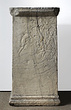
| Chipped on sides and at molding on top.
Rectangular altar, square in section. Molding at top and bottom. Top flat. Relief on three faces: 1) scene of sacrifice with a bull, large square hole in center ... Relief on three faces: 1) scene of sacrifice with a bull, large square hole in center (re-use?), 2) sacrifice of a goat, 3) scene with Pan, Dionysos and Satyr. |
Mended with missing pieces restored in plaster and painted, notably all of the mouth, neck and handle, much of lower body, nearly all of ring base. Thin glaze on inside. Glaze pitted and flaked in many ... Ca. 450-440 B.C ... Durand, Sacrifice et labour en Grèce ancienne: Essai d' anthropologie religieuse, Paris/Rome 1986, p. 117, fig. 37; Straten, Hierà Kalá , p. 233, cat. no. ... Scene of Sacrifice. A nude youth (right forearm and hand, most of legs missing) walks to right, holding a kanoun on his outstretched left forearm. |
Deeply outcurved rim, slender uptilted handles, disc foot with spreading outer profile. Inscribed on inside, underside and exterior. The graffiti on this and other lekanai from the same deposit, here 1794, ... Context ca. 470-460 B.C ... A faithful representation of just such a lekane appears in the sacrifice scene on the cup in Oxford 1911. 617: ARV 559, 152, late work of the Pan painter. |
Two non-joining fragments. Fragment a comes from the lower part of the vase; fragment b is a shoulder fragment. Glaze on b is slightly abraded; streaky and pitted on inside. P.H. a) 0.175; max. dim. b) ... Ca. 420 B.C ... V 60.
Sacrifice of a bull in celebration of a victory in a torch race, the figures continuing around the vase without interruption. ... For the subject, see Corbett, Hesperia 18, 1949, pp. 346--351, who quite plausibly suggests that the torch race depicted on 118 may be the one that took place at the Panathenaia. The sacrifice of a bull at the end of a torch race is not known from many examples, and Corbett has dealt with most of them(pp. 346--351). ... (p. 355, no. 27: Nike leading a bull to sacrifice) and a small oinochoe, St. |
| Inscribed fragments of votive or funerary reliefs.
Cave of Pan relief.
Fragment Ω 1525, broken all around. Part of top and bottom surfaces preserved. Bottom border of a stele with part of the tenon preserved ... 330-320 B.C. (?) ... Ten figures watching or participating in a sacrifice in a cave. ... Also smaller scale than surrounding figures; draped female, seated left, watching sacrifice (Nymph); standing draped female, facing left, her left arm rests on hip, her right is held forward, resting on an outcrop of rock (Nymph).
|
Wall fragment with start of rim, mended and strengthened with plaster. On the far right, start of handle. Reserved line on inside at top. Glaze misfired reddish and greenish in places. P.H. 0.22; max ... Ca. 430-420 B.C ... P.H. 0.22; max. dim. 0.256.
Sacrifice. At the far left, hand of someone holding something, probably an aulos, then Dionysos (top of head missing) standing to right, wearing a himation, a wreath around his head, and holding his kantharos in his lowered right hand, his left raised slightly, acknowledging the youth standing frontally, wreathed head turned toward the god. |
|
|