|
|
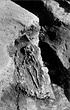
| Susan Rotroff ... Grave 1. Burial of a child perhaps 6 years old, covered by broken amphora. Skeleton lay extended on its back, oriented N-S, with head at south. No grave gifts. PD 2207 ... Final Mycenaean/Submycenaean ... Susan Rotroff |
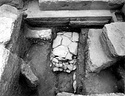
| Susan I. Rotroff ... Grave 2. Adult female inhumation. Grave extending under the south retaining wall of the Temenos of the Royal Stoa. It is oriented ne-sw, with head at sw. Grave built of slabs of schist, with packing of ... Final Mycenaean/Submycenaean ... Susan I. Rotroff |
| Susan I. Rotroff ... Grave 2 (bis). Cut into by builders of I 5:2. No remains.
Possible contents in I 4-5:1 Layer C (= layer 6, lower building fill), catalogued as ΒΓ 2065 - ΒΓ 2125 ... Middle Helladic or later Bronze Age (date uncertain) ... Susan I. Rotroff |
| Susan I. Rotroff ... Burial 3 beneath the floor of the Stoa Basileios. It consisted of a rectangular pit cut into bedrock to a depth of 0.44m, lined on all sides and covered with an admixture of narrow stone slabs of soft ... Final Mycenaean/Submycenaean ... Susan I. Rotroff |
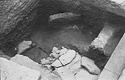
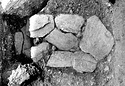
| Susan I. Rotroff ... Grave 4 under Royal Stoa. Cist Grave cut into bedrock and lined with limestone and schist slabs. There were two layers of cover slabs with a layer of dirt between. Grave measured 0.98x0,25-0,32x0,25-0,30 ... Final Mycenaean/Submycenaean ... Susan I. Rotroff |
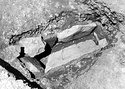
| Susan I. Rotroff ... Grave 5. Adult (female?) inhumation.
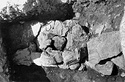
Cist grave lined and covered with slabs of limestone, sandstone and schist. Cut into virgin soil under Royal Stoa at I/12,13-5/3,4. Grave measures 1.79x0.39-0.49x ca ... Final Mycenaean/Submycenaean ... Susan I. Rotroff |
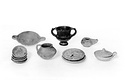
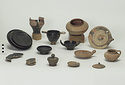
| Excavation of this pit began in 1995, tentatively identified as a pyre. This proved to be so with continued excavation in 1996. The deposits J 2:8 and J 2:9 were combined to become J 2:9. Miniature vessels ... Ca. 300 B.C ... Dated by S. Rotroff. |
| Classical Pyre between floors in Room 2 of Classical Building II.
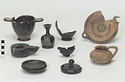
Below floor at 51.66 7masl. Broken pyre pots in fill of ash and carbon, from 51.541-51.513, resting on next floor at 51.513 masl, next ... Ca. 400-390 B.C ... Dated by S. Rotroff. |
| David Scahill ... Beneath toichobate floor level in Room 1 of Classical Building II, against the south ashlar wall, ca. 1.50m. east of the southwest corner of the building. Deposit of broken pyre pots in small pit, 1.00m ... Ca. 325 B.C ... Dated by S. Rotroff. |
Cistern with two tunnels, the one entering its neck cut off by an early Roman well, the other, at the bottom not excavated.
Chamber conical in shape, with a depressed draw basin in the center of the floor ... Early Roman-3rd c. B.C ... Rotroff (1994) (selection of pottery) ... Rotroff (1990), p. 177, pl. 24:3 ... Rotroff (1987a), pp. 185-186. |
| Stucco-lined bottle-shaped cistern, with tunnel and subsidiary manhole, in SW Baths, Room Α 10. Homogeneous dumped fill, mostly of mold-made bowls and and molds for terracotta figurines. Sixteen stamped ... 225-190 B.C ... Rotroff (2005), p. 25. |
| Hellenistic Pyre below packed clay floors of Room 2; west of Late Roman wall extension, below tile platform terracotta drain installation, bordered on the north by bedding foundation stones of crosswall ... Ca. 300 B.C ... Dated by S. Rotroff. |
Grid notation in error as 99/ΚΑ sometimes.
A well (diameter 1.20m; diameter inside tiles at bottom 0.85m) in the industrial area west of the Areopagus, at the bottom of the valley, about 10.00m. east of ... 3rd. c. B.C ... Rotroff (1987a), p. 185. |
| Pyre against north face of polygonal wall, Room 2, Classical Building II. No floor preserved above, but the pyre is below floor level 51.820masl, preserved just to the east and above patchy floor with ... Ca. 275-260 B.C ... Dated by S. Rotroff. |
| Sacrificial Pyre II, Classical Building II.
Found right beneath the stuccoed channel built for sluicing in the 1st c. A.D., and must have been partly disturbed when the channel was constructed. It may ... Ca. 250 B.C ... Dated by S. Rotroff.
AS 1719.1 in Study Collections-Case No. 99C-2 box V. |
| Komos Cistern at 66/Κ, on the north slope of the Areopagus. Homogeneous fill.
Thirty-four stamped amphora handles. Eight Histiaian tetrobols, dating 170-160 at the earliest, found near top, possibly an ... Last quarter of 3rd c. B.C.-Early 2nd century B.C ... Rotroff (2005), pp. 17-20 ... Rotroff (1987a), p. 186. |
Cistern at the southeast foot of Kolonos Agoraios.
Nbp. 2369: Two chamber cisterns, 88/ΛΔ and 100/ΚΘ, united by a long straight passage running almost due N-S. A draw shaft at 95/ΚΘ is set just off the ... Late 2nd-early 1st c. B.C.-86 B.C ... Rotroff (1987a), p. 193. |
Well at 66/ΛΖ. Homogeneous fill.
14 stamped amphora handles. Rhodian and Knidian handles find parallels in Middle Stoa building fill. Type 27 D lamp agrees with this date. Fragments of 50 bowls and one ... 225-175 B.C ... Rotroff (1987a), p. 191. |
| Cistern on lower north slope of Areopagus.
Latest of thirteen amphora handles dated ca.199; twelve legible coins, the latest dating ca. 196-190. Three intrusive pieces:two semiglazed fragments and piece ... 260-190 B.C ... Rotroff (1987a), p. 191. |
Cistern at 53/ΝΕ, bottle-shaped, stucco-lined, in the east aisle of the peristyle of Roman House H (courtyard of Greek House G, just west of andron).
Lower diameter 2.73m.
Homogenous fill all apparently ... Into early 2nd century B.C ... Rotroff (2005), p. 25. |
| In area West of the Areopagus. Fills with many figurines and molds, possibly from a terracotta factory.
Twelve stamped amphora handles; no long-petal bowls; Type 54 A lamp Coins:
31 May 1939 #11
1 June ... Mostly 200-150 B.C ... Rotroff (1987a), p. 189. |
A well behind the Stoa of Zeus. Noted as the finding place of the bronze head of Nike, B 30.
Two Rhodian stamped amphora handles. Fragments of only two bowls ... 260-210 B.C ... Rotroff (2006a), pp. 364-365. |
Filling over Floor of Square Peristyle (beneath Stoa).
122 stamped amphora handles. Many parallels with handles from cistern M 21:1. Latest coin dates ca. 200. latest lamp types 33 A and 34 A. Fragment ... 200 B.C ... Rotroff (2005), p. 25. |
| Sacrificial Pyre I, Classical Building II.
The pyre was set through the original floor level of the northern room of the Classical Building and apparently is the remainder of a ritual conducted when the ... Ca. 375-350 B.C ... Identified as pyre and dated by S. Rotroff. |
Tiled well, ca. 30m south of the Tholos. Associated with Building D. Hellenistic Group A with Late Roman fill in upper 3.00m. Objects A 245 and P 4597 are from fill on floor around well-head, contemporary ... 325-260 B.C ... Rotroff (1987b), p. 6. |
Cistern System #3: East Chamber at 69/Λ, joined by a crooked passage to 69/ΛΣΤ. Under the southwest corner of the Hellenistic Building to the north of the Temple of Hephaistos ... 175-125 B.C ... Rotroff (1987a), p. 190. |
South Stoa II Construction Fill.
About 85 stamped amphora handles, many with parallels in building fills of Middle Stoa and Stoa of Attalos. Fragments of long-petal bowls confirm date after mid-2nd c ... To ca. 140 B.C ... Rotroff (1987a), p. 188. |
Stoa Construction Fills (n.b. for all Stoa and pre-Stoa fills later than construction filling of Square Peristyle see P-R 6-12)
Over 100 stamped amphora handles in fill. No long-petal bowls, but one fragment ... Before ca. 150 B.C ... Rotroff (1987a), p. 188. |
Middle Stoa Building Fill (with filling to S) (See also Κ: H-I-J 14-15 and Λ: K-M 13-14)
This deposit is not definitive and must be considered with the above deposits before details are entered into database; ... To ca. 180 B.C ... Rotroff (1987a), p. 187. |
|
|