|
|
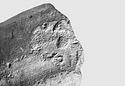
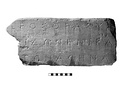
Inscribed fragment.
Broken all around and behind.
Citation.
Hymettian marble. Found in Byzantine context, below the floor of the room XVIII, of a Byzantine building, east of the Stoa of Zeus. Leica ... Ca. 200 B.C ... Found in Byzantine context, below the floor of the room XVIII, of a Byzantine building, east of the Stoa of Zeus. |
| Clay mostly fired grey.
Impression broken away right, incomplete all round otherwise; thyrsos(?). Par: SS 05544* Finished Byzantine Building, room XVIII, from black earth. Late Roman context. Θά[σιον] ... 26 June 1933 ... Byzantine Building, room XVIII, from black earth. |
Front part broken away.
On the discus, the head of Helios; the rim plain; the handle solid, plain.
On the reverse, a single circular groove.
Unglazed.
Light red clay, very soft.
Type XXVIII of Corinth ... 6 March 1934 ... Byzantine Building, room xviii, southest part of room, between floors 3 and 4. |
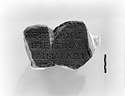
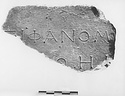
Inscribed fragment.
Broken all around and behind.
Honorary monument or decree (?).
Seven lines of the inscription preserved.
Bluish-white marble. Found in Byzantine context, under the floor of a Byzantine ... 3-5 May 1934 ... Found in Byzantine context, under the floor of a Byzantine building, room xviii, east of the Stoa of Zeus. |
Discus and handle broken away.
On the rim, herringbone pattern. The reverse almond-shaped, bounded by a double groove, enclosing the signature "KY".
Type XXVIII of Corinth collection. Byzantine Building, ... 8 March 1934 ... Byzantine Building, room xviii, lowest black filling in plundered foundation pit. |
Flat profile.
Coarse micaceous clay, fired buff inside with a pale yellow wash outside; distinct,
rather thick slip.
Retrograde.
Thasian(?). Stored wit "άγνωστα".
Class: Th?*
Dim: W 0.044* Byzantine ... 12 May 1934 ... Byzantine Building, room xviii, lowest layer above classical floor. |
The front part broken away.
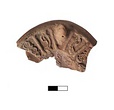
On the discus, Greek cross, jewelled; on the rim, a band of raised circles.
The handle solid, grooved.
On the reverse, a plam branch.
Unglazed.
Clay coarse, flaky.
Type XXVIII ... 6 March 1934 ... Byzantine Building, room xviii, southest part of room, between floors 3 and 4. |
Nozzle broken away.
On discus, rosette; on rim, two grooves; handle solid, three grooves above, two below.
On reverse, within two almond-shaped lines a "C".
Thin red glaze.
Red clay.
Type XXVIII of Corinth ... 13 February 1934 ... South of Byzantine Building, room xviii, below its ground level. |
Part of top only remains.
On discus, a dog to right, with head turned back.
Two filling holes and an air hole. Herringbone on rim.
Unglazed.
Buff clay.
Type XXVIII of Corinth collection. Byzantine Building, ... 9 March 1934 ... Byzantine Building, room xviii, from lowest black filling in pillaged foundation pit. |
Discus, deeply concave, plain; on the rim, vine pattern. The handle solid.
On the reverse, double almond-shaped bounding groove, punctuated by tiny circles and enclosing a palm branch.
Unglazed.
Red clay ... 8 March 1934 ... Byzantine Building, room xviii, lowest black filling in plundered foundation pit; coins. |
The handle, and part of the rim, discus, and sides preserved.
On the rim a band of circles containing a design resembling the "snappers" of modern clothes.
On the discus, the head of a cock left, with ... 26 June 1933 ... Byzantine Building, room XVIII, from black earth, at north end of room. |
Mended from two pieces.
Convex sides; herringbone on rim; Christian cross on discus; solid handle with double groove above and below; on the reverse, within a double groove, a palm branch.
Buff to red ... 5 July 1933 ... Byzantine Building, room XVIII, black earth overlying bedrock at west end. |
Fragment from the floor of a plate. On the top, a figure lightly impressed with a stamp. Only the head and shoulders remain; an aureole around the head.
Coarse but hard red clay, covered on the upper ... 28 February 1934 ... Byz. building, room xviii, below floor 1, Byz. context. |
Plain discus with three small filling holes.
A band of small raised circles on the rim. The handle solid; on the reverse, a palm branch within an oval bounded by a double groove punctuated by circles ... 8 March 1934 ... Byzantine Building, room xviii, lowest black filling in plundered foundation pit; coins. |
Intact save for center of discus.
Debased herringbone on rim. Concave discus with small raised rosettes alternating with formalized leaves. Raised ring around nozzle; small thin solid handle; circular ... 4 March 1938 ... Room XVIII between stroses with coins for the day, nos. 14-32. |
The top of the handle broken away; the nozzle cracked.
On the discus, a rosette; one large and three small holes. Herringbone on rim; the handle solid, grooved.
On the reverse, palm branch, within double ... 10 March 1934 ... Byzantine Building, room xviii, lowest black filling in plundered foundation pit. |
Most of the center of the discus gone.
Convex sides; herringbone on rim; Christian cross on discus with circles in the arms; solid handle, double grooved on top; on the reverse, within double almond-shaped ... 27 June 1933 ... Byzantine Building, room XVIII, from lowest black filling of plundered foundation pit. |
Tip of handle broken off.
Convex sides; stamped pellets on relief on rim; rosette on discus; handle with single groove below; on the reverse within a double circle; a palm branch.
Three circles toward ... 5 July 1933 ... Byzantine Building, room XVIII, black earth overlying bedrock at west end. |
Convex sides; herringbone on rim; plain discus with four filling holes; handle semi-perforated, with double groove above and below and ending in two circles at the discus end.
On the reverse, within a ... 6 July 1933 ... Byzantine Building, room XVIII, west end, black earth just above classical floor. |
In channel of rim a band of circles with two diameters drawn in each, and with a tiny circle in each quadrant.
On discus, Christ erect holding cross in right hand; a winged angel flies toward him from ... 10 February 1934 ... Byzantine Building, room xviii; northeast corner, between floors two and three. |
| The handle, and part of the rim sides, discus, and bottom preserved.
Convex sides; rim panels filled alternately with dolphins and degenerate quilloche (?); discus has running maeander lengthwise down ... 23 June 1933 ... Byzantine Building, room XVIII, between floor. |
The top is somewhat chipped. Only the crowning member of the pedestal is preserved.
In its top are two sinkings for the feet of a bronze statue. Beneath the plinth proper is a cyma recta above an ovolo ... 6 March 1934 ... Built into a wall of a Byzantine Building (room xviii), east of the Stoa of Zeus. |
The middle nozzle, with part of the bottom and most of the discus is broken away.
A trefoil arrangment of nozzles with the handle at the place of the stem. On the rim, debased vine leaf design. On the ... 12 May 1934 ... Byzantine Building, room xviii, lowest layer above classical floor. |
| Inscribed fragment of base (?).
Broken on three sides.
Rough picked on top. Draft edge. Rest of dowel hole on top, showing rust.
Five letters remain.
Pentelic marble. Found in the late Roman Gymnasium ... 20 April 1953 |
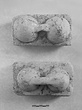
| Mastoid weight. Slightly chipped.
A small rectangular plinth with two breast-like projections connected by a handle.
Pentelic marble. Stoa, Room 2, debris layer 1. Herulian destruction fill. Leica, XVIII-26 ... 27 May 1939 ... Stoa, Room 2, debris layer 1. ... Leica, XVIII-26 |
Mastoid weight; slightly chipped.
A small rectangular plinth with two brest-like projections connected by a handle.
Pentelic marble.
Cf. ST 311 (I 1181). Stoa, Room 2, debris layer 1. Herulian destruction ... 27 May 1939 ... Stoa, Room 2, debris layer 1. ... Leica, XVIII-26 |
Small fragment of mold showing ray decoration on rim.
Fine pinkish-buff clay.
Mold for lamp of type XVIII of Corinth collection, type 52 variant of Agora collection. Well East of Stoa Room 11, container ... May 1950 ... Mold for lamp of type XVIII of Corinth collection, type 52 variant of Agora collection ... Well East of Stoa Room 11, container 42. |
| Inscribed fragments.
Fragment Ω 1557, full thickness possibly preserved, back very worn.
Face broken on three sides.
Trace of raised border along right side.
Four lines of the inscription preserved and ... (Ω 1557) 6 August 1970
(Ω 1673) 12 April 1971 |
About half the base and a bit of the side wall preserved, with the signature inside a single groove.
Type XVIII of Corinth collection.
Byzantine Building, room xxvii, below floor 5. Cf. coin, ii. 12.34, ... 12 February 1934 ... About half the base and a bit of the side wall preserved, with the signature inside a single groove.
Type XVIII of Corinth collection.
... Byzantine Building, room xxvii, below floor 5. |
Raised base of lamp.
Thin glaze, fired red to black outside, dripped inside.
Inscribed on bottom before glazing.
Type ca. XVIII (post-Sullan?) of Corinth collection, Signed Bases type of Agora collection ... 4 May 1950 ... Type ca. XVIII (post-Sullan?) ... Room VII area below strosis. |
Fragment from reverse.
Flat bottom, on which is inscribed "alpha".
Dull red glaze, worn.
Pinkish-buff clay.
Type XVIII (?) of Corinth collection (post-Sullan), Signed Bases type of Agora collection. N.-S ... 31 July 1947 ... Pinkish-buff clay.
Type XVIII (?) of Corinth collection (post-Sullan), Signed Bases type of Agora collection ... Trench VI, Roman House B, Room 4. |
Upper part of handle missing, otherwise intact.
Pointed nozzle, rays on rim.
Signed in relief letters "A I".
Glaze fired red to black.
Type XVIII of Corinth collection, type 52H of Agora collection. House ... 2 April 1949 ... Glaze fired red to black.
Type XVIII of Corinth collection, type 52H of Agora collection ... House F, Room 1, fill 4. |
Inscribed base.
Apparently complete (not fully exposed).
Dedication in eight lines by three magistrates (?) in archonship of Elpines; non-stoichedon.
Hymettian marble. Found used as step in anteroom of ... 356/5 B.C. |
| Fragments of an inscribed base.
Honorary monument.
Fragment Ι 435 a), the base was set into the north wall of the tower, right side up with the right side facing out, so that the inscribed face looks ... a) (Ι 435) 15 June 1933
b) (Ι 435) 16 July 1946 |
Small piece with part of bottom and lower side.
Metallic black to brown glaze.
First two letters of signature, stamped or incised before glazing.
Type XVIII (pobably post-Sullan) of Corinth collection, ... 16 April 1949 ... First two letters of signature, stamped or incised before glazing.
Type XVIII (pobably post-Sullan) of Corinth collection, Signed bases type of Agora collection.
... House F, Room 6. |
| Inscribed fragment.
Left end and back broken away.
Top is original but it has been rough picked to serve as a step. Bottom has been re-worked. Right end preserves anathyrosis.
Pentelic marble. Found in ... Ca. 375 B.C. |
Small fragment of rim and discus; broad rim decorated with large leaves and buds (?).
Discus set off by groove.
Dull black glaze.
Hard buff clay with bits.
Type XVIII of Corinth collection, type 50B of ... May 1950 ... Hard buff clay with bits.
Type XVIII of Corinth collection, type 50B of Agora collection ... Well East of Stoa Room 11, container 58. |
| Inscribed fragment.
From the front upper part of a statue base. The top is finished with toothed chisel. In the top is preserved part of the curved sinking for the plinth proper.
Archon Phanomachos.
Two ... 259/8 B.C. |
Handle broken, otherwise intact.
Small plain discus. Imbricated leaf pattern on rim. Angular nozzle. High swung handle. Small raised foot, flat underneath.
Dull red glaze.
Type XVIII (post-Sullan) of ... 9 May 1950 ... Dull red glaze.
Type XVIII (post-Sullan) of Corinth collection, type 55B of Agora collection ... Tiled Roman well east of Stoa, Room 11, Box 42. |
Handle missing except upper stub; otherwise intact.
In relief on rim, near handle an ivy leaf, near nozzle a shield. Triangular nozzle. Low ring foot.
Dull brownish glaze.
Type XVIII (post Sullan) of ... 15 May 1950 ... Dull brownish glaze.
Type XVIII (post Sullan) of Corinth collection, type 50B of Agora collection ... Tiled well east of Room 11, Box 79. |
|
|