|
|
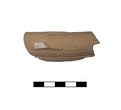
| Belly fragment of shallow cup.
Horizontal "thorn" motif on belly, ribbing below.
Light brown ware with grayish tint; clean breaks. Possibly from Rome region.
Date of context: ca. 50-20 B.C. Found with ... 15 May 1939 ... Possibly from Rome region.
Date of context: ca. 50-20 B.C. |
Plain rim.
Perhaps same potter as 962. Very similar, London 64.10-7. 1472 (F 202). See also Oxford 381: CVA 1(3) pl. 48(140) 42; Cambridge 167: CVA 1(6) pl. 41(279) 22, and cf. Rome, Vatican: Beazley ... Ca. 460 B.C ... See also Oxford 381: CVA 1(3) pl. 48(140) 42; Cambridge 167: CVA 1(6) pl. 41(279) 22, and cf. Rome, Vatican: Beazley and Magi, RG, pl. 22, G 77 and G 78, both with torus foot. |
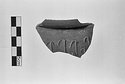
| Rim sherd of round-bellied jar with hollow bulging rim. Barbotine 'thorns' with arcs at tops: parts of 2 rows preserved on belly.
Thin gray to red/brown ware, polished at rim.
Possibly Rome or Naples ... 10-11 March 1936 ... Possibly Rome or Naples product. |
Small Plate With Projecting Rim: Rome Or Etruria.
Fragments of rim missing.
Angular ring foot; beveled resting surface; flat underside. Broad, projecting rim, curving down at edge and undercut on inside ... Context of ca. 275-210 ... Small Plate With Projecting Rim: Rome Or Etruria.
Fragments of rim missing.
... For plates of similar size and shape see Morel 1965, no. 127, pp. 72--73, pls. 10, 47; Morel 1969, p. 84, fig. 14 = Morel 1981, Type 1323b, p. 106, pl. 14 (dated by Morel between 305 and 265), from the workshop of the Petites Estampilles, an atelier perhaps located in Rome and dating from the late 4th to the mid-3rd century. |
| Broken all around.
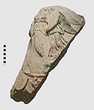
Left side of large-scale cuirass decorated with Athena and two Nikai.
Athena stands front in center with aegis and a shield in her left hand. To her left a winged victory helps to support ... 6 July 1972 ... Below Athena are indistinct traces of what should be the wolf of Rome.
White marble.
|
Floor fragment. Max. dim. 0.043; est. diam. of tondo 0.08.
I, youth (head, start of shoulder) bending over to right. Before him are an aryballos and sponge (part of each). Reserved line for tondo border, ... Ca. 510 B.C ... For the aryballos and sponge, see once Lucerne Market by the Epidromos Painter (ARV2 118, 14); Rome, Museo Artistico Industriale by Onesimos (ARV2 329, 129; Addenda 217); Oxford 1911.621 by Apollodoros (Paralip. 333, 9 ter).
|
Plate Or Bowl: Central Italian.
Foot and part of floor preserved.
Angular ring foot; rounded resting surface; pointed underside. Three circles on floor: four stamps within inner two circles; very fine ... Context of 150-86 ... This form of stamp is typical of central Italy and, according to Morel, is often found at Arezzo, Volterra, Cosa, Cerveteri, Rome, and Alba Fucens (Morel 1963, p. 50). |
Foot, lower body, half of rim, and fragments of wall missing.
Globular body. Offset at base of long, tubular neck. Torus rim.
Double-grooved strap handle. Decoration in orangish brown glaze: narrow band ... Context of 160-130 ... XLVIII (Cyprus); CVA, Stuttgart 1 [Germany 26], p. 46, pl. 40 [1252]:3 (Rome). For rays see comparanda to 1508. |
Floor fragment with part of narrow ring base. Circle on underside. Max. dim. 0.055. H. A. Thompson, Hesperia 23, 1954, pl. 15:a.
I, nude hetaira (legs, part of left shoulder and arm, right forearm and ... Ca. 520-510 B.C ... Hebe on Tarquinia RC 6848 (ARV2 60, 66; Paralip. 327, 66; Addenda 165); Athena on Florence 1 B 24, which belongs to the same cup as Copenhagen, Thor. 100 and Rome, Villa Giulia no no. |
Floor fragment with start of stem. Two concentric circles with central dot on underside. Max. dim. 0.053. H. A. Thompson, Hesperia 28, 1959, pl. 22:b; Schefold, Göttersage, p. 154, fig. 203; LIMC V, 1990, ... Ca. 510 B.C ... The example on 1579 is closest to the fragmentary scene near the Salting Painter, also a cup tondo, a format that suits the subject well: Rome, Antiquarium Forense (ARV2 178, ---). 1579 may be slightly earlier and, if so, would be the earliest preserved example of the Ixion myth. |
All of mouth and neck, much of body restored in plaster and painted. Thin, black glaze on inside. Much of the glaze on the lower part fired red. Some abrasion to left of panel. H. to top of handle 0.245; ... Ca. 440-430 B.C ... For a similar but better-preserved composition, see the one on Rome, Villa Giulia 50511 (Choes and Anthesteria, p. 180, cat. no. 904, fig. 49).
|
Shoulder fragment with start of neck. Glaze pitted in places. Part of the glaze fired brown. Max. dim. 0.077.
Youth or woman (wreathed head), then part of a wing of someone, both to right. Relief contour: ... Ca. 480-470 B.C ... Petersburg inv. 2070 = 805 (ARV2 484, 10; Paralip. 512; Addenda 248) and Rome, Villa Giulia (ARV2 485, 33; Paralip. 379, 33; Addenda 248); Hamburg 1980.174 attributed to the Painter of the Birth of Athena by D. |
Mended with missing pieces restored in plaster and painted, notably all of the mouth, neck and handle, much of lower body, nearly all of ring base. Thin glaze on inside. Glaze pitted and flaked in many ... Ca. 450-440 B.C ... Durand, Sacrifice et labour en Grèce ancienne: Essai d' anthropologie religieuse, Paris/Rome 1986, p. 117, fig. 37; Straten, Hierà Kalá , p. 233, cat. no. |
Wall fragment from rather low on the vase. Max. dim. 0.093.
Triptolemos (segment of wheel and wing of throne) to right. Relief contour. Rim of wheel incised (compass-drawn). Dilute glaze: decoration at ... Second quarter of the 5th century B.C ... Dugas ("La mission de Triptolème d'apres l'imagerie athénienne," Melanges Rome 62, 1950, pp. 9--31 [reprinted in Recueil Charles Dugas, Paris 1960, pp. 123--139]) recognized three categories of this theme in Greek art: (1) Demeter giving instructions to Triptolemos, often with Kore present; (2) Triptolemos about to set off on his mission and a libation being poured; (3) Triptolemos and the Eleusinian divinities following his return to Eleusis. |
Fragment of cul and body. Max. dim. 0.09.
On cul, chain of double lotuses and encircled palmettes.
The only painter to favor the chain of double lotuses and palmettes on the culs of his calyx-kraters ... Ca. 450 B.C ... N 32); Rome, Villa Giulia 909, the namepiece of the Villa Giulia Painter (ARV2 618, 1; Paralip. 398, 1; Addenda 270); Ferrara 2893 = T.617, the namepiece of the Peleus Painter (ARV2 1038, 1; Paralip. 443, 1; Addenda 319; CVA, Ferrara 1 [Italia 37], pl. 22 [1666]:2, 3; Reeder, Pandora, pp. 349--351, cat. no. 110; Matheson, Polygnotos, p. 436, cat. no. |
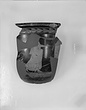
| Many fragments, giving essential parts of the walls but nothing of the foot. On each side, four figures grouped in twos.
A) Warrior to left holding shield in the left hand; Attic helmet, chiton, corselet ... 25 May 1951 ... Hydria, Rome, Torlonia, group of Polygnotos, ARV, p. 702, bottom. |
Wall fragment. Burned (clay is gray). Glazed misfired reddish brown on outside. Max. dim. 0.06.
Pelias and daughters. The fragment shows the cauldron with the foreparts of the ram (head missing). On the ... Probably mid-5th century B.C ... Meyer, Medeia und die Peliaden: Eine attische Novella und ihre Entstehung, Rome 1980, pl. 13:1; the attribution is Cahn's: Münzen und Medaillen A.G. |
Four non-joining fragments of neck and shoulder. P.H. a) 0.125; max. dim. b) 0.16, c) 0.11, d) 0.99. E. Laufer, Kaineus: Studien zur Ikonographie [Rivista di archeologia Suppl. 1], Rome 1985, pl. 12:35 ... Ca. 470-460 B.C ... Laufer, Kaineus: Studien zur Ikonographie [Rivista di archeologia Suppl. 1], Rome 1985, pl. 12:35.
|
Wall and shoulder fragment with start of neck. Thin, brownish glaze here and there on inside. Max. dim. 0.069. H. A. Thompson, Hesperia 17, 1948, pl. 68:5; Choes and Anthesteria, p. 93, cat. no. 245 bis, ... Ca. 450-440 B.C ... Presicce [curators], Ulisse il mito e la memoria (Roma, Palazzo della Esposizioni 22-febbraio--2 settembre, 1996), Rome 1996, cat. no. 31.
|
Wall fragment. Glaze dull and misfired reddish here and there on inside and outside; slightly abraded. Max. dim. 0.107. H. A. Thompson, Hesperia 17, 1948, pl. 67:4; Matheson, Polygnotos, p. 354, cat. no ... Ca. 440 B.C ... Cristofani, Materiali per servire alla storia del vaso François [Bollettino d'Arte, Serie Speciale 1], Rome, 1980, fig. 65: the figure of Theseus) and in the slaying of the Minotaur on the cup in Munich by Archikles and Glaukytes, 2243 (ABV 163, 2; Paralip. 68, 2; Addenda 47), also on a late-6th-century cup in Taranto by the Edinburgh Painter (ABV 476, 3): there the lyre is hanging up. |
Four non-joining fragments, a and b of lip and bowl, c and d of floor. Glaze abraded on rim. Est. diam. of rim 0.225; max. dim. a) 0.13, b) 0.055, c) 0.042, d) 0.032; est. inner diam. of tondo 0.10. J ... Ca. 430-420 B.C ... Neils, The Youthful Deeds of Theseus: Iconography and Iconology, Rome 1989, p. 175, cat. no. 148; LIMC VII, 1994, p. 928, no. 53, s.v. |
Fragment of torus mouth, neck, and start of shoulder, part of body on each side. Neck glazed on inside. Glaze misfired reddish brown; abraded in places, especially on mouth and on Boreas. P.H. 0.14; diam ... Ca. 460 B.C ... Neuser, Anemoi: Studien zur Darstellung der Winde und Windgottheiten in der Antike, Rome 1982, p. 62, cat. no. |
Three non-joining wall fragments. Dull, hard glaze on inside. Max. dim. a) 0.091, b) 0.075, c) 0.071. L. Talcott, Hesperia 8, 1939, pp. 268--269, figs. 1, 2 (the fragments have been relettered since this ... Ca. 470-460 B.C ... Gebhardt, in The Muses at Work: Arts, Crafts and Professions in Ancient Greece and Rome, C. Roebuck, ed., Cambridge, Mass. |
Four non-joining fragments, a -- c of shoulder, d of neck. Glaze misfired slightly on tongue pattern on fragment a. From a very large krater. Max. dim. a) 0.127, b) 0.15, c) 0.089, d) 0.093. G. Schwarz, ... Ca. 460 B.C ... Of the three categories of this theme recognized by Dugas (Mélanges Rome 62, 1950, pp. 9--31, reprinted in Recueil Charles Dugas, Paris 1960, pp. 123--139), the scene on 238 belongs in the second category (the departure for the mission) and is one of six by the Altamura Painter. |
Mended from many fragments, with missing pieces restored in plaster and painted, notable among them the left horizontal handle and part of the wall below it. Glaze fired greenish around left handle; abraded ... Ca. 430 B.C ... Moret, L'Ilioupersis dans la céramique italiote: Les mythes et leur expression figurée au IVe siècle, Rome 1975, p. 19 and note 4: the "pyxis perdue" in this list is now New York, M.M.A. 1972.118.148 [D. von Bothmer, Ancient Art from New York Private Collections, New York 1961, pl. 91:243]); E. |
Four non-joining fragments of rim and neck, P 25978 a preserving the spiral of one handle, P 28759 with start of shoulder. Two small fragments (P 25978 b and c) give a bit of the flange of a handle and ... Ca. 500-490 B.C ... Neils, The Youthful Deeds of Theseus [Archaeologia 76], Rome 1987, passim, but esp. p. 154, cat. no. 9 and p. 56 for 234); and F. |
Thirteen non-joining wall fragments with thin reddish wash on inside. Mended in antiquity (part of lead repair in b; hole in d). Glaze pitted and abraded here and there. P.H. a) 0.14; max. dim. a) 0.281, ... Ca. 440 B.C ... Reho, La ceramica attica a figure nere e rosse nella tracia Bulgara [Archaeologica 86], Rome 1990, pl. 31) and the pelike in Leyden, Ro II 60 by the Cassel Painter (ARV2 1084, 16; Addenda 327).
|
Eight non-joining wall fragments, a and b with rim and strengthened with plaster. Band on inside at rim, a narrower one 0.068 below rim. Glaze fired red on inside, slightly misfired below figures on outside ... Ca. 460-450 B.C ... The Group of Polygnotos, Undetermined: Once Rome, E. Strong (unpublished): Eros flies towards Menelaos, holding a phiale in both hands (ARV2 1056, 93; Ghali-Kahil, p. 95, no. 78 for a description; Matheson, p. 466, cat. no. |
|
|