|
|
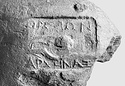
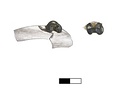
| Strigil. Finished 4th century B.C. fill under early Roman Agora floor. Θασίων
oil flask?
strigil
Ἄρχηναξ Leica ... 28 May 1951 ... 4th century B.C. fill under early Roman Agora floor. |
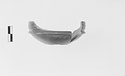
Point of pin broken off.
Bow has longitudinal ridge with cross-hatching in relief. Well in street of Roman Agora, 2nd meter.
Early Roman : 1st c. A.D. Leica, Various vii-87 ... 6 August 1946 ... Well in street of Roman Agora, 2nd meter.
Early Roman : 1st c. A.D. |
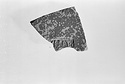
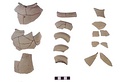
Four joining fragments give part of side and rim; groove around rim outside.
Flaky cinnamon-brown clay, orange-red glaze.
Sigillata. Samian? Well in street of Roman Agora. 2771 Leica ... 5-6 August 1946 ... Well in street of Roman Agora. |
Small fragment preserving part of rim and nozzle volute.
Red-brown glaze.
Red clay.
Type XX of Corinth collection. Cut through street of Roman Agora: layer 3a, pebble bedding for martyr. Leica ... 2 August 1946 ... Cut through street of Roman Agora: layer 3a, pebble bedding for martyr. |
| Small piece from flat floor, with rectangular stamp, illegible:
Good red glaze inside and out, chipped inside.
Sigillata. Well in street of Roman Agora. 2771 Leica, 93-43-19 PD 1172-7 ... 5-6 August 1946 ... Well in street of Roman Agora. |
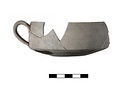
Complete; mended from two pieces. Low broad foot with narrow foot ring; thick wall curving in to plain lip.
Micaceous gray clay; black glaze. Well in street of Roman Agora. Leica PD 1171-121 ... 6 August 1946 ... Well in street of Roman Agora. |
| Foot, center of floor and pieces of rim missing. Shallow bowl with keeled, grooved rim.
Light buff clay, firm dull red glaze.
Sigillata. Well in street of Roman Agora. 2771 Leica, 94-44-13 PD 1171-50 ... 5-6 August 1946 ... Well in street of Roman Agora. |
Mended from several pieces; about one-half of rim missing. Small bowl on rather high flaring ring foot; keeled rim, concave, and with flaring lip.
Thin matte red glaze inside and out. Well in street ... 5-6 August 1946 ... Well in street of Roman Agora. |
| Anathyrosis on preserved edge. On top a mason's mark: ΑΡ. A shallow rectangular cutting and a deeper circular cutting at one corner of broad surface, from reuse as threshold block.
From Temple of Ares ... February 1949 ... Brought in from Roman Agora. |
| Fragment a): from angular shoulder, with small handle twisted back on itself on shoulder.
Fragment b) scrap with similar handle.
Very thin bluish glass. Other fragments probably from same jug stored in ... 5-6 August 1946 ... Well in Street of Roman Agora. |
Mended from a number of pieces; some wall and rim fragments, and the handle, missing. Large wide funnel, with neat flaring rim. Horizontal handle attached at junction of rim and wall.
Pinkish-buff clay; ... 5-6 August 1946 ... Well in street of Roman Agora. |
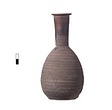
| Scattered pieces missing. Onion-shaped, large. Deep pear-shaped body; tall neck; flat rim.
Heavy gray fabric; shallow grooves on body; matte black glaze on neck.
Fragments of several unguentaria of ... 5-6 August 1946 ... Well in street of Roman Agora. |
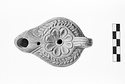
| Intact.
On disc, rosette of 8 petals framed by ring; herringbone pattern on rim. Solid grooved handle. On base, within two concentric grooves "A".
Purple-brown glaze.
Orange clay.
Late Roman.
Cf. Agora ... 28 June 1967 ... Orange clay.
Late Roman.
Cf. Agora VII, no. 1912 ... Lamp deposit beside Roman wall; removed in landscaping. |
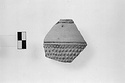
| Rim fragment from bowl or deep cup. Steep wall; plain rim thickened on inside. Rim undecorated, marked off by a groove above and below. On the wall, rows of applied dots.
Light buff fabric. Vitreous ... 5-6 August 1946 ... Well in street of Roman Agora. |
| Two joining sherds of rim and upper wall. ''Kalathos" cup, Knidian (?). Shallow conical body, projecting flange, vertical tapered rim. Shallow rippling (with faint rouletting?) covering exterior of rim ... 5-6 August 1946 ... Well in street of Roman Agora. |
Oinochoe: Italian?
Part of handle and mouth.
Slightly outturned rim. Large triple handle with appliqué head of Dionysos at base, facing into mouth of vessel. Head turns to proper left, has thick hair, ... Late Roman context |
Rim Of Large Bowl?
Small section of rim and stub of handle.
Rim steeply beveled to inside and slightly undercut; two shallow grooves below rim inside and two deep grooves outside. Handle round in section, ... Early Roman context |
Inscribed fragment of statue base.
A fragment from the top of a cylindrical base, crowned by a small moulding.
The base was later hollowed out and used as a well curb.
Four lines of the inscription preserved ... 14 June 1937 ... Found in the excavation for a modern cellar at the corner of Hadrian and Mnesikles streets, east of the Roman Agora. |
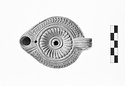
| Intact.
On disc, rays with two framing rings; two rings around filling hole. Herringbone rim. Solid grooved handle.
On base, within two concentric grooves: "X".
Orange-brown glaze.
Buff clay.
Late Roman ... 28 June 1967 ... Buff clay.
Late Roman.
Cf. Agora VII, no. 1606 ... Lamp deposit beside Roman wall; removed in landscaping. |
Plate.
About half of foot and small part of floor preserved, along with many small fragments.
Low ring foot; grooved resting surface. White fabric (10YR 8/2) with pale yellow surface (ca. 2.5Y 8/4), ... Context of before ca. 180 |
Flat bottom and convex side wall.
The letters -AI- (Greek?) incised on the resting surface after firing with a sharp point. Left to right?
Coarse, pinkish buff clay, unglazed.
Jugs with flat bottoms ... Early 7th c. A.D ... Jugs with flat bottoms are veryy late in the Roman period: cf. Agora V, pl. 35, th ejugs from Grup N. |
Most of handle and parts of foot, underside, and body restored.
Low foot; flat resting surface; flat underside with some string marks still visible. Straight lower body, convex shoulder. Tapering neck ... 150-110? (Roman context) |
Wall Fragment.
Single fragment, broken all around.
Vessel with nearly vertical wall and fairly small diameter. Interior glazed but somewhat irregular. Large appliqué grape leaf. Soft, fine, very micaceous, ... Roman context (no lot) |
Stamped Plate.
Center of floor preserved.
Convex underside, with trace of groove around edge. At center of floor, six-petaled rosette within hexagon with concave sides, all within circular field. Reddish ... Late Hellenistic? (Roman context) |
Filter Jug.
Wall fragment.
Wheelmade lower body joins moldmade upper body at an angle. Lower body nearly horizontal. Moldmade body: egg and dart below imbricate lotus petals with tips oriented towards ... Roman context (no lot) |
Plate.
Most of foot and part of wall preserved; badly shattered and flaking.
Low ring foot; broad, flat resting surface; flat underside. Sloping wall of fairly deep plate. Very porous, white core (2.5Y ... Context of late 2nd century after Christ |
Neck and one complete handle, stub of other, of unglazed amphora.
Two dipinti in red:
a) Beside handle:
b) On top of shoulder beside other handle:
Traces of second line below on edge of break.
Buff ... 5 August 1946 ... Well in street of Roman Agora, container 1. |
Four joining fragments preserve nozzle and part of lower wall. Filled out in plaster.
Round-ended nozzle; remains of applied ornament on sides and top.
Remains of thin brown wash.
Thin fabric, light buff ... 5-6 August 1946 ... Well in Street of Roman Agora. |
| About half, broken into many pieces, including half of base (a,b), wall fragment (c), most of rim (f-h), and loose handle (e). Round-bellied, tapering conically above; cupped rim, low neat foot, flattened ... 5-6 August 1946 ... Well in street of Roman Agora. |
Krater.
Part of moldmade body and wheelmade rim area.
Long petals with jeweling between them, with sightly concave wheelmade body above. Hard, fine, gray/light gray fabric (10YR 6/1) with some fine mica; ... Late Roman context (no lot) |
Large Vessel: Krater?
Part of wall and handle.
Rounded, moldmade shoulder with large egg and dart in relief. Base of horizontal handle, round in section, ending in rotelle. Fingerprint and glaze on lower ... Early Roman context (no lot) |
Bottom, handle, and two-thirds of body and rim restored.
Two grooves on exterior of rim. Light red fabric (2.5YR 6/6) with mica, small grits, and voids; gritty, shiny red glaze (2.5YR 4.8), with lower ... 100-25 ... Similar: P 22097 (Agora V, G 88, p. 30, pl. 5 [D 4:1, Layer II]).
... Δελτ 21, 1966, B1 1 [1968], p. 80, pl. 84:α, from late Hellenistic to early Roman potters' debris on Otho Street in Athens. |
Shoulder And Neck.
Part of shoulder and base of neck.
Slightly convex shoulder runs smoothly into neck. Decoration in brown glaze: row of dots around base of neck; rays alternate with dots on shoulder ... Mixed early and late Roman context |
Plate With Upturned Rim.
Three joining fragments of rim (a) and one fragment of floor (b).
Thick wall. Gently upturned rim. Very fine and hard gray/light gray fabric (10YR 6/1) with very little mica; ... Mixed Hellenistic and late Roman context |
Large Closed Vessel.
Single fragment, broken all around.
Probably from steeply sloping shoulder of large, closed vessel.
Vertical olive branch with white stem, orange leaves. Two swags or fillets attached ... Late Hellenistic and early Roman context |
Cup Or Bowl.
Wall fragment, broken all around.
Lower body curves in to foot, which is now broken away. Upper body nearly vertical, slightly convex, and decorated in relief: front half of bovine walking ... Late Hellenistic and early Roman context |
Plate Or Bowl.
Part of foot and floor.
Low, thick foot, concave to outside; rounded resting surface. Kiln support embedded in floor, with trace of another on underside. Hard, very pale brown fabric (10YR ... 2nd-century to early Roman context |
Plate.
Fragment of rim.
Large plate with rolled rim. Beginning of lug or handle at left edge of fragment. Hard, light gray fabric (5Y 7/1) containing abundant fine sand and a few larger black and red ... Late Roman context |
| More than half of side and rim missing. One vertical handle preserved, and trace of attachment of a second. Small flat bottom; gently sloping floor; nearly vertical walls, slightly tilted in; plain rim ... 5-6 August 1946 ... Well in street of Roman Agora. |
Cup Or Bowl: Pergamene Appliqué.
Center of floor, broken all around.
Slightly pointed underside; trace of foot. Appliqué is eight-legged creature (scorpion? lobster?). Front and back ends missing. Something ... Mixed late Hellenistic and early Roman context |
|
|