|
|
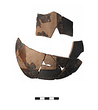
Inscribed fragment.
Inscribed face and rough picked back preserved; broken elsewhere.
On line 1, part of an alphabet reading from left to right, but the individual letters retrograde.
On lines 2-4, another ... 13 June 1935 |
Mended from four pieces.
Letters incised retrograde with a blunt point which often slipped, leaving long, shallow scratches.
-.ς πρόπινε τενδί
Young believed the inscription to be ... Letters incised retrograde with a blunt point which often slipped, leaving long, shallow scratches ... Jeffery has suggested that the reading should be τενδί-τηνδί with -δι as the epideictic iota which is often found in vase inscriptions. The graffito says " Drink this up." |
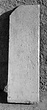
Inscribed fragments of grave stele.
Two joining fragments probably preserve original dimensions; chip missing from upper right corner and lower left.
Simple rectangular stele with smooth finished upper ... 10 April 1953 |
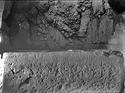
| Inscribed block.
The block as reused is standing upright, the inscribed face towards the west.
Inscribed in a smoothed band across the top, above a rough picked surface.
There are cuttings in the top, ... 6 June 1938 |
| Inscribed Agora boundary stone.
Top worn smooth by traffic. Corners broken.
Inscription written retrograde across top and along left side. Inscription does not cover corners, a fact perhaps indicating ... 27 July 1967 |
| Inscribed grave stele.
A great stele, broken off at the top. Back and sides finished smooth. Two fine drafted lines run vertically down each side of the front face, near the edge, to 0.082m. from the bottom, ... 6th. century B.C. |
Mended from many fragments with the missing pieces restored in plaster, notably about half of the mouth, lower half of body in back, and all of foot. Glaze abraded on handle. Rest. H. 0.187; rest. diam ... Ca. 490-480 B.C ... Inscribed diagonally above her head:
(written rather carelessly), retrograde. To right:
then
Below, frieze of saltire-squares. ... Red (flaked): inscriptions; flames.
|
Mended with missing pieces restored in plaster and painted, mainly the rim and part of the wall directly below. Glaze misfired on outside; much of it has flaked (especially the contour line) and abraded ... Ca. 500 B.C ... Next to the left symposiast:
retrograde; above the krater:
Preliminary sketch. ... Red: fillet; inscriptions.
For symposiasts at a krater, see F. |
| Peleus and Thetis. Repairs to sculpture in antiquity. Peplos in archaistic sculpture. Perirrhanteria in the form of archaistic korai. Retrograde inscriptions. Persephone. Re-use of sculpture in antiquity ... Agora 11 184 ... Retrograde inscriptions |
Mended with small missing pieces restored in plaster and painted, handle B/A completely modern. Glaze flaked slightly on outside. Top of rim reserved. H. 0.103; diam. of rim 0.29; diam. of tondo 0.113; ... Ca. 510-500 B.C ... Along the contour of his back:
retrograde. In front of him:
Uneven reserved line for tondo border. ... Red (flaked): wreath; inscriptions.
Part resembles Tarquinia RC 1130, in the manner of the Epeleios Painter (ARV2 153, ---; Addenda 180). |
| Eleven pieces comprising two non-joining fragments. To Young's publication of six pieces are now added five more, two of which help to complete to inscription.
Part of the side wall with reserved panel ... 600 B.C ... Inscription along two sides of panel in three lines: line 1, left to right, sideways to vase, running from top to bottom, no letters missing at ends; line 2, left to right, upside down to vase, several letters missing at right; line 3, retrograde, upside down to vase, several letters possibly missing at right. ... The final sigma is reserved, as is not uncommon in early inscriptions.
In Line 2 Δί for the dative of Ζεύς is a mispelling or unusual spelling for Attica, where Διί is expected. |
|
|

.png.icon.jpg)