|
|
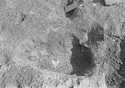
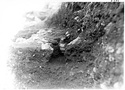
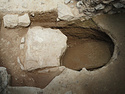
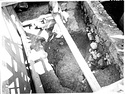
Rectangular cutting at 58-60/ΚΘ-Λ, probably a plundered wall trench ... 350-290 B.C ... Rectangular Cutting |
| Dorothy Burr Thompson ... Grave 12 in notebook. Cut in bedrock. (E.L. Smithson: Grave VII: PG) Few bones (discarded). Rectangular cutting in bedrock.
JP ... Early Protogeometric ... Smithson: Grave VII: PG) Few bones (discarded). Rectangular cutting in bedrock.
|
Rectangular cutting, not entirely preserved, west of underground drain. Contained good black glazed pottery, some stamped, and a little coarse ware, along with bits of bone and part of a skull ... Third quarter 5th c. B.C ... Rectangular cutting, not entirely preserved, west of underground drain. |
| Margaret Crosby ... Grave, disturbed.
Rectangular cutting in bedrock 1.70m long and 0.60m deep. The north half was cut away by a modern cellar wall and only 0.20-0.10m of fill was left. A the bottom there was a thick layer ... 510 - 490 B.C ... Grave, disturbed.
Rectangular cutting in bedrock 1.70m long and 0.60m deep. |
A 3rd. c. B.C. cistern and an unfinished rectangular cutting of the 2nd c. B.C. which destroyed some of its upper part. These two features are combined in this deposit; the following objects are identified ... 3rd-2nd c. B.C ... B.C. cistern and an unfinished rectangular cutting of the 2nd c. ... These two features are combined in this deposit; the following objects are identified as from the rectangular cutting: P 16675, P 16676, P 30434, P 30435,
L 4038.
|
| Mycenaean Chamber Tomb SE of Stoa Pier 12 (Burial 8).
Roughly rectangular, measuring 1.70m by 1.40m, and was cut down to within 0.65m. by the construction of the Square Building. A rectangular cutting ... Early Myc. IIIA ... Roughly rectangular, measuring 1.70m by 1.40m, and was cut down to within 0.65m. by the construction of the Square Building. A rectangular cutting at the northwest corner may have been the entrance, although this cutting may be later; the southwest corner of the chamber appeared to have been unfinished.
|
| (Grave XXIX: EG).
Rectangular cutting with remains of charred human bones and both burned and unburned pottery fragments. Bones discarded.
Rectangular trench cut through earth into bedrock, oriented east-west ... Middle Geometric I ... (Grave XXIX: EG).
Rectangular cutting with remains of charred human bones and both burned and unburned pottery fragments. Bones discarded.
Rectangular trench cut through earth into bedrock, oriented east-west and measuring 1.10m long, 0.70m wide and under 0.30m deep. |
| Mycenaean grave. It consisted of a shallow rectangular cutting in bedrock about 1.40m by 0.70m, but it was probably somewhat bigger, since the east side and a large part of the north side had been cut ... Myc. IIIA:1-2 ... It consisted of a shallow rectangular cutting in bedrock about 1.40m by 0.70m, but it was probably somewhat bigger, since the east side and a large part of the north side had been cut away by later builders. |
| Mycenaean grave to west of House N, room 5, with the burial of two young children. Rough rectangular cutting in soft stereo (0.95x0.64x0.28), lying under the western wall of a Geometric house, contained ... Myc. III C:1 ... Rough rectangular cutting in soft stereo (0.95x0.64x0.28), lying under the western wall of a Geometric house, contained the doubled-up skeletons of two small children. ... The cup had been placed in an upright position at the bottom of the cutting, before the upper body was put in, but because of the cramped space and double up postures, it seems likely that both burials took place simultaneously.
|
| Mycenaean Burial.
The cutting was roughly rectangular (1.60 by 0.50m) and was once covered with rough stone slabs, two of which were found over the body. The skeleton, presumably that of a man, lay in ... Myc. III A-B ... Mycenaean Burial.
The cutting was roughly rectangular (1.60 by 0.50m) and was once covered with rough stone slabs, two of which were found over the body. |
| Eugene Vanderpool ... Infant grave near Phaidon street cistern. No offerings.
Roughly rectangular, almost elliptical cutting in bedrock, measuring 0.70m long, 0.35m wide, and 0.40m deep, oriented south-southwest to north-northeast ... Late Helladic III C/Early Protogeometric (date uncertain) ... Roughly rectangular, almost elliptical cutting in bedrock, measuring 0.70m long, 0.35m wide, and 0.40m deep, oriented south-southwest to north-northeast. |
| Rodney S. Young ... Grave 19 (In some records as Grave VIII). No remains, no burned matter or traces of burning.
JP
A small cutting with a single offering. The pit may have been for a simple child/infant inhumation, with ... Early Protogeometric ... JP
A small cutting with a single offering. ... Another similar cutting, at right angles, probably from another burial. A further cutting, just to the south, roughly rectangular, oriented east-southeast to west-northwest, measured 0.95m in length, 0.53m wide, and 0.47m deep. |
| Homer A. Thompson ... (Grave XXX: EG)
Rectangular cutting with burned bones of a female 40-45 years old, and both burned and unburned pottery fragments.
Rectangular trench, measuring approximately 0.80m long, 0.40m wide, with ... Middle Geometric I ... (Grave XXX: EG)
Rectangular cutting with burned bones of a female 40-45 years old, and both burned and unburned pottery fragments.
Rectangular trench, measuring approximately 0.80m long, 0.40m wide, with a preserved depth of 0.20m, cut through earth, partly into irregular outcroppings of bedrock, oriented northwest-southeast. |
| Marcie Handler ... This deposit is a Mycenaean cist grave with two cover slabs, a type of burial described by Immerwahr in Agora XIII (pp. 103-104). Cist graves appear side by side with chamber tombs in the Mycenaean cemeteries ... LHIIB-LHIIIA:1 ... Cist graves appear side by side with chamber tombs in the Mycenaean cemeteries of the Agora.
The cutting for the grave measured 1.80m long (E to W) and 1.06m wide (N to S). ... Six small stones were found wedged between the edges of the boulder and the edges of the cutting, and four more small stones were found just south of the collapsed poros slab, indicating that they were also used to line the cutting or fill the gap between the cutting and the slab.
... The upper fill covering the boulder on the west end of the cutting (Lots ΒΖ 2128 and 2130) dated to ca. 500 B.C., and the fill lying directly on top of the boulder (Lot ΒΖ 2131) dated to the late 8th c. |
| Anne McCabe ... Adjacent to the SW face of Byzantine Wall 14. The circular cutting, 0.90m in diameter, appeared at 53.504m under a layer of loose rubble (Lot 481). Wall of the well roughly built, consisting at the top ... 11-19 July 2006
24 June-21 July 2009 ... The circular cutting, 0.90m in diameter, appeared at 53.504m under a layer of loose rubble (Lot 481). ... These lining segments are probably reused: one has a cutout triangular foothold; other have cutout rectangular footholds; one is marked with π incised twice. |
| Eugene Vanderpool Homer A. Thompson ... Mycenaean Grave to W. of "Court Room" below Stoa Terrace with "Ballot Box" (Grave XXIX).
Unusual type, conforming neither to our pit nor to our cist graves, and consisted of two parts. The outer part was ... Mycenaean III A-B ... The outer part was a rectangular pit (2.10 by 1.30m) cut down in the soft bedrock to a depth of ca. 0.90m, with both long sides walled with field stones, leaving a passage only 0.45m wide in the middle. ... The inner part of the grave was revealed when the stone packing along the north side had been removed. The cutting in bedrock was seen to extend well beyond the stones, forming a rectangular cist (1.50 by 2 by 0.90m deep). |
Mycenaean Well (S/1,2-13/20,14/1). Underneath the NE Room of the Library of Pantainos, along its S side, as a cutting in bedrock containing reddish fill with bits of green bedrock. The feature is rectangular ... 30 June-23 July 1975 ... Underneath the NE Room of the Library of Pantainos, along its S side, as a cutting in bedrock containing reddish fill with bits of green bedrock. The feature is rectangular in shape, and measured ca. 1.00m NS by 0.65m EW at the bottom.
|
| Mycenaean Chamber Tomb occupies a considerable part of the western half of section ΕΕ; lies about half way up the north slope of the Areopagus towards its eastern end, just below the highest point of the ... Myc. III A:1 ... The tomb consists of a roughly rectangular chamber approached from the north by a long dromos. it is entirely hewn out of the rock of the hill and except for the wall of rough stones that blocked the doorway, there is no masonry. ... The chamber (max N-S dimension 4.30m, max E-W dimension 5.90m, max height 2.75m) is roughly rectangular in shape and is entirely hollowed out of the rock. ... There is only one grave cutting in the floor of the chamber, neatly placed in the SW corner (1.80m length; 0.60m width; 1.20m depth). |
|
|