|
|
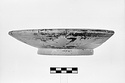
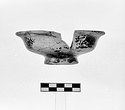
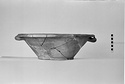
Intact except chips of lip. Small open bowl on ring foot, grooved below; projecting flat lip.
Hard dark buff clay with grits; good black glaze, streaked with brown.
Cf. Agora XII, no. 881. No disturbance ... 10 March 1933 ... No disturbance noted in pottery lists, but lies above disturbed layer 61. |
| Profiles and drawings for Evelyn Smithsons' pottery ... Helen Besi ... Book lists Σ 3036-assuming it's the section number, which leads up to the catalogue number of P 30502. Dirty Heavy Tracing Paper Drafting Ink ... 1965 |
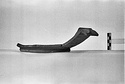
| Preserved from just below rim to near tip of nozzle.
Pinkish-buff clay. Cf. lists, Nb. p. 618 ff. Trial Trench I, Extension, Pre-Stoa fill (ash and carbon fill south of Brick Building). Box 5. 618 Leica, ... 25-26 February 1936 |
NM 16070
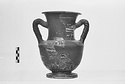
Disk foot and oval mouth. All glazed inside.
Thick black glaze inside, thin and brown outside.
Brann lists other clay-ground kantharoi under I 49 and suggests that the idea may have been inspired ... LG I ... Thick black glaze inside, thin and brown outside.
Brann lists other clay-ground kantharoi under I 49 and suggests that the idea may have been inspired by analogous shapes of Middle Helladic Yellow Minyan pottery which have been found in late Geometric groups. |
| Section Β 1934. Bouleuterion. General. Cleaning court and walls of porch. Pottery lists. General note. Heavy Roman wall (retaining wall of court). Description, date, destruction. List of objects from wall ... 1934 Β ... Pottery lists |
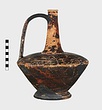
Neck and fragmens of body missing. Fusiform.
White lines around shoulder.
Gray clay. Cf. lists, Nb. p. 618 ff. Trial Trench I, Extension, Pre-Stoa fill (ash and carbon fill south of Brick Building) ... 25-26 February 1936 |
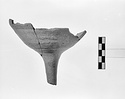
| Profile preserved. Restored in plaster. Plain slightly spreading ring foot; narrow flat rim undercut on inner edge.
Buff clay. Only traces of black glaze. Cf. lists, Nb. p. 618 ff. Trial Trench I, Extension, ... 25-26 February 1936 |
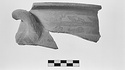
| Part of rim and handle preserved. Projecting rim flat on top; vertical rolled handle rising from shoulder to rim, adhering to wall.
Schematic horizontal vine between broad lines in red below lip. Daubs ... 25-26 February 1936 |
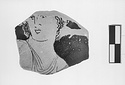
| Fragment from body.
Head right; outline in thin red; the hair a solid mass of darker red.
Fine buff clay, slightly micaceous. Good hard white surface. Cf. lists Nb. p. 618 ff. Trench I, extension. Fallen ... 9 March 1936 |
| Section Β 1934; Index for Volumes I-VI. Tholos. Summary of season 1934. Pottery Lists. Coin Lists. Floor. Fallen bricks and tiles on floor. Lamps Type XXVIII from fill on floor. Wall and wall trench. Isolated ... 1934 Β ... Pottery Lists ... Coin Lists |
Mended from several pieces; a fragment from the lip and small pieces of the walls missing. Squat shape; ring foot; narrow neck; deep bulging lip pinched together for pouring; strap handle from below lip ... 25 February 1936 |
| Profile preserved and about one-quarter of rim and wall, with two-thirds of base. Broad low raised base; overhanging rim set below upper edge of wall.
Applied pie-crust decoration on rim.
Pinkish-buff ... 25-26 February 1936 |
| Fragments missing from sides. Small fairly high ring foot; nearly flat floor; out-turned rim.
Pinkish-buff clay. Metallic black glaze, somewhat peeled. Cf. lists Nb. p. 618 ff. Trench I, Brick Building ... 24-25 February 1936 |
| Most of the base preserved, with ring foot, and rather more than half the walls, with about one-third of the rim. Restored in plaster. Low ring foot; flaring sides; narrow rim, rolled over; horizontal ... 25-26 February 1936 |
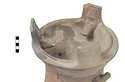
| Fragmentary brazier on stand with bearded heads as pot supports. Mended from many fragments; most of the rim and walls of the bowl missing; a second bearded head belongs but does not join. The brazier ... 25-26 February 1936 |
| Mended from many pieces; restored in plaster. Broad flat foot; squat body; flat sharp shoulder; wide mouth; rope handles.
Black glaze inside and out. Clay-colored paint and white for conventional patterns ... 25-26 February 1936 |
Well at 115/ΣΤ (all the 5th c. fills of 116/ΣΤ). The lower part of the shaft contained a heavy deposit of pottery and other objects of the late archaic period, both coarse and finer wares; probably a post-Persian ... Ca. 500-480 B.C.-Roman ... The lower part of the shaft contained a heavy deposit of pottery and other objects of the late archaic period, both coarse and finer wares; probably a post-Persian clean-up. ... Little pottery catalogued ... Deposit Lists file has the 5th c. objects from this deposit listed together with those fallen in from D 15:2. |
| Base, neck and most of one side of body preserved. Handle and much of walls restored in plaster. Heavy flaring ring foot, grooved; sides very flaring; shoulder wide and at a sharp angle to the walls; at ... 25-26 February 1936 |
| From the shoulder of a closed pot; a few drips of glaze inside.
Head and shoulders of female figure, wearing thin chiton and necklace; head three-quarters left; the hair falls in loose locks around the ... 14-24 February 1936 |
Mycenaean Well (S/1,2-13/20,14/1). Underneath the NE Room of the Library of Pantainos, along its S side, as a cutting in bedrock containing reddish fill with bits of green bedrock. The feature is rectangular ... 30 June-23 July 1975 ... The presence of Roman pottery and the absence of pottery from intervening periods (5th-4th c. ... [per Jan, some of the info for this lists new grid as ,T1/1 instead of the correct , 14/1. ... (layers I-III), Roman pottery from 66.10-65.00masl ? |
| Lang, M ... American School of Classical Studies at Athens ... Over 3,000 informal inscriptions scratched or painted on pottery, lamps, or other clay fragments have been found in the excavations of the Athenian Agora. In this volume, 859 of these graffiti and dipinti ... 1976 ... Over 3,000 informal inscriptions scratched or painted on pottery, lamps, or other clay fragments have been found in the excavations of the Athenian Agora. ... The texts consist of messages and lists, love names and curses, rough calculations, dedications, commercial and tax notations—in short, all manner of fascinating, all-too-human trivia. |
Cistern at the southeast foot of Kolonos Agoraios.
Nbp. 2369: Two chamber cisterns, 88/ΛΔ and 100/ΚΘ, united by a long straight passage running almost due N-S. A draw shaft at 95/ΚΘ is set just off the ... Use filling of late 4th-early 3rd c. B.C.
Accumulative fillings of late 3rd-early 2nd and late 1st c. B.C.
Upper dumped filling of 3rd c. A.D ... Objects either from 95/ΚΘ (middle fill) or 88/ΛΔ (lower Hellenistic fill), but uncertain which (they are in the finds lists of both but not assigned to subdivisions PAF) are the following: P 5655, P 5656, P 5657, P 5659, BI 154, S 574, L 1788, IL 193, SS 4091.
T 220 when opened in 1981 found to contain pottery chiefly of the 3rd c. ... Most of pottery dates in second half of 3rd c. but evidence of disturbance includes coins and Knidian handles, early Roman pottery, lamp, and glass, "Pergamene" ware and fragments of 18 long-petal bowls. |
http://agathe.gr/publications/monographs.html Monographs Excavations in the civic and cultural center of classical Athens began in 1931 and have continued almost without interruption to the present day. The first Athenian Agora volumes presenting ... JSTOR | Search for Items Inside Pottery of the Roman Period: Chronology Author: Robinson, H. ... Pottery from wells, roads, and other deposits as well as individual vases without significant context, augment the pottery from tombs as the basis of a detailed analysis of Mycenaean pottery. ... The third presents the plain wares, including household pottery, oil containers, and cooking pottery. |
| Simms, R. 1990. Myesis, Telete, and Mysteria, GRBS 31, pp. 183-195. Simon, E. 1983. Festivals of Attica: an Archaeological Commentary, Madison. Sironen, E. 1994. Life and Administration of Late Roman Athens ... Agora 31 xviii ... Two Centuries of Hellenistic Pottery, Hesperia 3, pp. 311-480 ... Hellenistic Pottery and Terracottas, Princeton ... New and Old Panathenaic Victor Lists, Hesperia 60, pp. 187-236 |
Broneer, O ... American School of Classical Studies at Athens ... The calyx-krater of Exekias, first published in 1937,1 was discovered at the bottom of a well in the American School excavations on the North slope of the Acropolis in Athens. The circumstances of discovery ... 1956 ... In his recent publication, Attic Black-figure Vase-Painters, Professor Beazley lists the Pharsalos krater under the heading 'Manner of Exekias' and leaves the question open whether it was painted by Exekias himself or by a companion imitating the style and designs of his master. ... Other wells, containing much pottery, mostly isolated pieces, from the Acropolis were found in the same area. |
|
|




.png.icon.jpg)