|
|
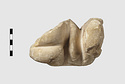
Part of one end preserved, but neither edge. On underside, lug for holding tile in position.
Island marble. Marble pile. Leica ... 20 June 1959 ... On underside, lug for holding tile in position.
Island marble. |
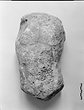
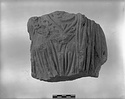
| Split off from background roughly on the plane of contact. Head, both arms and both legs broken off. Front of torso and breaks except those of back much weathered.
Nude male torso in more or less frontal ... March 1954 ... Nude male torso in more or less frontal position with both arms raised, legs apart, back arched so that small of back is cut free of background.
Shape and size of breaks on back and position of drill-channels indicate that this is the torso of Theseus from the Sinis metope, S II.
... From marble pile in position of Odeion stage. |
Handle missing.
Small one-handler; break at side gives position of handle. Flat bottom, plain rim. Purplish brown clay, buff surfacing, worn; streaky brownish glaze wash, applied by dipping, inside and ... Context ca. 425-400 B.C ... Small one-handler; break at side gives position of handle. Flat bottom, plain rim. |
| From lower wall.
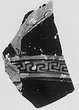
Male right lower leg in striding position.
Below, band of key pattern. Good glaze; dilute glaze for muscles. No relief contours. "Latrine" cut 3, green fill below floor F. 2115 Leica ... 16 May 1949 ... Male right lower leg in striding position.
Below, band of key pattern. |
Lower body and legs of a boy in a seated position, supported by a woman's hand which is life-size. The boy's body is nude, but a cloak covers his legs.
Pentelic marble. House 650 A/19. Leica ... 9 January 1959 ... Lower body and legs of a boy in a seated position, supported by a woman's hand which is life-size. |
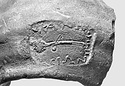
| Broad, ribbed handle of typical curve and position of seal.
Clay russet to ash-gray.
Impression carelessly made (clay die?) and shallow set. Stp: clay die?* Finished Middle Stoa Building Field with 4th ... 25 February 1933 ... Broad, ribbed handle of typical curve and position of seal.
Clay russet to ash-gray.
|
Fragment from upper part of lamp.
Grotesque head with pierced handle on forehead and filling hole behind it. Trace of wick hole in position of mouth.
Traces of matte brown to red glaze.
Thick yellow-buff ... 7 May 1952 ... Trace of wick hole in position of mouth.
Traces of matte brown to red glaze.
|
| Intact. Found in situ in the southwest corner of the small shrine with naiskos and round altar west of the ancient road and partly under the modern street. Removed from its position by some unauthorized ... 27 October 1965 ... Removed from its position by some unauthorized person in October 1965. |
| Upper half of body preserved.
Athena wears chiton with aegis over it, himation over left shoulder. Right arm, missing, doweled on separately, held in raised position.
Island marble. Byzantine wall over ... June 1959 ... Right arm, missing, doweled on separately, held in raised position.
Island marble. |
Dipinti; graffiti on flanges. Archaic.
Same series as A 2600 (Τ 3586).
For discussion of dipinti and graffiti see notebook p. 6157.
Finished Found in position in the archaic pipe line that fed the Southeast ... March 1956 ... Found in position in the archaic pipe line that fed the Southeast Fountain House; cf. |
Knob missing.
Lid. Flat top with two grooves. Raised disc beneath with two small tabs projecting from it. The position of one of the tabs is indicated on the top by a scratch made in the soft clay before ... 5th c. B.C ... Raised disc beneath with two small tabs projecting from it. The position of one of the tabs is indicated on the top by a scratch made in the soft clay before glazing. |
| Depicts leg in horizontal position so that figure was prostrate or swimming or running rapidly. Brownish glaze on a slip of the pinkish brown clay; incision for ankle and toes. Inside covered with silvered ... 29 February 1932 ... Depicts leg in horizontal position so that figure was prostrate or swimming or running rapidly. |
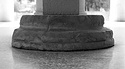
| Cuttings in under side for two channel dowels placed on radii alternating with dowels in top of base; dowels centered 0.20m. in from periphery.
From Stoa of Attalos.
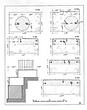
Removed from poros bedding below base ... 5 August 1955 ... In Lower Colonnade beside its original position ... Found in situ in first position from south in inner colonnade; removed by engineers after repeated discussion in the course of which it was decided that the ancient base, cracked and faulty, should be replaced with a new base to carry the weight of the new column. |
| Single fragment preserving one-quarter of the circumference of neck wall: transition from neck to shoulder.
Offset ridge rides fairly high on neck, though position of handles and rim unclear.
Smooth ... 9 August 1994 ... Offset ridge rides fairly high on neck, though position of handles and rim unclear.
|
| Head, arms, lower legs and feet missing.
Female figure in twisted position. She lies on her stomach with body from waist up held upright in frontal position, with arms placed horizontally across the body, ... 1938 ... Female figure in twisted position. She lies on her stomach with body from waist up held upright in frontal position, with arms placed horizontally across the body, with hands meeting in center. |
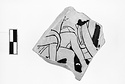
Fragment from wall of a cup. Preserved is the greater part of a nude man and woman in erotic position; at right and below, part of another figure or object. Purple for man's hair, white for woman's flesh ... 23 May-3 June 1938 ... Preserved is the greater part of a nude man and woman in erotic position; at right and below, part of another figure or object. |
Part of dome, flange, and cylinder preserved.
High dome. Flange thickened at edge, with stamped ovolo on reserved face. Dome: volute garland running right, with white dots within tendrils (now missing) ... 290-275 ... For stamped ovolo in this position cf. Kopcke 1964, no. 4, pp. 26--27, pl. 10:3. |
Half of upper body and part of one spout preserved.
High upper body. Two scraped grooves at junction of upper and lower body. Spiral wave pattern running right on upper body, with dolphins above; olive(?) ... 225-200 ... For dolphins in this position see Alt-Ägina II, i, no. 493, p. 70, pl. 38. |
| Wall fragment, broken all around. Upper wall of mug, probably of Phideas shape. Ribbed wall. In gap between ribs, stamped palmettes. Probably same palmette stamp as P 31451; probably from the same vase ... 27 June-5 August 1972 ... Agora XII, nos. 207, 408, for stamped decoration in this position. |
Clay fine, buff, fairly soft. Solid. Head, arms, right leg and left below knee are missing. Modeled fully behind. Traces of white slip with touches of yellowish color.
Carefully modeled torso is in a ... Late fourth century B.C ... Carefully modeled torso is in a position straining upward and towards the right. |
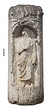
| In a niche in the column, there is a standing man in relief. The face is broken off. He wears a long robe. His left arm hangs at his side, his right across his chest. Inscribed on column below. Parts of ... 14 November 1934 ... Parts of two lines; better reading perhaps when in better position.
Pentelic marble.
|
About one-third of floor and foot preserved. From a bowl with rounded wall and low ring foot. A ridge on the floor just outside the position of the foot. At center of floor a stamp, partly preserved: cross ... 1931 ... A ridge on the floor just outside the position of the foot. |
Part of flattish irregular clay ring with signs of attachment of originally six small standing figures. Restored with one such figure in position.
Applique headdress, arms stretched forward, cleft face ... November 1959 ... Restored with one such figure in position.
Applique headdress, arms stretched forward, cleft face.
|
Plastic Attachment From Large Open Vessel: Pan.
Wall fragment.
Scraped groove on wall at level of bottom of attachment. Trace of something, possibly a bolster, resting above head of attachment.
Beardless ... 240-200 ... For scraped groove in this position on bolster bowl cf. 581, 586. |
Lip and bowl fragment with ring base. H. 0.042; est. diam. at rim 0.145; diam. of base 0.077; est. diam. of tondo 0.11.
I, jumper (head, most of arms missing) about to take off to left from a standing ... Ca. 420 B.C ... I, jumper (head, most of arms missing) about to take off to left from a standing position. In front of him is an object that looks like a goal post. |
Fragment depicts hand holding five-stringed lyre. Wheel marks and curve of fragment indicate the lyre is held in a horizontal position. The strings rendered by incision; white on the horns of the lyre ... August-September 1932 ... Wheel marks and curve of fragment indicate the lyre is held in a horizontal position. The strings rendered by incision; white on the horns of the lyre. |
Broken at one corner. A sheet of lead almost square pierced with 21 holes grouped together not quite in the center of the plaque.
The broad edge of the plaque was bent back to help hold the strainer in ... 5 June 1954 ... The broad edge of the plaque was bent back to help hold the strainer in position over the mouth of the pipe.
|
| Part of the stem and floor; incised line around the stem. On the floor, part of a figure, nude save for a cloak over his arms, running right in a crouching position. Trace of some object at the extreme ... June 1937 ... On the floor, part of a figure, nude save for a cloak over his arms, running right in a crouching position. Trace of some object at the extreme right. |
Top broken off. Equal sides.
Stamp on side (near bottom): Sphinx (?) The impression is quite indistinct and may not be a sphinx at all, but it is hard to see what else it could be. It faces right, its ... 1932 ... It faces right, its head cocked upward in an awkward position, wing projecting stiffly behind, almost rectangular.
|
Dipinti; graffiti on flanges. Archaic.
Same series as A 2600 (Τ 3586).
Cf. picture, notebook p. 5454 (M.C. notes however that she never could see a trace of the upper half of the pipe itself.)
For discussion ... March 1956 ... Found in position in the archaic pipe line that fed the Southeast Fountain House; cf. |
| Top surface shows practically no wear but bottom is badly worn by reuse as a paving block.
Both ends show clamp position scratched on, and further back the clamps as executed.
Same workmanship and series ... 1933 ... Both ends show clamp position scratched on, and further back the clamps as executed.
|
Fragment of floor and lower wall, broken all around. From bowl(?) with plain convex walls and very low ring foot. Center of floor, within position of foot, recessed in two degrees.
Orange-cinnamon micaceous ... 22 July 1931 ... Center of floor, within position of foot, recessed in two degrees.
|
| Two joining fragments forming complete Samian A plate. Deep plate on low ring foot; vertical rim with rouletting at top and bottom. On floor, over position of ring foot, two concentric grooves. At center ... 10 May 1952 ... On floor, over position of ring foot, two concentric grooves. |
Unglazed outside. On black glaze inside, part of a nude figure lying face down with arm extended out behind, in a diving position(?). The figure painted in added red with interior detail incised. To left, ... 1935 ... On black glaze inside, part of a nude figure lying face down with arm extended out behind, in a diving position(?). The figure painted in added red with interior detail incised. |
Broken at bottom.
Female frontal head crowned with polos decorated with palmettes. Hair worn in chignon. Earrings added flat discs of clay.
Broken just below neck.
Back not articulated, solid.
Buff fabric ... 1 August 1973 ... best stored in a horizaontal position, with the perspex dowels not removed (but not mounted on the base.)
... Best stored in a horizontal position, with the perspex dowels not removed (but not mounted on the base). |
| Broken on three sides. One edge, front and back preserved.
Subject not clear: looks like a fold of drapery falling to bottom edge of a plaque. Could possibly be a mould.
Back surface gone.
Yellowish-pink ... 2 August 1973 ... best stored in a horizaontal position, with the perspex dowels not removed (but not mounted on the base.)
... Best stored in a horizontal position, with the perspex dowels not removed (but not mounted on the base). |
Badly weathered; broken away on all sides.
But tool marks on top and rough appearance and position of letters suggest that the top may be original and the stone never carefully finished to receive the ... 27 December 1933 ... But tool marks on top and rough appearance and position of letters suggest that the top may be original and the stone never carefully finished to receive the inscription.
|
| Apparently the left hind leg.
The position, not vertical, but forming an angle of ca. 0.45 to the supposed ground line, suggests that the horse was rearing. Hollow cast; carefully modelled; the hairs of ... 23 June 1933 ... Apparently the left hind leg.
The position, not vertical, but forming an angle of ca. 0.45 to the supposed ground line, suggests that the horse was rearing. |
Broken on three sides. Bottom edge preserved.
Back of fragment preserved.
Smooth and not articulated.
Inside rough.
Buff fabric.
ADDENDA RVN: Joins with T 4122. See also T 4136. Well in Room 6, box 62, ... 2 August 1973 ... Best stored in a horizaontal position, with the perspex dowels not removed (but not mounted on the base.)
|
| a) Lower part with fillet at bottom. Covered with doodles.
b) Upper part with torus at top and flat band below it.
From East Building.
Blue marble. Found at S/9-17/7 (Fall 2016). a) Erected from original ... 1959 ... a) Erected from original recumbent position inside East Building.
b) In situ to the south of fragment a), lying recumbent north-south below epistyle A 2850. |
|
|