|
|
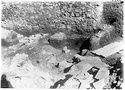
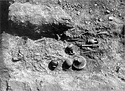
Grave 11 in notebook. Grave disturbed by diggers of pit A.
Only skull and left arm of man's skeleton remained in position, head toward N.E. Cover slabs were piled near head ... Late Geometric ... Only skull and left arm of man's skeleton remained in position, head toward N.E. |
| Grave XV in notebook = RSY Grave 1.
Part of a burial jar with bones of 18-month-old child. Position of body not determinable. Foot of jar had been broken to insert body of child and stopped with stones ... Second half of 8th. c. B.C ... Part of a burial jar with bones of 18-month-old child. Position of body not determinable. |
A pit, perhaps a well, extending beneath the foundations of [Building D, the Primitive Bouleuterion] the Hellenistic Metroon. Not completely dug due to its position. A dumped filling so far as dug, apparently ... Ca. 575-525 B.C ... Not completely dug due to its position. A dumped filling so far as dug, apparently thrown in within a very limited period. |
| John Camp ... Burial north of Roman temple, E. of polygonal wall.
The tomb, as preserved, consisted of the cinerary urn, which stood in an upright position, its upper part damaged by later disturbance. It contained ... Late Helladic IIIC Late-Final Mycenaean/Submycenaean ... The tomb, as preserved, consisted of the cinerary urn, which stood in an upright position, its upper part damaged by later disturbance. |
Grave in cella of Hephaisteion with cover slab with inscription (I 5885). Grave XXXIV in notebook. One skeleton and two leg bones. The remains of G. Watson were replaced in his original position.
Pottery ... 15 August 1810 ... Watson were replaced in his original position.
Pottery discarded: Turkish. |
| Mycenaean Burial.
The cutting was roughly rectangular (1.60 by 0.50m) and was once covered with rough stone slabs, two of which were found over the body. The skeleton, presumably that of a man, lay in ... Myc. III A-B ... The skeleton, presumably that of a man, lay in a somewhat contracted position with the head at the southeast and with the offerings, two pots and a bronze knife, at this end of the grave. |
| Identified as pyre by SIR.
In room E. Burnt "pocket" found while digging red earth that contained late Hellenistic pottery, including a fragment of Pergamene (discarded). No pit was discerned, but concentration ... 3rd quarter 4th c. B.C ... No pit was discerned, but concentration in a "pocket" suggests that the pyre was in its original position and the layer in which it was buried contained late Hellenistic intrusions. |
Well cut through cistern at 6/ΝΕ (C 9:7).
The stele I 3244 in position in the cistern over the mouth of the well is listed with the cistern deposit C 9:7. Coins:
26 February 1936 #2-#4
27 February 1936 ... A.D. 1st ... The stele I 3244 in position in the cistern over the mouth of the well is listed with the cistern deposit C 9:7. |
| Laura Gawlinski ... Burial of a woman (young adult female ca. 18-20); precise dating difficult due to disturbance by later features, but the amount of Neolithic and Geometric pottery extracted from the trench is significant ... Prehistoric ... Body partially rests on bedrock, tightly contracted position with head at east. |
| In NE corner of Room D. In a Byzantine vessel=P 34464.
The position of the vessel in the corner of the room suggests that the burial was made after the construction of Byzantine Walls G and E. This type ... 10th-11th c. A.D ... In a Byzantine vessel=P 34464.
The position of the vessel in the corner of the room suggests that the burial was made after the construction of Byzantine Walls G and E. |
| Mycenaean grave. It consisted of a shallow rectangular cutting in bedrock about 1.40m by 0.70m, but it was probably somewhat bigger, since the east side and a large part of the north side had been cut ... Myc. IIIA:1-2 ... Only the skull was preserved in position. Many minute glass beads were found under the skull and around the feeding bottle, and doubtless came from a necklace worn by the child. |
| John Camp ... Protogeometric Grave about 0.60m to the southeast of T 15:2.
Unlined roughly rectangular-elliptical pit, oriented north-south, neatly cut into bedrock to a depth of 0.70m, with rounded corners. The pit ... Early-Developed Protogeometric ... Within the pit, the skeleton of a woman, aged about 40-44 years at death, within significant osteoarthritis and degenerative joint disease, was placed on the floor of the tomb, on her back, in a fully extended supine position, arms by the side of the body, head to the south. |
| Mycenaean grave to west of House N, room 5, with the burial of two young children. Rough rectangular cutting in soft stereo (0.95x0.64x0.28), lying under the western wall of a Geometric house, contained ... Myc. III C:1 ... The cup had been placed in an upright position at the bottom of the cutting, before the upper body was put in, but because of the cramped space and double up postures, it seems likely that both burials took place simultaneously.
|
Eugene Vanderpool Homer A. Thompson ... Mycenaean burial (no offerings) in NW corner of Stoa Terrace (original north end).
" It consisted merely of an adult skeleton lying in an extended position with head to east and the left leg slightly flexed ... Mycenaean or Protogeometric ... Mycenaean burial (no offerings) in NW corner of Stoa Terrace (original north end).
" It consisted merely of an adult skeleton lying in an extended position with head to east and the left leg slightly flexed at the knee. |
| Eugene Vanderpool ... Rectangular pit, oriented east-west, cut party into filling of Early Protogeometric pit-well (I 18:4), to a preserved depth of about 0.30m. A late Byzantine wall founded below the floor of the grave destroyed ... Middle Geometric I ... The deceased was found in a fully extended supine position on his/her back; fingers, pelvis, and lower body through toes are preserved.
... In the process of studying the skeletal material, the fragmentary remains of two further individuals were noted, including the secondary or disturbed remains of an adult inhumation (AA 52b), as well as those of a cremated adult (AA 52c). the position or even presence of these two individuals was not noted in the field, and both are probably intrusive, particularly as the grave was disturbed by later activity.
|
| Mycenaean Chamber Tomb by Stoa Pier 12 (Burial 10).
The entire north side of the chamber had been cut away by Stoa Pier 12 and most of the depth by leveling operations in connection with Square Building, ... Early Myc. IIIA ... Despite the disturbance two skeletons were found in order as far as their thighs, lying inn a north-south position with their heads to the south; the east skeleton lay on its right side with the right hand under the head, the left over the chest; the west skeleton had the left arm raised to its chin, the right arm at its side. |
| Homer A. Thompson ... PG grave to NW of Stoa Pier 19 (Tomb no. 5 in notebook). In some records as Grave XLII.
It consisted of a rectangular pit, oriented north-south, cut into bedrock. The sides of the pit were lined and the ... Earlier-Developed Protogeometric ... The skeleton of a child (7-8 years at death) was found on its back in a fully extended supine position, head to the south, filling the cist almost entirely. |
R. Ross Holloway ... Protogeometric Grave in Koletti Garden. Male inhumation.
Tomb first encountered and partially damaged by workmen who were digging a cess pit for the restored Koletti House on Polygnotos street. The tomb ... "Submycenaean"/Early Protogeometric ... Within the pit, the skeleton of a man aged 18-21 years at death, and described as somewhat decayed, was laid out on his back in a fully extended position, head to the southeast. the fill of the tomb appeared to consist of sterile redeposited bedrock and it was hastily dug by the workmen prior to the arrival of a trained excavator. the floor of the tomb was encountered at 1.95m below the level of the court in the area of the cess pit, ca. 1.15m below the level of the tiled pavement along the east side of the Kolletti House |
| Susan I. Rotroff ... Burial 3 beneath the floor of the Stoa Basileios. It consisted of a rectangular pit cut into bedrock to a depth of 0.44m, lined on all sides and covered with an admixture of narrow stone slabs of soft ... Final Mycenaean/Submycenaean ... Woman 35-45 years old, placed on her back in a fully extended position, head to the southwest. |
| Eugene Vanderpool ... Grave (E.L. Smithson: Grave III: SM).
The close proximity and similarity of this tomb and tomb M 16-17:1 strongly suggests that they were intentionally laid out in relation to one another and were contemporary ... Late Mycenaean/Submycenaean-Earliest Protogeometric ... Within the pit, the skeleton of a fetus or newborn infant was placed on its back in an extended position, head to the south. |
| RSY Grave 51.
The grave lay on the slope of the Areopagus in Roman house O, just east of the line where the hillside is scarped for the foundation of the west wall of the house.
Cutting:the pit cut in ... Archaic period/6th or 7th c ... Skeleton: On the bottom of the pithos were found the skull and some of the leg-bones of a small child who had seemingly been buried in a doubled-up position with the head toward the mouth of the pithos (south). |
| Mycenaean Chamber Tomb opposite ΣΑ pier 15. It was discovered about 20m to the west of Pier 15 of the Stoa of Attalos and almost in a line and a few meters south of Tomb XX. although the entire upper part ... Myc. II-IIIA/B ... The tomb had been used for five or more burials. three skeletons were found in their original position. One lay along the east side with head to south and legs doubled up; another in the center with feet toward the door; and a third at the back of the chamber. |
| John Camp ... Protogeometric grave (female inhumation) located about 0.60m northwest of T 15:1. It consisted of a roughly rectangular pit, with the corners slightly rounded, oriented approximately north-south. The pit ... "Submycenaean"/Early Protogeometric ... Within the pit, the well-preserved skeleton of a woman aged about 40-44 years at death was found laid out in a fully extended position on her back, head to the south. |
| Dorothy Burr Thompson ... Grave 2. Urn cremation (trench-and-hole). In some records as XXIII.
Variously labeled as grid 7/Δ, 7/Γ and 7/Γ-Δ.
Rectangular pyre trench cut through earth into bedrock, with only the lowest 0.04m surviving ... Transitional Late Protogeometric/Early Geometric I ... In it, a neck-handled amphora , which served as cinerary urn, was placed in an upright position; it contained the cremated remains of an individual described as an adolescent aged 10-14 years at death. |
| Dorothy Burr Thompson ... Child's Grave (E.L. Smithson: Grave XXVIII: G).
Cf. Container Lot ΣΤ 165 (fill over geometric grave).
Neat, rectangular, unlined trench, cut into bedrock to a preserved depth of 0.20m,below the level ... Early Geometric I ... The skeleton of a child (4 years old by Angel and 3.5-4.5 years old by Liston) was found in a fully extended supine position, on its back, head to the northeast. |
|
|