|
|
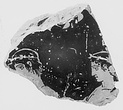
Fragment from near top with hole for suspension made after the plaque broke. Max. dim. 0.059; Th. 0.0081. W. B. Dinsmoor, Hesperia Suppl. V, p. 132, fig. 58:10.
Combat. At the left is part of a round ... Ca. 520 B.C ... Red Figured And White Ground | Plaques |
Fragment, slipped on back. Max. dim. 0.072; Th. 0.013.
Youths (heads with wreaths, start of shoulders) to left, the right one carrying a small branch. Above at the break, a hanging wreath. Relief contour ... Ca. 440 B.C ... Red Figured And White Ground | Plaques |
| Two garlanded male heads left. Accessory white used on wreaths, in a garland at upper edge of fragment, and on a branch(?) carried(?) by one of the figures and appearing in the field between them.
Very ... 17 March 1932 ... Red Figured And White Ground | Plaques |
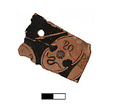
| Fragment from near top, broken all around. Two warriors in combat. Of the one on the right there remains a thigh, a Boeotian shield with two snakes flanking a rosette, and a spear; of the one on the left, ... 13 March 1937 ... Red Figured And White Ground | Plaques |
First interpretation: mold for a sphinx (?).
A thick tile-like fragment, flat in back.
At the top, a bit of the edge of the mold preserved. Preserved is part of a wing, hind-quarters and tail, to left ... 9 March 1933 ... His opinion: they resemble campanian wall plaques in repertory and dimensions.
"The Agora moulds produced plaques earlier in date than the Campanian. The campanian plaques are to be connected only with public buildings, never with private houses. |
Part of upper edge preserved; from a mold for a plaque.
Upper half of dancing figure.
Fairly coarse fabric; somewhat resembling the moulds for large "architectural" plaques; but thiner, and this at a smaller ... 5 June 1954 ... Fairly coarse fabric; somewhat resembling the moulds for large "architectural" plaques; but thiner, and this at a smaller scale. |
| Fragment from edge of plaque.
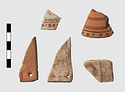
At edge of plaque, border of two narrow red stripes with blue between. Within, bit of sharply twisting snake, red outlined with blue dots. Red and blue pigment on white ground ... 1 April 1932 ... There are two other fragments from similar plaques, with traces of a red border. |
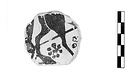
| Nearly circular fragment from plaque; a bit of the lower edge of the plaque preserved.
Hind legs of animal with dot rosettes. Accessory purple; incised line between haunches.
Pale pinkish-buff clay ... 3rd quarter of 7th c. B.C ... Resembles closely Corinthian or Black Figure plaques found elsewhere (cf. |
|
|