|
|
Lewis, D. M ... American School of Classical Studies at Athens ... Hesperia 28.3 3 239-247 10.2307_147227 ... 1959 ... Law on the Lesser Panathenaia |
| Neils, J. Tracy, S. V ... The American School of Classical Studies at Athens ... This attractive book presents a general introduction to the Greater Panathenaia, the week-long religious and civic festival held at Athens every four years in honor of the city’s patron goddess, Athena ... 2003 ... This attractive book presents a general introduction to the Greater Panathenaia, the week-long religious and civic festival held at Athens every four years in honor of the city’s patron goddess, Athena. The highlight of the city’s festival calendar, with its musical, athletic, and equestrian contests, tribal events, processions, sacrifices, and other activities, the Greater Panathenaia involved all the residents of Athens—not just adult males but women, children, metics (resident aliens), foreigners, and even slaves. |
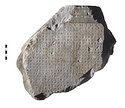
| Inscribed fragment.
Inscribed face, back, which is rough picked, and the top with a simple moulding preserved.
Decree of Nomothetai concerning the Lesser Panathenaia.
Twenty-two lines of the inscription ... Ca. 335 B.C ... Decree of Nomothetai concerning the Lesser Panathenaia.
Twenty-two lines of the inscription preserved.
|
Wall fragment. Max. dim. 0.058.
Wooly satyr (torso, start of arms, legs, and tail) to right. White: tufts of fur.
The satyr is dressed in the costume of Papposilenos and is closest to the satyrs on the ... Ca. 420 B.C ... An inscription above their heads tells us that they are singers at the Panathenaia. For the most recent discussion of the meaning of the representation on the New York vase, see Froning, Dithyrambos, pp. 25--26, who opts for the scene reflecting a satyr play rather than a dithyrambos performance. |
| Pit ... Ω-10 1969, 1970 Ω:1957.0516:15 Ω:1957.0516:16 Ω:1957.0516:17 Ω:1957.0516:18 N 72285 Ω:1957.0517:1 N 72286 Ω:1957.0517:2 N 72287 Ω:1957.0517:3 N 72288 Ω:1957.0517:4 N 72289 Ω:1957.0517:5 N 72290 Ω:1957.0517:6 ... Athens, Roman Imperial ... Athens, Roman Imperial, Augustan Panathenaia |
| Odeion. Parmenides. Parrhasios. Parsley. Parthenon. Odyssey. Patrokleides. Oedipus. Pausanias. Offices, public. Oikema (prison etc.). Peace. Oineus. Oinoe, battle-painting. Pegasos of Eleutherai. Olbiades ... Agora 3 255 ... Panathenaia |
| IG I³, 35, line 8. IG I³, 45, lines 10-11. IG I³, 84, lines 5-6. IG II², 204, lines 66-67. IG II², 463, line 36. IG I³, 129. IG II², 334. Aristotles, Ath. Pol. 47.2-3. Aristotles, Ath. Pol. 47.4. Aristotles, ... Agora 19 64 ... Law on the Lesser Panathenaia, Hesperia 28, 1959, pp. 239-247 |
Washed-in filling at the base of the Acropolis cliffs, some 7m. east of the Klepsydra; the fill was characterized by teh fragments of a series of red-figured oinochoai of special shape, of the late 5th ... Late 3rd c. B.C ... The characteristic shape and decoration show certainly that the oinochoes were made for some special cult purpose. the armed Athena, in the style of the Athenas of the Panathenaic amphoras, on the necks of two of the vases, and the helmeted Athena who mounts a chariot in the figured scene on the body in, apparently, every case suggest not merely a general connection with the cult of the goddess,but a specific association with teh festival of the Panathenaia; while the mammae which appear on the shoulders of all teh vases point with even greater certainty to a fertility cult. |
Mended with missing pieces restored in plaster and painted, notably sections of the lower part of the body. Glaze abraded around handle B/A. H. 0.563; rest. diam. 0.415. T. L. Shear, Hesperia 7, 1938, ... Ca. 440-430 B.C ... A, chariot team to left and Nike (victor at the Panathenaia). The charioteer (head, part of arms missing), dressed in a long chiton, leans forward, holding the reins in both hands as well as a goad in his right. |
Two non-joining fragments. Fragment a comes from the lower part of the vase; fragment b is a shoulder fragment. Glaze on b is slightly abraded; streaky and pitted on inside. P.H. a) 0.175; max. dim. b) ... Ca. 420 B.C ... For the subject, see Corbett, Hesperia 18, 1949, pp. 346--351, who quite plausibly suggests that the torch race depicted on 118 may be the one that took place at the Panathenaia. The sacrifice of a bull at the end of a torch race is not known from many examples, and Corbett has dealt with most of them(pp. 346--351). |
Lower half of body, all of torus foot, start of handle B/A. Strengthened with plaster. Thin reddish glaze on inside. Misfired reddish in places on outside. Pitted here and there. P.H. 0.035. R. R. Holloway, ... Ca. 440-430 B.C ... For the two scenes reflecting musical contests at the Greater Panathenaia, see R. R. |
| The Athenian Agora 24; Late Antiquity A.D. 267-700; Index; General Index; Longinus. The Athenian Agora 24; Late Antiquity A.D. 267-700; Index; General Index; Olympiodorus. The Athenian Agora 24; Late Antiquity ... Agora 24 148 ... The Athenian Agora 24; Late Antiquity A.D. 267-700; Index; General Index; Panathenaic Festival and Procession; Panathenaia |
|
|
.jpg.icon.jpg)
.png.icon.jpg)
.png.icon.jpg)
.png.icon.jpg)