|
|
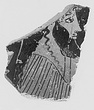
| From a cup with a low broadly flaring foot. Gorgoneion in the medallion inside. Part of the mouth preserved, with tusks and protruding tongue. Purple red for tongue and inside of mouth seen between teeth ... 5 March 1935 ... Paralip., p. 78, (Palermo Gorgoneion P.) |
Shoulder, much of body. P.H. 0.06; diam. 0.052.
Fallow deer (hindquarters missing) rearing up against a tree, trying to reach the leaves. On the shoulder: rays; above, tongue pattern. Dilute glaze: muscles ... Third quarter of the 5th century B.C ... For the subject, see Warsaw 198553 from the Group of Palermo 16 (ARV2 1687, 10; Paralip. 462, 10). |
| Broken all around.
Bearded head with long loose hair, right; he wears a chiton. Relief contour.
Light red clay. Good glaze.
Probably by the Altamura Painter; cf. CVA, Palermo, V 780, pl. 39,3; and CVA, ... 28 April 1953 ... Agora:Object:CVA, Palermo, V 780, pl. 39,3. |
Handle, part of shoulder, a little of wall, all of foot missing. P.H. 0.135; diam. 0.053.
Owl (part of head and body missing). At right, olive sprig. On the shoulder: rays; above, tongue pattern.
Originally, ... Third quarter of the 5th century B.C ... The Painter of the Palermo Owl (ARV2 1201, 2). |
Center of floor missing.
Recessed underside. Reserved: underside with traces of a circle near the center.
P 11043, from the same deposit, forms the pair. Less plump specimens are P 12784 G 11:3-POU; ... Ca. 500 B.C ... Four others which belong to this series are: Athens, Kerameikos inv. 1028; Berlin F 2755; London 64.10-7.1455 (F 230); Palermo. |
Shallow convex wall, incurving at the rim; disc foot. Glaze on rim and outer face of foot. Intentional red glaze on wall inside and out, much peeled. Underside reserved. Incised on underside: Κ.
One similar ... Ca. 450 B.C ... One similar to 954 is in private possession in Athens (H.0.03; diam. 0.08) and there are others in London 91.8-6.78, New- castle and Palermo. P 26229 Q 20:1 is quite close in shape though there is no intentional red. |
Wall fragment. Max. dim. 0.055. Burn, Meidias Painter, p. 117, cat. no. MM 144.
Woman (body, legs, start of arms) kneeling on the ground to right, dressed in a long, belted chiton. In front of her is ... Ca. 400 B.C ... Manner of the Meidias Painter, xii: Sundry: Very close to the Meidias Painter, but compare the Group of the Palermo Phaon (no. 9) (Paralip. 479, 99 bis). |
Wall fragment with start of shoulder. Some of the glaze flaked. P.H. 0.09.
Youth (a little of his left shoulder, lower legs, and feet missing) stands to left, looking back. He is dressed in a himation, ... Ca. 470 B.C ... The scheme of decoration and the style of drawing seem closest to Warsaw 142470 by the Painter of Copenhagen 3830 (ARV2 303, 3; 724, 9) and Palermo, no no. compared with him (ARV2 302, 16; 724 [a]). |
Fragment of flanged handle, the underside indicating the curved surface of the loop. Glaze blistered in a few places. Max. dim. 0.117. Schleiffenbaum, Volutenkrater, p. 324,cat. no. V 204.
On flange, ... Probably mid-5th century B.C ... N 1); Palermo G 1283 (ARV2 599, 2; Paralip. 394, 2; Addenda 266; Prange, p. 180, cat. no. |
Wall fragment of stand from near top with start of projecting rim.
Black bands on inside. Glaze abraded in places. P.H. 0.085.
Upper parts of two Doric columns, one column slightly behind the other ... Ca. 440-430 B.C ... For the palmettes and lotuses, see Palermo 2162 = 616 (ARV2 1145, 38; Paralip. 456, 38; Addenda 335; Matheson, p. 415, cat. no. |
|
|