|
|
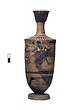
| Repaired; bits missing. Quadriga with charioteer. Behind horses, armed warrior. In background, ivy spray with white berries. Above, double dotted line. On shoulder, rays. Red for horses' manes, tails and ... 23 March 1936 ... ADDENDA The style of the Diosphos and Haimon painters overlap, and this is one of those difficult cases. |
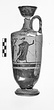
| Repaired. Parts missing. Neck does not join. Hermes, Herakles, two other draped figures. Background, ivy sprays. Above, double dotted line. On shoulder, palmettes and rays. Ground a light buff slip as ... 23 March 1936 ... ADDENDA Style of Diosphos and Haimon painters; may be a careless work by one of these two. |
Floor fragment with stem and fillet. Incised line at top and bottom of fillet. Max. dim. 0.035.
I, satyr: long beard, start of outstretched right arm, part of chest and abdomen, left hand holding the ... Late 6th century B.C ... The position of the satyr's left hand, loosely gripping the shaft of the thyrsos, resembles these, all trumpeters: one by the Bowdoin Eye-Painter, Berlin inv. 3217 (ARV2 168, 15); Louvre G 70 by the Scheurleer Painter (ARV2 169, 6; Paralip. 338, 6; Addenda 183); and Louvre G 73, near both painters, the tondo (ARV2 170, ---). |
Wall fragment from top of stand with molding and bottom of lebes.
Glaze abraded along edge of rim. P.H. 0.09.
Woman (most of head with sakkos) to right. Behind her, traces of an object, perhaps a chest ... Ca. 410-400 B.C ... For a chest held at this height, see Athens, N.M. 1659 from the Sundry Group of Painters in the Manner of the Meidias Painter (ARV2 1322, 11; Burn, Meidias Painter, p. 106, cat. no. |
Wall fragment of stand. Glaze fired brownish. P.H. 0.067; max. dim. 0.08.
Woman (torso, right arm) standing to right, wearing a peplos and holding a box on her left forearm. Preliminary sketch.
Probably ... Ca. 410 B.C ... Probably from the Sundry Group of Painters in the Manner of the Meidias Painter. |
Floor fragment. Max. dim. 0.041.
I, youths (top of head of one; head of other) facing. Around tondo, stopped-maeander pattern. A, feet, start of drapery of man to right; toes of another facing. Between ... Ca. 450-440 B.C.? ... For the two lines below the figures on the outside, cf. 1447 and 1448 by his companion, the Painter of Heidelberg 211. 1450 seems to share features of both painters. |
Rim fragment. Glaze misfired reddish on outside; much abraded on rim and on neck. Max. dim. 0.092.
Below the torus rim, chain of lyre lotuses and encircled palmettes.
For this ornament, only with lyre ... Ca. 480 B.C ... Paul Getty Museum 92.AE.6) signed by Syriskos as painter: A, Pantelea seated between Okeanos and Dionysos; B, Themis between Balos (seated) and Ephaphos (all names inscribed) and the namepiece of the Tyszkiewicz Painter, Boston 97.368 (ARV2 290, 1; Paralip. 355, 1; Addenda 210). 259 is too abraded to be sure if it is by one of these two painters, but it is fairly close. |
Fragment from near top with hole for suspension made after the plaque broke. Max. dim. 0.059; Th. 0.0081. W. B. Dinsmoor, Hesperia Suppl. V, p. 132, fig. 58:10.
Combat. At the left is part of a round ... Ca. 520 B.C ... Sundry Very Early Red-figure Pots by Various Painters (ARV2 12, 14). |
Fragment of inset lip and start of bowl. Max. dim. 0.069.
On exterior, lozenge pattern, each reserved lozenge decorated with a lozenge and dot drawn in dilute glaze.
The lozenge pattern on the exterior ... Ca. 430-420 B.C ... GR 1917.7--26.2 (ARV2 1283, 13). 1348 is probably by one of these two painters, but without figures, one cannot be certain which. |
Floor fragment with start of stem. Glaze misfired bluish in places.
Max. dim. 0.083; est. outer diam. of tondo 0.11.
I (illustrated), two youths (forehead, lower legs, and feet of one missing; head, ... Ca. 430-420 B.C ... But 1474 looks slightly later than the work by the painters of the Penthesilea Workshop. |
Bowl fragment. Max. dim. 0.082; est. diam. of tondo 0.16.
I, jockey (head with long hair streaming behind him; shoulder) to right. Around tondo, stopped-maeander pattern. A, horse race. At the left, one ... Ca. 470-460 B.C ... During his visit to the Agora in June 1988, Bothmer noted the similarity between 1429 and the work of the Stieglitz and Pistoxenos Painters. Not enough remains of 1429 to offer a firm attribution, but the character of the horses recalls those on three cups by the Pistoxenos Painter: Berlin inv. 4982.19 (ARV2 860, 5; CVA, Berlin 3 [Deutschland 22], pl. 104 [1033]); Louvre G 108 (ARV2 860, 9; Addenda 298); Louvre C 235 (ARV2 862, 24). |
Body fragment with start of neck, all of ring base. P.H. 0.085; P. diam. 0.075.
A woman dressed in a chiton and himation sits to right on a klismos, juggling two balls(?). In front of her, the right hand ... Ca. 420-400 B.C ... For a seated woman juggling, see Baltimore, Walters Gallery 48.271 (CVA, Baltimore 1 [USA 28], pl. 33 [1445]:7--10), placed by Oakley (CVA, p. 31) on the fringes of the Group of the Paidikos Alabastra but not by one of its painters; the one on a hydria from Abdera attributed by Romiopoulou to the Peleus Painter (Δελτ 19, 1964 [1966], pl. 439); the cup by the Telephos Painter: Louvre G 331 (ARV2 819, 42; Paralip. 421, 42; Addenda 293); also Florence inv. 151458 = 16 B 41 by the Splanchnopft Painter (ARV2 894, 45; Esposito and de Tommaso, Vasi Attici, p. 71, fig. 112). |
Wall fragment with thin matte glaze on inside. Thickens slightly at top. Max. dim. 0.094.
Youth (forehead, much of legs missing) standing to right, looking back, a himation draped around his waist and ... Ca. 410 B.C ... Eleusinian subjects are not very common among painters of the Meidian group (Burn, p. 73), and if the assignment of 17 is correct, it adds another example. |
Wall fragment. Glaze thin in places on outside. Max. dim. 0.113.
A, male pursuing a woman. Parts of three figures remain: at the left, a bit of the himation and chiton, and left foot of a woman running ... Ca. 460 B.C ... The border of esses for the bottom of the woman's chiton is a distinctive pattern that appears in the work of both painters: the Boreas Painter: New York, M.M.A. 96.19.1 (ARV2 536, 5; Addenda 255) and Munich 2375 (ARV2 537, 9; Addenda 255); the Florence Painter: Syracuse 21189 (ARV2 541, 4) and Louvre G 360 (ARV2 541, 8). |
Four non-joining fragments, a with part of trefoil mouth and all of handle, part of body; b -- d are wall fragments from lower down. Brown glaze on inside. P.H. a) 0.073. Max. dim. a) 0.108, b) 0.102, ... Ca. 430 B.C ... /10 1378, which is Penthesilean but not attributed to one of the group's painters (CVA, Tübingen 4 [Deutschland 52], pl. 40 [2557]:3). |
Mended with small missing pieces restored in plaster and painted. Lip offset on inside; foot offset on underside. Glaze slightly abraded on handles. H. 0.074; diam. of rim 0.18; W. with handles 0.238; ... Ca. 510-500 B.C ... To designate this cup and those by the Carpenter and H.P. Painters as prime examples of his earliest work would necessitate explaining why he switched from cups to pots for the remainder of his career. For the most part, Athenian painters of the Middle and Late Archaic period specialize in painting either cups or pots. ... Also, the quality of drawing on the Gorgos cup is more fluid and surer than that on the cups by the Carpenter and H.P. Painters, which is stiffer and drier, and it really ought to be kept apart, although the combining of the two painters seems acceptable. |
Two non-joining fragments, a of neck and shoulder, b of rim, neck and shoulder. Max. dim. a) 0.095, b) 0.085.
Fragment a preserves the filleted head of a man and the head of a muzzled horse, both to right ... Ca. 520 B.C ... Sundry Very Early Red-figure Pots by Various Painters (ARV1 14 τ ; ARV2 11, 6). |
Two non-joining fragments, a of wall, b of rim and neck with start of handle zone at far left. Glaze pitted on inside of a. Max. dim. a) 0.077, b) 0.14; W. of rim 0.025; H. of neck 0.063. W. B. Dinsmoor, ... Ca. 480 B.C ... But the drawing of the figures on 237 is weaker than that of these two painters. |
|
|