|
|
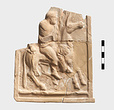
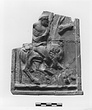
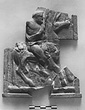
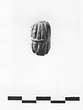
| Rectangular plaque with plain flat frame. Mended from several pieces; the upper edge missing, the upper left corner, a piece from the right side and a small piece from the bottom.
Herakles, wreathed and ... 1 August 1947 ... Herakles, wreathed and bearded, mounted on a mule moving right. The head and forepaws of the lion-skin appear on the mule' s withers, as if the skin served for a saddle cloth. ... He is turned slightly towards the front, his right arm (missing) upraised in the act of beating his mount with his club, the end of which remains on the mule' s hind-quarters.
|
| Relief Plaque: Herakles on a Mule ... AMS Horizontal (normal) ... Relief Plaque: Herakles on a Mule |
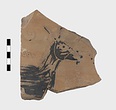
| Amphora fragment with donkey or mule ... Angelique Sideris ... Museum object.
Stoa Gallery-Case No. 70. Horizontal (normal) ... 23 Feb 2012 ... Amphora fragment with donkey or mule. |
| Amphora fragment with donkey or mule ... Angelique Sideris ... Museum object.
Stoa Gallery-Case No. 70. Horizontal (normal) ... 23 Feb 2012 ... Amphora fragment with donkey or mule. |
| Terracotta Relief Plaque: Herakles on a Mule ... Horizontal (normal) ... Terracotta Relief Plaque: Herakles on a Mule |
| Terracotta Relief Plaque: Herakles on a Mule ... Horizontal (normal) ... Terracotta Relief Plaque: Herakles on a Mule |
| Relief plaque with Herakles on a mule ... AMS Horizontal (normal) ... T 2466 ... Relief plaque with Herakles on a mule. |
| Terracotta plaque with Herakles on a mule in relief ... Craig Mauzy ... Rawfiles in Public / Photography / Unworked / Projects / 2018.03. Objects Horizontal (normal) ... 23 Apr 2018 ... Terracotta plaque with Herakles on a mule in relief. |
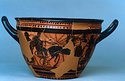
| Black figure skyphos. Side A. Dionysos sitting in a mule cart ... 1 Jun 2000 ... Dionysos sitting in a mule cart. |
Mended from two pieces, broken all around. Head of horse or mule facing right. Rather rounded nose seems mule-like. Mouth of animal open and teeth visible. Short mane. Traces of a figure at the right ... 27 June-5 August 1972 ... Head of horse or mule facing right. Rather rounded nose seems mule-like. Mouth of animal open and teeth visible. |
| Bowl Fragment. Mold Fragment for Head of Mule Figurine. Red Figure Cup Fragment. Stamped Amphora Handle: Knidian ... Φ-6 1120, 1121 G 554 T 3558 Φ 974 P 26164 SS 14317 G 554 T 3558 P 26164 SS 14317 ... 24 April 1957 ... Mold Fragment for Head of Mule Figurine |
| Plastic Lamp (?): Grotesque Head. Well. Stamped Amphora Handle: Unidentified. Lamp. Type 20. Relief Plaque: Herakles on a Mule ... ΠΠ-2 306, 307 L 4329 SS 10206 L 4330 T 2466 I 10:1 L 4329 SS 10206 L 4330 T 2466 ... 31 July 1947 ... Relief Plaque: Herakles on a Mule |
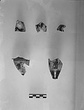
| Five fragments from rim and wall.
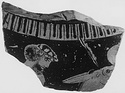
a) At left, head and forequarters of a rearing mule, right; then a satyr, looking towards the mule; at right, part of the handle palmette, and the start of the handle ... 2 June 1938 ... a) At left, head and forequarters of a rearing mule, right; then a satyr, looking towards the mule; at right, part of the handle palmette, and the start of the handle.
b) At left, half of the handle palmette, then the arm, tail and legs of a satyr running right; at extreme right, end of a satyr's tail.
c) Part of rim and one handle.
d) A satyr's upraised hand.
e) The legs of an animal, probably the mule of fragment a).
|
Eight joining fragments from upper part of body and edge of shoulder. Shoulder: lotus buds. Top of body: dots. Body: Hephaistos on a mule preceded and followed by a maenad. Branches in field. Green earth ... 21-31 March 1932 ... Body: Hephaistos on a mule preceded and followed by a maenad. |
| First interpretation: Top-knot of hair from a large figurine (?)
Grooved object, bound round the middle with a string, and broken off below.
ADDENDA: C. Grandjouan: Pack (wood, vegetables?) for animal, ... Publication: ca. 375 B.C ... for animal, donkey or mule.
Chronology: ca. 375 B.C. |
Wall fragment, broken all around.
Woman on mule to right.
White for flesh; red for stripes on her cloak and on animal's mane.
Clay grayish; perhaps burned. North Extension of Stoa, east edge, layer V, ... 2 July 1954 ... Woman on mule to right.
White for flesh; red for stripes on her cloak and on animal's mane.
|
| Open shape. Two joining fragments preserve hindquarters of ithyphallic mule on which a figure is riding. Return of Hephaistos? Only feet of Hephaistos and some of leg preserved. Careful incision. Fragment ... 24 May-9 June 1954 ... Two joining fragments preserve hindquarters of ithyphallic mule on which a figure is riding. |
Philippicus ... Restruck.
1st striking:
There are certainly traces of restriking but types cannot be determined. Either this is a mule, the I type not having taken over the K of Justinian II or else it is a K denomination ... 711-713 A.D ... Either this is a mule, the I type not having taken over the K of Justinian II or else it is a K denomination of Philippicus. |
| Shoulder fragment, preserving start of neck.
Tongues below neck. Head and one shoulder of Hephaistos(?) right, riding a mule (ears, back of head and neck preserved). Ivy wreath; shortsleeved garment ... 10 February 1956 ... right, riding a mule (ears, back of head and neck preserved). |
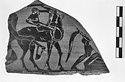
| Fragment a) preserves more than half the shoulder, with linked buds below a band of dots and part of the wall. Upper border, dotted zigzag. Scene depicts Dionysos seated between two youths on donkeys ... August-September 1932 ... Preserved is most of the figure of Dionysos, seated right, and the heads of a mule and of a youth approaching him from the right. Fragment b) presumably to be placed to the left of a), preserves the hind legs and part of the body of a second mule, right. Incision; added red for details; delicate tendrils in field.
|
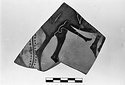
| Amphora fragment mended from two pieces. Slightly convex.
Front part of donkey or mule to right; nostril, teeth and jawbone incised; white of eye reserved. Upper left, pendent spiral; below, row of open ... May 1952 ... Front part of donkey or mule to right; nostril, teeth and jawbone incised; white of eye reserved. |
| Identical in fabric and from similar, if not same amphora, are part of neck and rim with handle attachment and a toe; rim flares slightly with very sharp lip and is set off from neck by a deep groove ... 15-26 May 1937 ... Circular stamp; a bearded, draped figure, his right arm outstretched, rides, reclining, on back of a mule to right. A dotted circle surrounds the whole. ... bearde draped figure, his r. arm outstreched, rides reclining
on back of a mule to r
(in O) |
Shoulder fragment with start of neck. Grainy glaze on inside. Max. dim. 0.10.
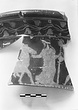
Return of Hephaistos. The fragment shows the slightly bowed head of Hephaistos (with ivy wreath) and the upper part of the ... Ca. 440 B.C ... The fragment shows the slightly bowed head of Hephaistos (with ivy wreath) and the upper part of the head and neck of his mule or donkey. Above, tongue pattern at junction of neck. |
| Fragment from the neck of a large krater, preserving part of a Dionysiac revel. In the middle a naked rider on an ithyphallic mule, right. On either side, a satyr and a maenad struggling. Red for the rider's ... 20 June 1938 ... In the middle a naked rider on an ithyphallic mule, right. On either side, a satyr and a maenad struggling. |
| Part of the lip and upper wall remains, mended from several pieces. The lip band is decorated by a garland of ivy, the side wall by two zones of figures separated by a band of ovules. Of the upper zone ... 4 March 1935 ... riding right on a mule, holding a kantharos behind him; Dionysos(?) leading the mule with his right hand, carrying a kantharos and thyrsos in his left; the right leg of a figure moving right.
|
The base preserved; more than half the lip, and the handle; much missing from the walls; nothing of the shoulder remains. Tall shape with trefoil mouth (Type V). Broad foot, flat beneath, slightly rounded ... 19-23 March 1936 ... Scene: a female figure (white foot and hand preserved) riding, right, on a mule. In front of the animal, a satyr kneeling on one knee (running?) |
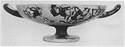
| (Initially) a single fragment broken all around, preserves part of the stem and central medallion of a kylix. A discus-thrower, holding the discus in front of him with both hands. Sketchily drawn with ... 5 March 1935 ... In the center, a figure riding on a mule, right; before and behind him, a dancing satyr. |
| Human foreparts. Hunter. Iolaos. Iris. Pantheress. Funeral Games for Patroklos. Javelin thrower. Judge. Pegasos. Judgment of Paris. Jumper. Funeral Games for Pelias. Peleus: seizing Thetis. Kerberos. Chorus ... Agora 23 361 ... Mule |
Four non-joining wall fragments. Glaze brownish and streaky on inside and stops 0.08 from top break on fragment a. Max. dim. a) 0.119, b) 0.069, c) 0.091, f) 0.04.
Men or youths with horse or mule. Fragment ... Ca. 490 B.C ... Men or youths with horse or mule. Fragment a preserves the hind legs of the animal to right and a bit of the reserved ground line. |
| Lion guarding fountain. Menodoros. Lions, beneath throne. Menon. Livia. Metalworkers. Logistai. Meter. Logisteria. Metichos or Metiochos. Lokros. Meton. Lollianos. Metragyrtes. Long Rocks. Metronomoi ... Agora 3 254 ... Mule, given public maintenance |
| Graffiti. Metal working, influence on pottery. Brann S 17-18. Brann R 22. Young pp. 225f. Miniature painting. Grinders, list of. Mourning women. Handmade pots. Mule. Heads, plastic. Mycenaean revival ... Agora 8 133 ... Mule |
Two non-joining fragments, P 5107 with rim and body, P 44 of wall. Reserved line on side at rim; another 0.06 below rim. Glaze misfired greenish and reddish in places. P.H. P 5107: 0.127; est. diam. at ... Ca. 430 B.C ... What appears to be an object between the face of Hephaistos and the top of his mule's head are the ears of the mule, the inside covered with glaze that fired red, like the strip on the mane and the stripe across the shoulder. ... For the seated Hera combined with the procession of Hephaistos on a donkey or a mule accompanied by Dionysos, see Halm-Tisserant, AK 29, 1986, pp. 20--22; LIMC IV, p. 638; also, Froning, Dithyrambos, pp. 67--71, as it applies to the volute-krater in Ferrara attributed to Polion: 3033 = T.127 (ARV2 1171, 1; Paralip. 459, 1; Addenda 338).
|
|
|
.jpg.icon.jpg)
.jpg.icon.jpg)


.png.icon.jpg)
.png.icon.jpg)
.png.icon.jpg)