|
|
Coins:
27 May 1936 #1-#2 ... 25-27 May 1936 ... Layer II |
Estimated Grid ... Early 3rd c. A.D ... Layer II |
Accumulated filling over Bouleuterion Plateia, Layer II. Coins:
8 May 1935 #1 ... 1st or 2nd c. A.D ... Accumulated filling over Bouleuterion Plateia, Layer II. |
Nbp. 3104: When dug, the fill of the well divided itself into 3 deposits.
Objects catalogued from the "earth" are: L 4838, P 21602, P 21603, P 21604. Dumped filling of Turkish times. Coins:
17 May 1937 ... Late 6th-7th c. A.D ... 1=Layer I ... 2=Layer II |
Nbpp. 3104-3105: Represents well deposit; the [baskets] from this layer showed no stratification. Containers marked "earth" presumably represent primarily Layer II.
... it is presumed that the sherds of ... Late 6th-7th c ... Nbpp. 3104-3105: Represents well deposit; the [baskets] from this layer showed no stratification. Containers marked "earth" presumably represent primarily Layer II.
... it is presumed that the sherds of Layer III, not differing appreciably from the heavy well deposit above were put into the well deposit container. |
| Classical Building II, Layer 7B ... 1st c. A.D ... Classical Building II, Layer 7B. |
Nbp. 3104: Container includes a miscellaneous accumulation of Greek and Roman pottery with some fragments of Byzantine brown glaze. No joins were observed between this layer and Layer II ... 16-24 May 1937 ... No joins were observed between this layer and Layer II. |
Backfill of demolition of Great Monument beneath Middle Stoa.
[Soft pit below Layer II of south aisle (=fill of early "Great Drain")] ... Early 4th c. B.C ... [Soft pit below Layer II of south aisle (=fill of early "Great Drain")] |
Crosscut between Middle stoa Piers 1 and 2 from west (south aisle), layer II.
Chiefly late 5th to mid-4th c. B.C. Coins:
2 July 1965 #1 ... Late 5th to mid-4th c. B.C ... Crosscut between Middle stoa Piers 1 and 2 from west (south aisle), layer II.
Chiefly late 5th to mid-4th c. |
Accumulated fillings in the Bouleutrion Plateia beginning in late 5th c. B.C. and continuing into the 3rd c. A.D., reaching a depth of 0.20-0.30m. (Hesp. 6 (1937), p. 168. Subdivisions:
.1=Layer I
.2=Layer ... 5th c. B.C.-3rd c. A.D ... Subdivisions:
.1=Layer I
.2=Layer II
.3=Layer III
.4=Scraping Bedrock |
| Laura Gawlinski ... Well in courtyard of Early Building I, adjacent to wall of Room B. Tile lined; upper course in situ, lower two collapsed probably in antiquity. Letters inscribed on rims (eta, phi, omicron, theta). Medium ... First quarter of the 4th c. B.C ... Well contained three main dumped fills: a slightly later fill perhaps for leveling after filling settled (Layer I and perhaps Layer II), a fill with ceramic and some stones (Layer III and perhaps Layer II), and a fill with large stones, tiles, and collapsed well lining (Layer IV).
Layer I 58.03-57.40m., softer brownish fill
Layer II 57.40-57.16m., sandier fill with streaks of charcoal
Layer III 57.16-56.24m, similar to Layer II, increase of stones and tiles
Layer III/IV 56.24-56.07m., transition between fill of Layer III and Layer IV
Layer IV 56.07-54.94m., fill primarily consisting of large stones, tiles, and collapsed well lining (little soil or ceramic) |
| Includes finds from layer II and III of cistern passage. Coins:
1 April 1937 #1 (east end of passage)
14 April 1937 #2-#8
15 April 1937 #1-#7
16 April 1937 #1 ... Second half 1st c. A.D ... Includes finds from layer II and III of cistern passage. |
| Shallow pit below layer I in Stoa Shop VI (Pyre)
Diameter 0.90; D. 0.15m Under shop VI of the Stoa of Attalos Pottery, ash, burning and packing of small stones in pit in stratum. The pyre was covered by ... Ca. 350 or 325 B.C. ? ... The pyre was covered by layer I (Lot ΣΑ 495) and was visible in the surface of layer II, into which it had been dug. Layer II in turn covered a cobbled surface flush with a water channel. ... The pyre must date at least as late as layer II, and probably not too much later. |
N-S Cut on 50m. line (area of Road, area of Stoa, area N of Stoa) various levels and dates over the three areas.
Investigations to the northwest of the market square in the area of the road running out ... Prehistoric to Roman ... A.D.
Layer II: 1st-2nd c. ... A.D.
Layer II: 1st c. A.D. (?)
... Area North of Stoa:
Layer I: early Roman
Layer II: late 3rd-early 4th c. |
Includes finds from layer II and III of cistern passage. Coins:
1 April 1937 #1 (east end of passage)
8 April 1937 #8-#10
9 April 1937 #4
10 April 1937 #1-#4
12 April 1937 #1
13 April 1937 #4 ... Late 1st-early 2nd c. A.D ... Includes finds from layer II and III of cistern passage. |
Evidence of stratification into five layers, although joins between the layers. Layer VI added when the construction of the Roman building above required it. No subdivisions assigned.
Flask-shaped cistern ... Early 3rd-late 2nd c. B.C ... Layer II: dug bedrock with no objects. ... Layer III: fine red earth. It was put in to fill the cistern immediately after Layer II, and having settled, was later supplemented with layers IV and V, in close succession. |
Lower fill:
See Deposit G-I 11-12, where the finds are again listed.
Dug as Tholos Trench A, Layer VI, no finds.
Dug as Tholos Trench C, Layer IV+Va, A 756, A 757, P 10507.
Dug as Tholos Trench N, Layer ... 6th c. B.C ... Dug as Tholos Trench A, Layer VI, no finds.
... Dug as Tholos Trench N, Layer III, no finds.
... Dug as Tholos Trench N, Layer II, no finds. |
| Laura Gawlinski ... Circular pit uncovered in Early Building II, south of Room E latrine, adjacent to the preserved latrine floor surface. Continues beneath the latrine surface and the western scarp (unexcavated). Fill relatively ... Late 5th c. B.C ... Circular pit uncovered in Early Building II, south of Room E latrine, adjacent to the preserved latrine floor surface. ... Layer II 58.02-57.65m, softer filling streaked with ash and small bones.
Layer II 57.61-57.45m, large tiles and substantial fragments of amphora.
|
May be of Hellenistic origin when cistern system went out of use.
For a general note on the cistern see Nb. ΟΕ III, pp. 246 ff.
Objects from B 586 various depths (no subdivision): S 2324-S 2330,
P 34894, ... Late 2nd-early 6th c. A.D ... Subdivisions:
.1=Layer VIII
.2=Layer VII
.3=Layer VI
.4=Layer V
.5=Layer IV
.6=Layer III
.7=Layer II
.8=Layer I
Estimated Grid |
Stroses I, II, III, IV in Court J (below marble chip layer), House of Greek Mosaic.
No independently datable objects. Estimated Grid ... Early 3rd c. B.C ... Stroses I, II, III, IV in Court J (below marble chip layer), House of Greek Mosaic.
|
N-S Cut on 20m. line (area of Road, area of Stoa, area N of Stoa)
various levels and dates over the three areas.
Investigations to the northwest of the market square in the area of the road that bordered ... Protogeometric to Late Roman ... A.D.
Layer V: "Augustan"
Layer VI: chiefly 4th c. ... Area of Stoa:
Layer I: Early Roman
Layer II: Hellenistic
Layer III: 1st c. ... B.C.
Layer V: 8th-7th c. |
| Mycenaean Double Grave (Graves A and B).
Grave A was in Layer II. We laid a skull and a few other bones, three vases and a stone bead. We have dug to a maximum of about 0.06m below the top of Layer II ... Myc. IIIA/B ... Grave A was in Layer II. We laid a skull and a few other bones, three vases and a stone bead. We have dug to a maximum of about 0.06m below the top of Layer II. It contained two skeletons.
|
Roman Group L.
Layer I (cont. 59-64) Pre-Herulian second half of 3rd c. (bottom, 15.95-13.90).
Layer II (cont. 42-58) 4th c.-first quarter of 4th c. (11.90-13.90).
Layer III (cont. 17-41) -4th c. (10.00 ... Second half 3rd c.-early 5th c. A.D ... Roman Group L.
Layer I (cont. 59-64) Pre-Herulian second half of 3rd c. (bottom, 15.95-13.90).
Layer II (cont. 42-58) 4th c ... Layer IV (cont. 1-16) nearly 5th c. |
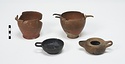
| A compact group of four complete vases and a lamp, found on a house floor; possibly the remains of a sacrificial pyre but without evidence of burning or the characteristic votive vases.
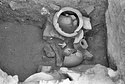
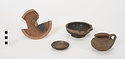
Layer II, "nest ... 425-400 B.C ... A compact group of four complete vases and a lamp, found on a house floor; possibly the remains of a sacrificial pyre but without evidence of burning or the characteristic votive vases.
Layer II, "nest of small pots" in SE corner. ... See also P 17211 (ΞΞ 171) from Layer II but not from the nest of pots. |
Within the precinct of the Hephaisteion, about 10m. north of the north stylobate of the temple.
Flask-shaped pit (W. (bottom) 3.14 x 2.73m) probably originally intended as a cistern; used for dumping ... Ca. 375-310 B.C.-Byzantine ... At 1.60m. a layer of stones, also containing some pottery, had been dumped in over the furnace waste. ... Subdivisions:
.1=Layer I, top (Mid-late Byzantine)
.2=Layer II of stones
.3=Layer III, bottom |
| Eugene Vanderpool Homer A. Thompson ... Mycenaean Tomb to NW of Pier 19 (Burial 7).
The chamber was roughly square in shape (2.70m wide by 2.10m deep), oriented northeast to southwest across in transverse axis. The entrance was at the northwest ... Myc. II-IIIA:1 |
Investigations in Room to N of Tholos, various layers and periods. ... 470 B.C.-post-Herulian reuse ... Layer VI-X.2 Repairs at the end of 5th c. or early 4th c. B.C.
Layer V.3 Second period; reconstruction in third quarter of 4th c. ... Layers I and II. Fourth Period. |
| David Scahill ... Below packed clay floors in Room 2 of Classical Building II; bordered on east and south sides by polygonal cross wall and back wall extension for Classical Building. Late Roman wall and drain installation ... LHIII A:1 ... Below packed clay floors in Room 2 of Classical Building II; bordered on east and south sides by polygonal cross wall and back wall extension for Classical Building. ... Loose fill of stones and earth with large number of Geometric sherds ranging from Protogeometric to late Geometric in date, from top of cutting extending down into layer of tomb contents. |
| Laura Gawlinski ... Fill excavated south and west of Early Building Ii, Room E latrine, with a high concentration of votive material, such as pyre saucers, miniature loom weights, and ribbon handled plates. Some traces of ... 400-350 B.C ... Fill excavated south and west of Early Building Ii, Room E latrine, with a high concentration of votive material, such as pyre saucers, miniature loom weights, and ribbon handled plates. ... A bowl containing pigment was found in the same layer. |
Dug as Metroon Porch Pit A and Pit C (layers II and III). ... 7th-6th c. B.C ... Dug as Metroon Porch Pit A and Pit C (layers II and III). ... In the lowest layer the dug bedrock was mixed with viscous red earth. |
| Laura Gawlinski ... Ovoid pit cut into bedrock or sterile fill just north of preserved floor surfaces in the so-called Strategeion. Length (west-east) 2.6m; widens at 1.25m from the east scarp so that at west pit is 0.75m ... 4th B.C ... Therefore, it seems that both whole and fragmentary amphorae were dumped here.
Layer I: 57.59-56.99m.
Layer II: 56.99-56.78m.
|
| Rodney S. Young ... Grave 20 (E.L. Smithson: Grave X: PG). Bones discarded. Pit tomb, inhumation (on bier or in coffin?), perhaps of a child. Little ash and carbon in the filling, but the grave offerings were unburned.
JP ... Developed Protogeometric |
| Well cut into bedrock, associated with late Roman building G in ΕΛ 1.2m in diameter, narrows to 0.5m at bottom. Disturbed by later pits at top. Excavated from 85.77-79.25m (6.52m), but bedrock at 85.91m ... Late 4th/early 5th AD ... Upper portion originally lined; collapsed lining found in Layer V. Six layers of dumped fills and one period of use fill. ... Layers:
I. (85.77-84.94m) mixed rocky fill.
II. (84.94-83.92m) dark fill with tiles.
|
| Well cut into bedrock under late Roman building in ΕΛ. 1.2m in diameter with small cutting of unclear function at south edge about 0.2m wide. Walls cut straight down, tapering near bottom to 0.8m. Footholds ... Late Archaic ... Layers:
Hellenistic fill under Roman floors
I.(86.34-85.93m) rubble
II.(85.93-85.58m) dark brown rubble
III.(85.57-85.30m) more stony rubble
IV.(85.30-84.80m) very rocky, almost sterile, increase of clay and sand
V.(84.80-84.03m) less rocks, almost sterile, increase of clay and sand
Late 6th/early 5th B.C dumped fills
VI.(84.03-82.64m) mix of clay and sand deposits, dog skulls
VII.(82.64-81.79m) mostly sand
VIII.(81.79-81.39m) light brownish-grey clay, almost sterile
IX.(80.39-80.99m) mix of grey clay, brown clay and sand, much ceramic
X.(80.99-80.24m) sandy, more ceramic
XI.(80.19-77.74m) sandy, enormous stones (some 100kg+). A "contamination layer" was excavated after layer X because heavy rains refilled the well.
|
|
|