|
|
http://agathe.gr/overview/the_altar_of_zeus_and_statue_of_hadrian.html The Altar of Zeus The Agora Excavations began with the aim of revealing the monuments and history of the ancient Agora. Of course, every artifact or feature that was exposed held importance, but when something ... The Altar of Zeus The Agora Excavations began with the aim of revealing the monuments and history of the ancient Agora. ... View of the orthostate block (A 404) of the Altar of Zeus Agoraios Nb. ... Ε III, pp. 503–507). The altar was later identified as the Altar of Zeus Agoraios, an important ancient monument believed to have been erected first on the Pnyx in the 4th century B.C. and later dismantled and re-erected at the turn of the millenium in its present location. |
http://agathe.gr/democracy/tyranny.html Tyranny As happened in many other Greek states, a tyrant arose in Athens in the 6th century B.C. His name was Peisistratos, and after several unsuccessful attempts he seized power in 546 B.C. and ruled ... Model of the Altar of the Twelve Gods. ... The altar was famous in antiquity as a place of asylum and refuge. No traces remain of the altar itself, but excavation has revealed a foundation of squared blocks supporting a low sill of limestone blocks with the marks of a stone fence on the upper surface which formed the altar enclosure. |
http://agathe.gr/guide/history_of_the_agora.html History of the Agora The excavations of the Athenian Agora have uncovered about thirty acres on the sloping ground northwest of the Acropolis (Fig. 3). Material of all periods from the Late Neolithic to ... (Herodotos 1.153) A gradual change from private to public land seems to have occurred during the middle of the 6th century, and the first certain public buildings or monuments (Southeast Fountain House [15], Altar of the Twelve Gods [2]) were erected in the 520s, during the tyranny of the Peisistratids. The creation of the new democracy in 508/7 B.C. led to the construction of the Old Bouleuterion on the site of the later Metroon [8], the setting of boundary stones [10], and, perhaps, the construction of the Royal Stoa [27]. ... The Stoa Poikile [28], Tholos [6], New Bouleuterion [7], Stoa of Zeus Eleutherios [3], South Stoa I [14], Mint [16], and Lawcourts [23] were all added to the periphery of the great square, as were fountain houses, temples, and shops. |
| Temple of Ares. Step Block, Modern Foundation. Step Blocks, Late Foundation in Northwest Corner. Marble Lion's Head; Loose Upper Fill South of Railway. Exhedra in Front of Stoa of Zeus. Clearing. Section ... Η'-12 2251, 2252 A 146 A 215 A 248 A 249 A 272 A 2522 ... Exhedra in Front of Stoa of Zeus ... Monument Bases in Front of Middle Part of Stoa of Zeus ... Later Altar of Zeus |
| Athens ... Sv. 92.5, 6; NCP, BB:iii Coin no. 8.
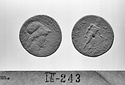
Casts stored in Lab Case No. 52E Cut 6, late disturbed fill. Transitional bust of Athena r.; border of dots. AθHNAI-Ω-N Zeus stg., nude, to r., holding thunderbolt ... ca. 120's--140's or later after Christ |
| Monument to SOuth of Later Altar of Zeus. General Note. Monument Bases Between South Wing of Stoa and Great Drain. Early Poros Geison. Monument Bases to East of Great Drain. Large Base at 21/ΛΣΤ, Plan ... Η'-12 2253, 2254 A 759 ... 1933 ... Monument to SOuth of Later Altar of Zeus ... Monument Bases to East of Great Drain ... Removal of Section of Foundation to Explore South Side of 12 Gods |
|
|
.jpg.icon.jpg)
.jpg.icon.jpg)