|
|
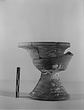
| Fragments of rim and body missing; one fragment does not join. Open bowl with flaring sides and rim; high conical foot.
Brownish clay; dull green surface over which a white slip, now much flaked. Traces ... 3rd. c. A.D ... Incense Burner |
| Incense burner ... AMS Horizontal (normal) ... Incense burner. |
Rim missing all around, and most of the foot, but full profile of stem and foot preserved. Restored in plaster. Flange at the join of bowl and stem. Moulded foot, flat resting surface.
White slip over ... 4 June 1951 ... Incense Burner |
Fragment from the center of a slightly domed lid with attachments for small loop handle. Lid pierced with holes.
Gritty reddish-brown clay; unglazed. Well 15, late Mycenaean. 1746 ff. Leica ... 28 March-3 April 1939 ... Incense Burner Lid Fragment |
| Mold. Jug Fragment. Cistern at 13/Δ. Incense Burner. Jug ... ΠΠ-4 736, 737 B 852 P 19496 P 19497 ΠΠ 534 P 19380 P 19498 B 852 P 19496 P 19497 P 19498 ... 1948 ... Incense Burner |
| Loom Weight. Stamped Amphora Handle: Unidentified. Saucer on Stand (Incense Burner?) ... ΝΝ-24 4668, 4669 MC 696 SS 10036 P 17917 ΝΝ 2902 MC 696 SS 10036 P 17917 ... 6 Jun 1947 ... Saucer on Stand (Incense Burner?) |
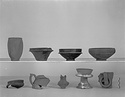
| Bowls, beaker, incense burner and various fragments from Roman group H ... AMS Horizontal (normal) ... Bowls, beaker, incense burner and various fragments from Roman group H. |
| Miniature Kantharos. Black Glaze Skyphos Fragment. Miniature Altar or Incense Burner. Lamp ... Χ-2 330, 331 P 9350 T 1365 P 9351 MC 326 L 2804 Lot Χ 21 P 9350 P 9351 MC 326 L 2804 ... 10 March 1937 ... Miniature Altar or Incense Burner |
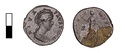
| Faustina I ... Σηστέρτιο: Φαυστείνα Ι 138 161 μ.Χ. Coin no. 7. DIVA FAVSTINA
Bust of Faustina r., draped. Border of dots. AETE-R-NIT[AS]
Pietas standing l., raising r. hand and hox of incense. In field l. and r., S [C] ... 138-161 A.D ... AETE-R-NIT[AS]
Pietas standing l., raising r. hand and hox of incense. In field l. and r., S [C]. |
Broken above and below.
Small tapering stand for a lamp or an incense burner (?) broken over half way up by a large bead.
Pinkish buff clay; the bead black; horizontal bands of black glaze around the ... 3 June 1938 ... Small tapering stand for a lamp or an incense burner (?) broken over half way up by a large bead.
|
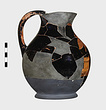
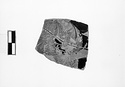
| From the wall of a round-bodied oinochoe; glazed to neck inside, thinned, and brown below. Three joining fragments preserve the figure of Nike, standing to left, and bending to sprinkle incense on a small ... 9, 11 May 1939 ... Three joining fragments preserve the figure of Nike, standing to left, and bending to sprinkle incense on a small altar. ... Inscribed in added color diagonally across the field above Nike's head:
to right of figure above:
below:
Also in faded color are the altar flames and the grain of incense which she holds in her right hand. |
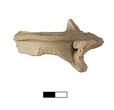
From wall or floor of an open pot; outside are preserved the ends of two lug-like attachments set parallel and close together.
Gritty pinkish clay, gray at core; mottled burnished slip inside and out, ... 24-26 April 1937 ... ADDENDA Matson suggests lugs are really part of base, as Neolithic incense burners (SAI Jul. 1964). |
Inscribed fragment.
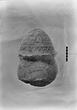
Broken below and behind. Rather more than half the incense bowl at the top is preserved.
Decoration at top corners missing. At left edge of die, part of a garland in relief. An iron ... 27 May 1959 ... Rather more than half the incense bowl at the top is preserved.
|
| Large end broken all around. Small end has joint surface with anathyrosis at back. A round hole in small end 0.05m. from joint surface contains remains of iron pin.
The omphalos-shaped small end curves ... February 1954 ... Addenda: Represent incense burner/plemochoe with penetrated lid.
|
| One side of body with a little of rim; foot almost all lost. Another element once attached to flange and rim on one side; only the clay attachment preserved. Slightly burnt patches and reamains of a white ... 5-9 March 1936 ... (An elaboration of the normal local Early Roman 'incense burner'.)
Light yellowish-brown clay. |
Common 5th century type. Others from the Agora are P 2362 R 13:4 Hesperia, IV, 1935, p. 515, fig. 27, 82; J.H.S., LXXXII, 1962, pl. V, 3, right; P 11015 B 15:1 Hesperia, XVIII, 1949, pp. 335-6, 99; P 21695 ... Context ca. 460-440 B.C ... The miniature P 11016 B 15:1 Hesperia, XVIII, 1949, pl. 97, 100 was perhaps an incense burner; see the fine-ware versions, 1359-1363, Pl. 44. |
| Preserved are upper right corner (BE 103) and joining section to lower left (BE 61). Broken diagonally above, at left side, and below.
Votive relief with simple fillet and ovolo molding above. Narrow frame ... Late 5th c. B.C. (410-400 B.C. ?) ... The vase compares to late fifth century thurible or incense burners.
White marble with small crystals, probably Pentelic.
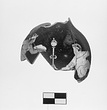
... VII) identify the scene depicted as Aphrodite descending a ladder, carrying an incense burner. The scenes on the vases have sometimes been connected with the cult of Aphrodite and Adonis (cf. |
| Ionian alphabet. Ionian influence. Incense. Javelin. Jewelry. Goal post. Kalos name. Gorgoneion. Kamiros. Kantharos. Kerameikos. Graffito. Kithara. Geometric. Grave marker. Krater. Greaves. Krobylos. Glaze: ... Agora 23 365 ... Incense |
| From a fairly thin-walled vase, but large; unglazed on the inside. Represented is a draped woman, facing half right. Her right arm is held out in front of her. Above the hand is the corner of an object ... 21 February 1934 ... Above the hand is the corner of an object with a ring (incense burner?). Relief contours; the drapery done in fine swirling relief lines. |
| Five joining fragments of body preserve most of figured scene; base, neck, handle and wall at back missing. A naked boy (amulet string, bracelet, fillet with leaves) brings a large white cake on a plate ... 2-24 May 1939 ... Relief contours for the boy, and the incense burner. An ivy wreath was painted around the neck. |
Mended from many fragments with the missing pieces restored in plaster, notably about half of the mouth, lower half of body in back, and all of foot. Glaze abraded on handle. Rest. H. 0.187; rest. diam ... Ca. 490-480 B.C ... The goddess, dressed in a long chiton with a himation over it, a stephane on her head, bends over to left, sprinkling incense on a flaming altar from a box held in her left hand. |
P 17703 a, b, c
Three sections preserve over half of foot and part of lower wall (a), part of rim (b), and about one-fourth of lid (c). Burning on edge of rim.
Flat underside. Projecting molding at bottom, ... 4th century ... Bottom of bowl for incense not preserved; bowl must have been very deep. |
| The Neolithic and Bronze Ages; Index; Kraters Mycenaean. The Neolithic and Bronze Ages; Index; Kraters Mycenaean; In Funerary Ritual. The Neolithic and Bronze Ages; Index; Mellink Machteld. The Neolithic ... Agora 13 280 ... The Neolithic and Bronze Ages; Index; Naxos; Cycladic Incense Burners |
|
|
.jpg.icon.jpg)
.jpg.icon.jpg)
.jpg.icon.jpg)

.png.icon.jpg)
.png.icon.jpg)