|
|
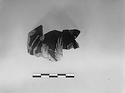
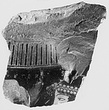
| Five joining fragments preserve parts of three figures: at left, draped female figure (chiton) holding torch; in center, Dionysos, seated, facing left, wearing an elaborately ornamented garment with long ... 27 April 1940 ... Hayashi (1992), p. 165, no. 141. |
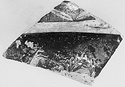
| From a bell krater; part of the rim and side wall just below. On the rim an olive wreath with red figured leaves, the berries white with yellow over. Below, head of a youth with flying hair, seen facing, ... 18 May-4 June 1937 ... Hayashi (1992), p. 161, no. 125. |
| Pausanias, 1.14.1-4. Pausanias, 1.38.6-7. Pliny, NH 18.65. Sutton, 1984, pp. 145-148. Richardson, 1974, pp. 194-196. Raubitschek and Raubitschek, 1982. Sfameni Gasparro, 1986, pp. 155-169. Schwarz, 1987, ... Agora 31 49 ... Hayashi, 1992 ... Hayashi, 1992, p. 19 |
| Plato, Ap. 41A. Cicero, Tusc., 1.41. Schwarz, 1987, pp. 57, 160-163. N. Spivey, Greek Vases in Etruria, in Looking at Greek Vases, T. Rasmussen and N. Spivey, eds., Cambridge 1991, pp. 131-150, p. 266 ... Agora 31 55 ... Shapiro, rev. of Hayashi, Gnomon 67 [1995], pp. 88-89 ... Hayashi, 1992, pp. 69-70 ... Hayashi, 1992, pp. 70-73, 86-87 |
| a) From the shoulder of a large volute krater of heavy fabric. Tongue pattern around base of neck. The upper part of a garlanded male head, left; in front, the flame of a torch added in red. Letters in ... 14 April 1939 ... Hayashi (1992), p. 142, no. 59. |
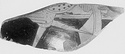
| Wall fragment from bell krater. Part of the wheel and floor of a chariot to the right, with the feet and the bottom of the drapery of the occupant. Part of a shield(?) in the chariot, and of a wing(?) ... 7 June 1938 ... Hayashi (1992), p. 136, no. 37, pl. 5:1 (wrongly called a calyx-krater). |
| Day, 1980, pp. 15-38. Schwarz, 1987. Sutton, 1984, p. 146. Raubitschek and Raubitschek, 1992, p. 111. M. Sakurai and A.E. Raubitschek, The Eleusinian Spondai (IG I³ 6, lines 8-47) in Studies Mylonas, 2, ... Agora 31 54 ... Raubitschek and Raubitschek, 1992, p. 111 ... Hayashi, 1992, pp. 73-87 ... Hayashi, 1992, pp. 126-174 |
| 6th Century Houses on the Middle Terrace. Mylonas, 1961, pp. 77-105. Travlos, 1988, s.v. Eleusis, pp. 91-102. Hayashi, 1992, pp. 19-29. Stähler, 1972. Stähler, 1978. Stewart, 1990, pp. 129-130. Childs ... Agora 31 28 ... Hayashi, 1992, pp. 19-29 |
| Statuary for the Temple. Pausanias, 1.14.1,4. Pausanias, 1.14.4. IG I² 78. Arnobius, Adv. Nat. 6.6. Clement of Alexandria, Protr. 3.45. Agora 3, nos. 194, 195. Pausanias, 1.5.2, 27.4. Eschbach, 1986, esp ... Agora 31 52 P 10960 ... Hayashi, 1992, pp. 74-75, no. 125 on p. 161 |
| Pausanias, 1.14.4. Triptolemos on Athenian Paintings. Triptolemos on Athenian Paintings; Athenian Vase Painting. Plato, Lg. 1.642D-E. RE 6, 1 (1907), s.v. Epimenides (O. Kern). H.A. Shapiro, Oracle-Mongers ... Agora 31 53 ... Hayashi, 1992 ... Williams, The Brygos Tomb Reassembled and the 19th-Century Commerce in Capuan Antiquities, AJA 96, 1992, pp. 617-636 |
| D. Buitron-Oliver, Douris: A Master-Painter of Athenian Red Figure Vases [Kerameus 9], Mainz 1995. L. Burn, The Meidias Painter, Oxford 1987. D. Callipolitis-Feytmans, Les plats attiques à figures noires ... Agora 30 xiv ... Ridgway, Godess and Polis: The Panathenaic Festival in Ancient Athens, Princeton 1992 ... T. Hayashi, Bedeutung und Wandel des Triptolemosbildes: Religionshistorische und typologische Untersuchungen [Beitrage zur Archäologie 20], Würzburg 1992 ... Oakley, Debris from a Public Dining Place in the Athenian Agora [Hesperia Supplement XXXV], Princeton 1992 |
| Craft, F. 1974. Eleusis und die orphische Dichtung Athens in vorhellenistischer Zeit, Berlin. Graindor, P. 1927. Athènes sous Auguste, Cairo. Graindor, P. 1930. Un milliardaire antique: Hérode Atticus ... Agora 31 xiv ... Habicht, C. 1992. Athens and the Ptolemies, CIAnt 11, pp. 68-80 ... Hamilton, R. 1992. Choes and Anthesteria, Ann Arbor ... Hayashi, T. 1992. Bedeutung und Wandel des Triptolemosbildes vom 6.-4 Jrh. v. |
|
|
.png.icon.jpg)
.png.icon.jpg)
.png.icon.jpg)
.png.icon.jpg)
.png.icon.jpg)
.png.icon.jpg)
.png.icon.jpg)
.png.icon.jpg)