|
|
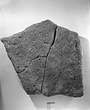
| In three joining pieces. Rough trapezoid of river conglomerate, probably an older grave marker broken and reused in door packing. Stoa Terrace Chamber Tomb; removed from the door packing. Leica, 84-434 ... 13 August 1965 ... Rough trapezoid of river conglomerate, probably an older grave marker broken and reused in door packing. |
| Inscribed fragment of stele.
Right edge missing. Broken below and at right and left along flaws.
Right side of a large stele with pedimental top. Text at top. Vacat below of ca. 0.105m. down to raised ... 1 April 1971 ... Grave Marker Fragment |
| Horos Stone. Grave Marker Fragment. Stamped Amphora Handle: Knidian ... Ω-12 2340, 2341 I 7265 I 7266 SS 14731 I 7265 I 7266 SS 14731 ... 2 April 1971 ... Grave Marker Fragment |
| Tomb with Coffins. Conglomerate grave marker removed from the top door packing. Deposit N 12:4 ... (chamber tomb) ... ca. 1965 ... Conglomerate grave marker removed from the top door packing. |
| Tomb with Coffins. Conglomerate grave marker removed from the top door packing. Deposit N 12:4 ... (chamber tomb) Horizontal (normal) ... ca. 1965 ... Conglomerate grave marker removed from the top door packing. |
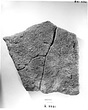
Inscribed fragment.
Battered and very worn. Roughly full width and thickness preserved. Broken below and perhaps above.
In appearance, rather like a grave marker.
Four lines of the inscription preserved ... 5 June 1971 ... In appearance, rather like a grave marker.
Four lines of the inscription preserved.
|
| Grave 14 in notebook.
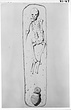
Length of shaft 2.12m; width 0.46m; depth from cover 0.60m. Man's skeleton stretched NE-SW with head at NE. Offering at foot of shaft, with the skyphos in the mouth of the pitcher ... 750-725 B.C ... Grave 14 in notebook.
... On the NE edge of the cover slabs was a small flat stone, perhaps to support a grave marker. |
| Grave at 102/M, from southeast (from approximately same angle as upper photo of stones - grave marker - p. 115). 1= Grave. 2= Late Roman water channel. 3= Continuation of Fills II and III under channel ... AMS Horizontal (normal) ... Grave at 102/M, from southeast (from approximately same angle as upper photo of stones - grave marker - p. 115). 1= Grave. 2= Late Roman water channel. 3= Continuation of Fills II and III under channel. |
| Marcie Handler ... Cist grave for two infants. The grave was cut into a sterile rocky layer on its southern and western sides, and a sterile fill layer on its northern and eastern sides. No obvious grave marker was present, ... Early Iron Age ... Cist grave for two infants. ... No obvious grave marker was present, although three flat stones arranged at the northern end of the grave were documented in the layer immediately above the grave (Lot ΒΖ 2281), and these stones may have been part of the disturbed covering for the grave. ... Within the lining, the length of the grave was 0.820 m. |
| Ionian alphabet. Ionian influence. Incense. Javelin. Jewelry. Goal post. Kalos name. Gorgoneion. Kamiros. Kantharos. Kerameikos. Graffito. Kithara. Geometric. Grave marker. Krater. Greaves. Krobylos. Glaze: ... Agora 23 365 ... Grave marker |
| Mycenaean Tomb to NE of Pier 19 (Burial #1)
Most of the doorway and the dromos had been cut away by the ancient Stoa builders. The dimensions of the chamber were 2.90m wide by 1.60m deep. Unusual features ... Myc. III A:1 ... Unusual features of the tomb were a small recess in the back or south wall, in which stood the askos, and a rough stone slab which was found on the floor near the center of the east side, but which may once have been a grave marker at ground level.
|
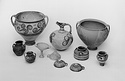
| Three-Handled Jar. Hesperia, 35, 1966, pp. 76-77, pl. 24, d. Furumark, M.P., p. 60, fig. 16. Ch.T., pl. XVI, 28. Kylix. Hesperia, 35, 1966, p. 77, pl. 24, e. Furumark, M.P., pp. 22-23, figs. 3-4. Furumark, ... Agora 13 246 P 27454 P 27458 P 27456 ST 734 A 3521 P 27457 ... Mycenaean III A ... Grave Marker |
| Mycenaean Chamber Tomb below Middle Stoa Terrace.
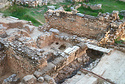
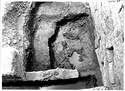
The tomb was entered from the west by a stepped dromos, at least 4.20m long by 1.10 to 1.50m. wide, splaying slightly toward the doorway, which was 1.26m ... Myc. IIIA:1 ... The doorway was found blocked with a stone packing, which included near its top a broken conglomerate grave marker, and which proved to have been erected at least three times; during one of the occasions of reopening, the doorway was widened 0.20m to the north. |
|
|
.jpg.icon.jpg)
.png.icon.jpg)
.png.icon.jpg)