|
|
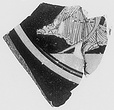
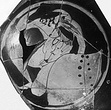
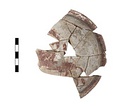
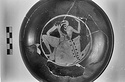
Chariot wheel. In exergue, ivy. C.H.M Nb. No 17
Pit E 71 ... 3 Mar 1934 ... Chariot wheel. In exergue, ivy. |
Mended with small missing pieces restored in plaster and painted. Glaze fired greenish on inside. H. 0.062; diam. at rim 0.17. H. A. Thompson, Hesperia 16, 1947, pl. 47:4, 5.
I, kantharos; small reserved ... Probably late 5th century B.C ... I, kantharos; small reserved exergue. On outside, frieze of ivy with berries. On underside of floor, kantharos; reserved exergue. |
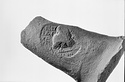
Fragment of discus.
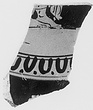
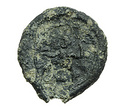
Lion seated right; in the exergue a row of vertical grooves.
Thin purplish-red wash.
Pink clay.
Type XXVIII of Corinth collection. In modern wall. Leica ... 12 April 1932 ... Lion seated right; in the exergue a row of vertical grooves.
|
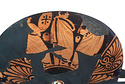
Obverse: at right, Herakles, left, sitting on a rock. At left a tripod.
Exergue with some symbol.
Cf. IL 450.
Reverse: plain. With coins for the day, nos. 1-77. Leica ... 27 May 1936 ... At left a tripod.
Exergue with some symbol.
|
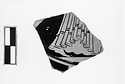
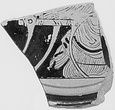
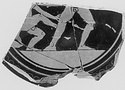
Floor fragment. Max. dim. 0.049; est. outer diam. of tondo 0.12.
I, male (feet, a bit of himation) standing to right. Below, part of reserved exergue. Around tondo, egg pattern with dots ... Probably third quarter of the 5th century B.C ... Below, part of reserved exergue. Around tondo, egg pattern with dots. |
Floor fragment with ring base. Concentric circles and bands on underside. Max. dim. 0.095.
I, woman (lower part of chiton and himation, feet) standing frontally. Below, reserved exergue. Reserved line ... Probably third quarter of the 5th century B.C ... Below, reserved exergue. Reserved line for tondo border. |
| From floor of stemless cup; nothing of foot preserved. Draped female figure from below knees down, seated on a chair. She wears sandals. Plain exergue. Reserved border. Pair of narrow reserved bands beneath ... 9 May 1940 ... Plain exergue. Reserved border. |
Most of the top of lid, a little of the side preserved. Rim around medallion molded; groove around inside of rim. Glazed on underside. Est. diam. 0.055; max. dim. 0.059.
On top side of lid, head of Phrygian ... Early 4th century B.C ... Below, in exergue, egg pattern. |
| Broken all around; from floor of cup with part of medallion.
Feet of a draped male figure to right, with lower edge of himation, and one falling end. Reserved exergue. Egg and dot border. No relief contour ... 11 May 1953 ... Reserved exergue. Egg and dot border. |
Floor fragment with start of stem. Much of the glaze fired grayish. A lot of the surface worn. Max. dim. 0.068.
I, satyr (head, most of arms missing) moving to right, body frontal.
Below, start of reserved ... Ca. 430-420 B.C ... Below, start of reserved exergue. On outside, part of reserved line below figures. |
| Mended from six pieces. Only bit of simple rim preserved (lower right). Depicts dolphins below feet. Ground line of feet is a chord to the circle; dolphin in the exergue. Behind the feet a piece of flying ... June 1932 ... Ground line of feet is a chord to the circle; dolphin in the exergue. Behind the feet a piece of flying drapery(?). |
| Obverse: at right nude Herakles sitting left on a rock. At left a tripod from which a snake arises. Other indistinct devices. Plain exergue.
All within border of dots.
Reverse: plain. With coins for the ... 28 May 1936 ... Plain exergue.
All within border of dots.
|
| Three joining fragments preserve part of floor, wall and ring base. Interior: lower parts of three women; added white for flesh. Exterior: black, with slight ridge reserved. In exergue: dolphin. No incision ... (May 1960) ... Exterior: black, with slight ridge reserved. In exergue: dolphin. No incision. |
| Obverse : Helios, rising, in his chariot.
His figure standing front, facing left, is seen between the two middle horses, galloping right and left respectively. In his left hand the reins, in his right ... 2 April 1935 ... Plain exergue.
Reverse : Selene, driving her two weary horses* left.
... In the field a star, in the exergue another.
* these animals may be panthers; cf. |
| Mended from many pieces; a small part of the rim preserved, all the medallion, and a little more than half the base. The handles missing. Inside, within an irregular reserved circle, a satyr looking right, ... August-September 1932 ... Beneath the wine-skin, a small exergue, reserved. Relief contours; dilute glaze for inner drawing. The imitation inscription in the exergue black. Outside, two scratched grooves just above the heavy foot. |
Much missing from rim and floor. Plain rim; torus foot; handles set well down. Nude youth left bending with outstretched arms; halteres in his hands? In front of him a goal post? Wide exergue; plain reserved ... April-June 1936 ... In front of him a goal post? Wide exergue; plain reserved border. |
| From center; low, slightly spreading foot, flat resting surface.
The exergue of the medallion only is preserved with a panther walking left. From the main picture a tiny piece, possibly toes or paws of ... 26 February 1953 ... From center; low, slightly spreading foot, flat resting surface.
The exergue of the medallion only is preserved with a panther walking left. |
| Owl right; inscription in field and in exergue. Msc: prob from jar dated in the term of =ERATIDAS=? andr,
=ARISTAINOS=? andr* In late mixed fill. Ἐπ owl ὶ Δ̣[α]
ιδά stand- λ̣[ο]
υ̣ Ε ing ὐ̣β̣[ο] ... 3 April 1935 ... Owl right; inscription in field and in exergue. |
Over half of the discus is preserved, and a bit of the rim near the nozzle.
At the left, standing on the exergue, is a soldier facing front but thrusting riht with his spear. He seems clad in a short chiton ... 7 June 1933 ... At the left, standing on the exergue, is a soldier facing front but thrusting riht with his spear. |
| Fragment from the medallion; single line border; reserved exergue. Preserved is part of the lower drapery and one foot of a woman moving to right. She wears a chiton which falls in broad pleated folds ... 2 March 1938 ... Fragment from the medallion; single line border; reserved exergue. Preserved is part of the lower drapery and one foot of a woman moving to right. |
| Piece from floor with part of very low base ring and trace of start of wall or rim preserved. The lower part of a seated woman facing right, part of chair and drapery (chiton and bordered himation) only ... 11 May 1938 ... Reserved exergue. Partial relief contour. |
Lip and bowl fragment with ring base. H. 0.042; est. diam. at rim 0.145; diam. of base 0.077; est. diam. of tondo 0.11.
I, jumper (head, most of arms missing) about to take off to left from a standing ... Ca. 420 B.C ... Below, reserved exergue. Reserved line for tondo border. |
| Lip fragment. Mended from four pieces. The feet and tails (accessory red on two) of three frontal horses preserved, also the lower part of two frontal wheels. Dolphins depicted are perhaps in an exergue ... June 1932 ... Dolphins depicted are perhaps in an exergue. Below them a narrow band of glaze lines the simple rim. |
| Fragment of floor and foot; mended from 5 pieces. Moulded ring foot; underside: three concentric moulded circles, black glazed, surrounding central reserved disk with dot and two painted concentric circles ... 1 November 1955 ... Medallion: two male figures dancing, large plain exergue. Border: two narrow reserved lines, surrounded by incised tongues.
|
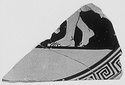
Floor fragment. Max. dim. 0.067; est. outer diam. of tondo 0.13.
I, man or youth (lower part of legs) to left with streamers or ribbons (a little bit on either side: ends of a fillet[?]). Below, reserved ... Ca. 400 B.C ... Below, reserved exergue. Around tondo: stopped-maeander pattern. ... The drawing is similar, as is the maeander pattern around the tondo and the rather large reserved exergue. |
Floor fragment. Concentric bands and circles on underside of floor. Max. dim. 0.03; est. outer diam. of tondo 0.09. Burn, Meidias Painter, p. 118, cat. no. MM 148.
Woman (lower part of chiton, sandaled ... Ca. 410-400 B.C ... Below, reserved exergue. From the position of her feet, her left leg was crossed over the right. |
| From the floor. On inside, part of maeander border and the lower legs of a figure facing left. Large plain exergue. Streamers, once white, in the field. On outside, feet of two figures facing left, and ... 16-19 March 1935 ... Large plain exergue. Streamers, once white, in the field. |
Floor fragment. Max. dim. 0.086; est. outer diam. of tondo 0.164.
I, maenad (lower drapery, feet) to left, wearing a long chiton. Behind her, an uncertain object that looks like a stone or a tympanon ... Second quarter of the 4th century B.C ... Below, a little of the reserved exergue. Around the tondo, trapped maeander pattern, each unit separated by two vertical strokes. |
Floor fragment with molded ring base. On underside of floor band and circle. Max. dim. 0.121; est. outer diam. of tondo 0.108; diam. of base 0.083.
I, youth (lower legs and feet, end of cloak) at laver ... Ca. 430-420 B.C ... Small reserved exergue. Two concentric circles for tondo border.
|
Four joining fragments, making up into about one-third of the whole. A deep plate with flat floor; wall in a single curve; lip marked off by a groove. Low base ring. In the medallion, a cloaked woman facing ... 2 May 1939 ... In the exergue, an ivy spray; on the wall inside, a band of looped buds.
|
| Fragmentary shield. Part of the right side and center of the shield preserved, with remains of arm strap on back.
High convex shape with sharply offset rim. Remains of winged horse with rider (?) left: ... 31 March 1932 ... left: horse and margin in red, rider, exergue and part of backround blue. |
Part of foot and adjoining floor preserved. Interior: female figure, preserved from hips to feet, seated facing right on a stool with legs in form of horse's legs. She wears an ankle-length garment. White, ... 31 May 1933 ... Uncertain object in exergue. No incision. |
| Four non-joining fragments; none of the stem preserved.
a) Part of the medallion, with maeander and checkerboard border; within, part of a winged creature griffin? Outside, three cloaked youths.
b) From ... 8 April 1936 ... b) From the other side of the cup, preserves inside, border, and part of exergue; outside a cloaked figure, left, with handle palmette.
|
Floor fragment, strengthened with plaster. Max. dim. 0.124; outer diam. of tondo 0.10.
I, Nike (most of arms, front of body missing) to right, dressed in a peplos, arms outstretched. Reserved exergue ... Late 5th century B.C ... Reserved exergue. Two reserved lines for tondo border. |
Floor fragment. Max. dim. 0.075; est. diam. of tondo 0.09.
I, figure (drapery) reclining to left. In the glazed exergue below the couch, part of an imitation inscription:
Reserved line for tondo border ... Ca. 510-500 B.C ... In the glazed exergue below the couch, part of an imitation inscription:
Reserved line for tondo border. |
Floor fragment with a little of molded ring base. Completely glazed on underside except for a small reserved medallion in the center that is decorated with two concentric circles and central dot. Three ... Ca. 430 B.C ... Below, reserved exergue. Around the tondo, two reserved lines and an incised tongue pattern. |
I. Youthful satyr dancing left, looking back right. Fillet at the level of his brow. To the right, the white foot of a small-scale figure (Eros). Exergue with wave pattern.
Black outlines, not relief ... 27 February 1931 ... To the right, the white foot of a small-scale figure (Eros). Exergue with wave pattern.
|
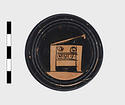
| Intact when found; lid broken by a visitor, but mended complete except for chips.
Small pyxis with molded foot and inset lip. Resting surface and top of lip preserved.
Single letter scratched on bottom ... 27 April 1954 ... On the lid is represented a chest seen from one end, with its lid partly open; ornament of egg pattern and circles; exergue reserved.
Scratched before glazing on underside of lid:
Good firm glaze. |
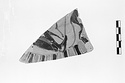
| Fragment from the floor preserving part of a groove and tiny part of the foot.
Around tondo, tongue pattern alternately red and black. Lower part of a draped figure right. Leg of someone lunging(?) to ... July 1947 ... In the exergue, dog right. |
| Mended from many pieces; a small part of the rim preserved, most of the medallion (bits missing from the satyr's face and right leg and from the border), and most of the foot. The handles missing.
Similar ... August-September 1932 ... Similar to P 3576: the medallion border very irregular; the satyr's right hand raised; no exergue. Two scraped grooves above the top of the foot; reserved, the outer edge of the foot, the resting surface and the top of the stem inside.
|
|
|