|
|
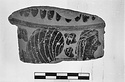
| The original side edges of the foot are preserved, with a small part of the body of the base above. The foot itself is broken off at about half its height. A small groove between foot and vase, on the ... May 1933 ... ABV, p. 21, no. 3 (Painter of Eleusis 767). |
Flat bottom; high, flaring upper wall; one vertical band handle (missing but restored correctly as indicated by handle attachments), and one horizontal rolled handle.
Inside all glazed except for a reserved ... LG II ... Cf., C.V.A., Cambridge 1[6], 1 [239], 16; Δελτ. 28, 1973, Μελ., pl. 10, α,β 9 (with lids) ; unpublished examples include one from Merenda on display in the Brauron Museum and another from Eleusis in the Eleusis Museum |
Fragment preserving part of bottom and of sides.
Glazed inside and out.
Type common in the later Geometric graves at Eleusis: cf. P 1654. From selected sherds found within or under apsidal house floor; ... 21 November 1932 ... Type common in the later Geometric graves at Eleusis: cf. P 1654. |
Legs and lower half of wings of Eros flying to right; he wears soft leather shoes; the lower left part of a sash which he is holding. Between his legs and wings a dotted rosette.
No relief contour.
Compare ... Compare p 121, Agora p. 18995, Eleusis lid and deningrad II (CR. 1881, Pl. 3) |
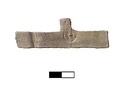
| Twenty-one long, narrow, flat, rectangular strips, twelve with a tab at the side, (one bent over), nine slightly shorter, without tabs.
All stamped at the middle with a small circular stamp: a kernos, ... 14 May 1937 ... All stamped at the middle with a small circular stamp: a kernos, from which protrude two ears of wheat, within a wreath: coin type of Eleusis. |
| Obverse: a lidded biconical vase (kernos ?) with a vertical branch on either side, through the handles.
Reverse: plain.
Cf. Money of Eleusis issued in name of Athens, cf. Svoronos (1923), pl. 104, no ... 22 February 1938 ... Money of Eleusis issued in name of Athens, cf. |
Inscribed fragment.
Inscribed face, left face, and rough picked back preserved.
Treasure record from Eleusis.
Seven lines of the inscription preserved; stoichedon.
Left edge worn away so first letters ... 5th. century B.C ... Treasure record from Eleusis.
Seven lines of the inscription preserved; stoichedon.
|
| Neck and handle mended from several fragments. Flat bottom; squat body; trefoil lip.
On neck, maeander panel, bordered by two stripes on bottom and one on top; striped handle; the rest of the vase glazed ... 6 May 1932 ... A simple example of the type of oinochoe common in Isis grave at Eleusis (CVA Athens, 1, 1.3). |
| Two joining fragments.
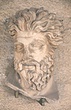
a) Lower part of neck with spring of shoulder from a bearded creature with head turned to his right. Good work; surface of marble comparatively fresh. Note spring of background on ... August 1946, 5 July 1949 ... a) From marble pile between Odeion and Giants. b) Reported to have been found in the region of the Frankish Tower at Eleusis, in excavations conducted by D. ... Transferred from Eleusis Museum (inv. no. 72) to Agora Museum 5 July 1949. |
Floor and rim fragment. Brownish black glaze on underside. Max. dim. 0.047. Wehgartner, Attisch weissgrundige Keramik, p. 152, cat. no. 5.
Toes of right foot of figure facing right. In background:
Around ... Ca. 500 B.C ... The same pattern occurs on a fragmentary red-figured plate by Oltos found at Eleusis (ARV2 67, 138; Addenda 166); also on a white-ground plate by Douris, where it serves as the ground line for the figures and is more carefully drawn than it is on 1213: London, B.M. |
| Mended from many fragments; one loose bit preserved. Nearly all of lip, half of body and top of handle missing. Shallow incurving body with slightly flaring lip; one horizontal handle preserved; bottom ... 18 April 1932 ... Simple Geometric style of type found in the Isis grave in Eleusis (CVA Athens, pl. 6:6). |
| Left end, rough-picked back and bottom preserved. Only the lower legs of the figures are preserved.
At extreme left, a draped standing figure, facing; next to her a shield, its inner side exposed; this ... 1937 ... ADDENDA An assembly of the Gods at Eleusis? |
| Three women bringing presents, one from the left carrying a plemochoe; and another from the right, bringing a large box and plemochoe. At the lower left corner, part of an uncertain object, ornamented ... 15 January 1931 ... By the same hand: 1) did Eleusis, 2) did, Compte Reudus 1881, pl. |
Two non-joining lip fragments, offset on the inside, both with start of bowl. Reserved line at rim. Max. dim. a) 0.045, b) 0.03.
Fragment a preserves most of the head and shoulders of a woman, her hair ... Ca. 500 B.C ... Close to the Eleusis Painter but weaker (ARV2 one 210, ---; ARV2 315, ---). |
| Four horses with driver figurine.
Forelegs missing; mended from many fragments.
The driver leans against the long hind legs of the central horses and rests his hands on their backs. The driver stands on ... 31 March 1932 ... See also JdI 14 (1899), p. 122, fig. 26, for similar pieces found in Eleusis, on Athenian Akropolis and at Menidi. |
| Part of handle missing. General type as P 24316 (ΣΑ 2526): This is the characteristic general type for the large proportion of the lekythoi from this group. Bell mouth with variations in height and spread; ... May-June 1954 ... Univ. pl. 6,11) attributed to Class of Athens 581; also on one at Eleusis (photo J.T.). |
Wall fragment from rather low on the vase. Max. dim. 0.093.
Triptolemos (segment of wheel and wing of throne) to right. Relief contour. Rim of wheel incised (compass-drawn). Dilute glaze: decoration at ... Second quarter of the 5th century B.C ... Dugas ("La mission de Triptolème d'apres l'imagerie athénienne," Melanges Rome 62, 1950, pp. 9--31 [reprinted in Recueil Charles Dugas, Paris 1960, pp. 123--139]) recognized three categories of this theme in Greek art: (1) Demeter giving instructions to Triptolemos, often with Kore present; (2) Triptolemos about to set off on his mission and a libation being poured; (3) Triptolemos and the Eleusinian divinities following his return to Eleusis. The first is known only in black figure from about 540 on; the second, in Late Archaic and Early Classical red figure; the third, in Classical and later. 229 is probably the second. |
Shoulder fragment with part of ring at junction with neck. Max. dim. 0.095.
Woman (head with hair tied up with fillets) to left before a loutrophoros-hydria (mouth, start of vertical handle, top of neck) ... Ca. 450 B.C ... GR 1931.1--14.3 by the Washing Painter (ARV2 1127, 9); Eleusis 635 by the Painter of the Naples Hydriskai (ARV2 1266, 1); Athens, N.M. 12540, near the Eretria Painter (ARV2 1256, 11; Oakley and Sinos, Wedding . . . |
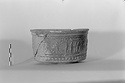
| A small fragment from the side and a chip from the rim are missing. The bowl has an offset rim, flat, with two mouldings below: one wide, one narrow. Between two raised ridges under the main zone is a ... 13 May 1933 ... Courby (1922), Vases Grecs a Reliefs, p. 440 ff. describes the same scene as represented on two bowls, BM G96 and a similar vase in Eleusis, and calls it "scenes from rural life", believing that the figure in the car cannot by Dionysos, that the small statue is Priapus, and the attendant figures are bucolic, not satyrs and maenads. |
|
|