|
|
Nozzle and part of rim preserved.
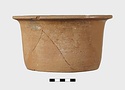
Blunt, short nozzle. Double groove around narrow, convex rim. Curving sides.
Clay: fine soft reddish; red-black glaze (much worn) all over. Assembly Place, filling of ... 1932 ... (No description on the book). |
| Intact, but some corrosion.
Description before cleaning.
Inner face appears to be smooth; the outer cut by a deep incision so that it looks like two narrow rounded rings superimposed.
Missing (Winter 1976) ... 15 June 1967 ... Intact, but some corrosion.
Description before cleaning.
|
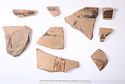
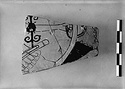
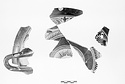
| Fragment of a krater, buff clay. Brown gray glaze decoration: rim - reserved triangle filled with concentric half circles.
Cf. Belonging with AP 2592, AP 2593, AP 2658, AP 2657.
See AP 2658 for complete ... 8 June 1938 ... See AP 2658 for complete description. |
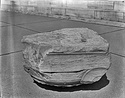
Top, bottom, front and right end preserved. Top rough-picked, as in South Stoa steps; bottom worn; front weathered. Right end has anathyrosis, picked back 0.007m. deep.
Stoa Poikile series.
Poros.
ADDENDA ... April 1949 ... ADDENDA This description does not correspond with the block numbered A 1740. |
| From a krater, brown on buff.
Cf. Belongs with AP 2592, AP 2594, AP 2593, AP 2658. See AP 2658 for complete description. C.f. slip of paper in the back of notebook Oscar Broneer, Nb. No. 5. (V). Finished ... 21 May 1937; 12, 13 June 1937; 6 April 1938 ... See AP 2658 for complete description. |
Eggs and flower
Provenience: East terrace behind retaining wall
Date:1932-4 NB pp. 677, 738
Description: max. diam. 0.035
Part of the rim occupied by a band of egg and dart and a 5-petalled rosette below ... Eggs and flower
Provenience: East terrace behind retaining wall
Date:1932-4 NB pp. 677, 738
Description: max. diam. 0.035
Part of the rim occupied by a band of egg and dart and a 5-petalled rosette below a bounding line of beading
Clay: Yellowish, buff
Glaze: Red glaze, much worn inside and out |
| For detailed description see H. A. Thompson's article in ArchEph (1953-1954), pp. 30-44.
Cf. A 41 for fragments of kithara. Catalogued 1961. Found in 1907 ca. 20.00m. south of Temple of Apollo Patroos ... 1907 ... For detailed description see H. A. |
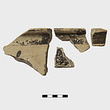
| Fragment of krater, buff clay.
Gray brown glazed decoration: rim - reserved triangle filled with series of diminishing chevrons.
ADDENDA Inventory 6 December 2017.
2 body sherds (one joining with rim, ... 13-15 April 1938 ... See AP 2658 for complete description. |
| Fragment of a krater, buff clay.
Gray brown glaze decoration: rim - reserved triangles filled with a series of diminishing chevrons.
ADDENDA 2020: Two single fragments added. A wall fragment with scar ... 21 May 1937; 12, 13 June 1937; 6 April 1938 ... See AP 2658 for complete description. |
| Full height and main mass of corner capital preserved, much damaged all around. Of the volutes only about half of one and a small bit of another preserved.
Pentelic marble.
Same series as A 1130 (ΙΙ 514) ... 15 June 1951 ... ADDENDA Detailed description and measurements by Bakalakis in ÖJh XXXVI, p. 60. |
Moulded decor: Herakles riding bull
Provenience: East stoa, NE corner, Layer II
Date:1934 NB pp. 606-607, 740
Description: max. diam. 0.109
Bowl of the lower wall preserved; Herakles riding a bull, a ... 1934 ... Moulded decor: Herakles riding bull
Provenience: East stoa, NE corner, Layer II
Date:1934 NB pp. 606-607, 740
Description: max. diam. 0.109
Bowl of the lower wall preserved; Herakles riding a bull, a lead springs from the edge below.
|
[No description on card]
ADDENDA 2018: Three non-joining sherds to a stirrup jar. No features are preserved.
The exterior decoration consists of medium bands flanking registers of isolated semicircles ... LH IIIC Middle ... [No description on card]
ADDENDA 2018: Three non-joining sherds to a stirrup jar. |
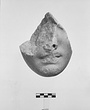
| Lower portion of female face.
Chin, mouth, nostrils, left cheek and part of left eye preserved.
The head is of a woman, life-size. The eyes are quite gone, the nose too battered for description. The ... 5 July 1937 ... The eyes are quite gone, the nose too battered for description. The lips are also worn away, and the chin, which is round and full, slightly abraded. |
Lid. Part of the glaze abraded on side. Thin brownish glaze on underside. Diam. 0.07; H. 0.012.
On top side, head, neck, and upper part of chest of panther. At the right, a thyrsos; at the left, two concentric ... Probably late 5th century B.C ... I know this piece only from the photograph and the description on the Agora record card; the dipinto is traced from the facsimile on the card. |
| Fragment of discus.
Plain rim, panelled with herringbone and impressed circles.
On discus, figure of Eros advancing to the right but looking back at an object held in the right hand; in his left hand is ... 17 July 1931 ... Corinth IV, ii, no. 1124: quoted from description, of which L 176 appears to be a cruder version; no. 1132: is a fragment like L 176, but less well preserved.
|
Upper part.
Tall-necked jug; round mouth with lightly collared rim, double-rolled handle from below rim. Neck set off from sloping shoulder by light ridge; around shoulder, at line of lower handle-attachment, ... Context ca. 520-490 B.C ... Close in profile and in general appearance, the early archaic jug from Antissa on Mytilene, B.S.A., XXXII, 1931-32, pl. 21, 12; the description of the Antissa fabric and surfaces also corresponds. |
Chip missing from top.
A: cart and horse right, seated figure (Dionysos ?) in cart, with large thyrsos (?) in front of figure.
Dots below ground line may have been letters.
Surface bad and details far ... 24 May 1951 ... The coin envelope read 1941, but no entry under that date; and description fits the 1951 date exactly. |
Wall fragment, slightly flaring. Glaze cracked a bit on outside.
Scratch at lower right. Max. dim. 0.064.
Lower part of draped forearm and hand of figure, perhaps a child, either frontal or standing ... Probably late 5th century B.C ... The description of 284 on the Agora record card suggests that the hand is that of a child and restores the inscription to read: θυμε'λη . |
Nearly a quarter of the circumference is preserved. Athena 's figure is broken away at the waist and only the head and the right shoulder of the man are preserved.
The edge of the mold curves up like ... 25 May 1933 ... (This description is of the plaster impression). |
| From a sizable open vase, glazed inside, rather dull.
a) At left a warrior whose cuirass flaps hang over a shaded body; his sword sheath projects to the right. The inside of the shield of another warrior, ... 21-24 February 1936 ... ADDENDA a) Description wrong here; see publications.
|
| Amended description in light of new fragments.
Total of 16 fragments, now preserving almost complete skyphos. Flat disk base preserving string marks. Rim slightly flaring, with plain rounded lip; horizontal ... 27 June 1952 ... Amended description in light of new fragments.
|
| Fragment a) preserves more than half the shoulder, with linked buds below a band of dots and part of the wall. Upper border, dotted zigzag. Scene depicts Dionysos seated between two youths on donkeys ... August-September 1932 ... ADDENDA The description in the manuscript inventory, which refers to "two youths on donkeys" and a patch of glue on the upper edge of fragment b) make it seem probable that something has been lost here. |
Plate.
Fragment of rim.
Large plate with rolled rim. Beginning of lug or handle at left edge of fragment. Hard, light gray fabric (5Y 7/1) containing abundant fine sand and a few larger black and red ... Late Roman context ... The description of Glazed Ware A, imported to Antioch in the 2nd and 1st centuries (Antioch IV, i, p. 80), fits these pieces; for the shape cf. ibid., pl. |
| Parts of rim and nearly a quarter of wall missing; restored in plaster.
A cylindrical drum, tapering around top. Heavy rim, flat on top and sharply profiled; lower wall thickened to form heavy collar ... 28 May-16 June 1938 ... ADDENDA
Fuller description of A 957 and A 958, with references. ... For the description of the chimney-pot, see A 958. |
Fragment of trefoil mouth, handle, neck, and start of body. Mended and strengthened with plaster. A small non-joining fragment with thin, streaky glaze on the inside also belongs. P.H. a) 0.12; Max. dim ... Ca. 470-460 B.C ... Three others by this painter also have palmettes, both at the top of the handle and at its root, but I know them only from van Hoorn's description (Choes and Anthesteria, p. 125, sub 497 and 499: London, B.M. 96.6--21.2 [ ARV2 871, 92]; Copenhagen, Thor. 109 [ ARV2 871, 93]; Cab. |
| Part of rim preserved.
Rhodian clay and slip.
An almost square stamp on the shoulder of the handle.
Joins with SS 3811 giving both handles of jar. This group (SS 3784-87; SS 3790-3813; SS 3901; P 5524-5536) ... 17 April 1935 ... Msc: see folder ROM : PEACOCK for VG comment of vii--viii.78,
on stps on smpled hdls(VG)*
Cxt: for deposit at 63/=ND=, there is a detailed description on
separate file card* |
Mended from four pieces. Fragment form lower part of picture, with a little of the maeander band below.
Lower part of a woman seated left. She wears a bordered peplos with long overfold and holds a string ... 12, 18 December 1930 ... Description entered from Hesperia Suppl. 10, original entry on card was crossed. |
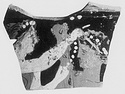
| Fragment from upper wall of bell krater; bit of reserved band below rim preserved. Parts of two figures remain, a youth, left, holding a large club and a woman facing him. He wears a white fillet and white ... 10 March 1939 ... ADDENDA New description, including additional fragments.
|
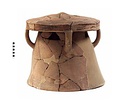
| Lid and about a quarter to a third of stand preserved; restored in plaster.
This curious object consists of an umbrella-like cover, with a wide vertical rim which overhangs the bluntly conical stand attached ... 28 May-16 June 1938 ... ADDENDA
Fuller description of A 957 and A 958, with references (by A.W. ... For the description of the wellhead, see A 957. |
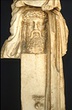
| A herm used as support for the left arm of la large statue carrying a child.
Upper half of the child is missing as well as the entire statue, whose left arm rests on the head of the herm. The base of ... 2nd c. A.D ... Cf. the description of the Herm of Alkamenes in Richter (1929) , Sculpture and Sculptors of the Greeks, p. 236, fig. 628 (p. 182, fig. 673 in the 4th edition 1970): "The style of the herm is evidently archaistic, the formal treatment of the hair and beard being conditioned by its architectonic character, for the rendering of the eyes places it in the second half of the fifth century." |
| Four fragments preserve parts of the wall and shoulder and the base of a round-bodied, narrow-necked jug with ring foot. No join between wall and base fragments. On b) the lower handle attachment. Decoration ... 29 March 1939 ... ADDENDA Joining fragment added from tin 115 in 1952, serves to unite frags. b) and c).
Description added by JWH in Sept. 2007:
Large parts of both sides of body (part-mended, now restored); whole of base (connection with body fragments now lost). |
| A large Droop cup, Class III E, cf. JHS 52 (1932), p. 66.
Exterior:
Rim black. Handle zone: palmettes at handles, large eyes toward center, dancing Satyrs in spaces between. Lower part of body: band of ... 2 May 1950
13 July 1950
24 April 1952 ... ADDENDA Description revised after finding of major part of fragments [1952]:
The fragments make up into six groups.
a) Most of one handle, some of rim and part of one handle palmette.
b) Some of rim and handle zone. |
Wall fragment. Glaze dull and misfired reddish here and there on inside and outside; slightly abraded. Max. dim. 0.107. H. A. Thompson, Hesperia 17, 1948, pl. 67:4; Matheson, Polygnotos, p. 354, cat. no ... Ca. 440 B.C ... On Bologna 177, a stamnos by the Agrigento Painter (ARV2 577, 53; Philippaki, Stamnos, pl. 48:3, side A only), Theseus and the Minotaur appear on the obverse, and a man offering a lyre to a youth, accompanied by a male, appears on the reverse, but it is far from certain that the two scenes are connected (Beazley separates his description with a period, not a semicolon, indicating that he considered the two unrelated; see ARV2 p. xlvi). |
Three non-joining wall fragments. Dull, hard glaze on inside. Max. dim. a) 0.091, b) 0.075, c) 0.071. L. Talcott, Hesperia 8, 1939, pp. 268--269, figs. 1, 2 (the fragments have been relettered since this ... Ca. 470-460 B.C ... Talcott, Hesperia 8, 1939, pp. 268--269, figs. 1, 2 (the fragments have been relettered since this publication; in the description below, the old letters are given in parentheses); A. |
Eight non-joining wall fragments, a and b with rim and strengthened with plaster. Band on inside at rim, a narrower one 0.068 below rim. Glaze fired red on inside, slightly misfired below figures on outside ... Ca. 460-450 B.C ... Boulter, Hesperia 22, 1953, pl. 23: there, the sequence of letters begins afresh for each side; to avoid confusion in the description, I include the old letter in parentheses after the new; L. ... Strong (unpublished): Eros flies towards Menelaos, holding a phiale in both hands (ARV2 1056, 93; Ghali-Kahil, p. 95, no. 78 for a description; Matheson, p. 466, cat. no. |
| Several pieces, including chunks from sides and rim, missing. Flat bottom; straight sides; flat-topped projecting rim.
Orange-buff clay. Light slip. Surface much worn.
On side wall, just below rim, a ... 9-12 February 1937 ... ADDENDA Text on an A4 attached to the card; "M.C.'s description of this pot, with refs |
Twelve non-joining fragments of lip and bowl. Fragment f preserves the start of the stem on the underside. Start of handle on fragment i. Reserved line on inside at rim. Max. dim. a) 0.133, b) 0.071, c/g) ... Ca. 450-440 B.C ... The brief description given in LIMC (p. 761, no. 81) is based on the arrangement of the fragments in the composite photograph. |
Ten non-joining fragments, f with start of handle, i part of handle (not illustrated). Max. dim. a) 0.42, b) 0.232, c) 0.239, d) 0.243, e) 0.085, f) 0.10, g) 0.149, h) 0.068, i) 0.057, j) 0.077. P.H. of ... Ca. 440 B.C ... Shefton, Hesperia 31, 1962, pls. 105:a, b, 106: the fragments have been relettered since this publication; for convenience, in the description below, the old letters are given in parentheses; LIMC IV, 1988, pp. 88--89, no. 217, figure at top of p. 89 (drawing), s.v. |
|
|