|
|
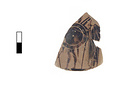
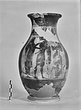
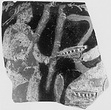
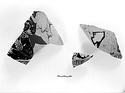
| Red figure bell-krater fragment: departure scene ... AMS Horizontal (normal) ... Red figure bell-krater fragment: departure scene. |
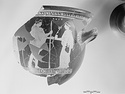
| Red figure bell-krater, three fragments: departure scene (?) ... AMS Horizontal (normal) ... Red figure bell-krater, three fragments: departure scene (?). |
Oakley, John H ... American School of Classical Studies at Athens ... Hesperia 76.2 2 347-357 ... 2007 ... The Departure of the Argonauts on the Dinos Painter's Bell Krater in Gela |
| Red figure cup. Late Severe style. View of the exterior wall: departure of warrior ... Slide set: 9.16 and 9.17 see also other views. Horizontal (normal) ... 1 Jun 2000 ... View of the exterior wall: departure of warrior. |
| Achilleus. Achilleus and Aias Gaming. Athena Polias. Athlete. Aias. Aineas carrying Anchises. Akademos. Akastos. Chimaera. Amazon. Bee. Bellerophon. Cock. Amazonomachy. Bird. Animal, upside down. Animal ... Agora 23 359 ... Antilochos, Departure or Death of ... Departure of Amphiaraos ... Departure |
Wall fragment. Max. dim. 0.046.
Danae (face) and Perseus (wreathed head) to right. Relief contour. White: wreath. Dilute glaze: hair of child.
During his visit to the Agora in the summer of 1953, Beazley ... Ca. 440-430 B.C ... From what remains on 324, one cannot tell if this is the departure from the Argolid or the landing at Seriphos. It is probably the departure, which is much more frequently depicted than the landing. |
Wall fragment with start of rim. Narrow reserved line on inside near top. Glaze somewhat greenish on outside. Max. dim. 0.08.
Departure of youth. A youth (head with pilos, left shoulder with chlamys, ... Ca. 440 B.C ... Max. dim. 0.08.
Departure of youth. A youth (head with pilos, left shoulder with chlamys, left forearm, and hand with spear or staff) stands frontally, head to left. |
| Four joining wall fragments.
Departure of a warrior. Hoplite with shield and spears, draped male at right. Trace of a figure at left. Stand on black glaze groundline. Sloppy incision. Added red: dots ... 3-8 August 1994 ... Four joining wall fragments.
Departure of a warrior. |
Wall fragment with start of rim. Max. dim. 0.061.
Woman (head with stephane) to left. Behind her, the shaft of a staff or spear. Relief contour: nose. Dilute glaze: upper contour of eyelid; accidental ... Ca. 440-430 B.C ... The subject may have been a departure and the composition similar to the one on side A of the painter's pelike in Laon (37.1024), in which a woman stands between two youths in Thracian costume (ARV2 1093, 87). |
Wall fragment. Narrow reserved band on inside near top. Glaze misfired brownish on outside. Max. dim. 0.172.
Departure of youth with horse. The youth (preserved about to hips except for the back of his ... Ca. 430 B.C ... Max. dim. 0.172.
Departure of youth with horse. |
The shoulder preserved and about five-sixths of the circumference of the upper part of the pot. On the shoulder, orange wash with double debased lotus bud pattern. Firm creamy ground below. Upper border ... August-September 1932 ... Figured zone depicts a departure scene, left to right: draped woman, right, holding a whip; a similar figure, right, looking left, holding a lyre; the haunches of two horses; behind the horses, the head and shoulders of Dionysos, left. |
Wall fragment. Glaze cracked in places. Reserved line on inside. Max. dim. 0.13. Oakley, Phiale Painter, p. 79, cat. no. 78, pl. 62:c.
Departure of warrior. On the right stands a woman (most of head with ... Ca. 430 B.C ... Oakley, Phiale Painter, p. 79, cat. no. 78, pl. 62:c.
Departure of warrior. |
| Mended from many fragments; missing pieces from neck and upper part of body including upper right corner of panel, part of base and of body just above base.
Departure scene of soldier in full armour, ... August-September 1932 ... Mended from many fragments; missing pieces from neck and upper part of body including upper right corner of panel, part of base and of body just above base.
Departure scene of soldier in full armour, spear in hand, helmet lowered, face right between two women who look toward him with veils held back. |
Wall fragment from lower part. P.H. 0.209; P.W. 0.155.
Warriors (part of legs of each): lower part of short chiton and round shield (seen in three-quarter view) of left, part of chlamys of right, who ... Ca. 400 B.C ... It, like 90, represents the departure of a warrior for battle. |
About half preserved, including a segment of the rim and all of one handle. Narrow reserved band on inside of rim; another 0.046 below rim. Glaze fired greenish on outside. P.H. 0.20; est. diam. of rim ... Ca. 440-430 B.C ... P.H. 0.20; est. diam. of rim 0.30.
A, departure of warrior (illustrated). |
Mended with missing pieces restored in plaster and painted, notably all of handle B/A, the foot, and about half of the rim. Narrow reserved band on inside at rim; another 0.053 below rim. Glaze cracked ... Ca. 430 B.C ... Holloway, Hesperia 35, 1966, pl. 27:b (Side A).
A, departure of warrior (illustrated). |
| Two non-joining fragments from a skyphos, giving parts of rim and walls. Triptolemos' departure.
a) Most of the central part of the scene is preserved. On the right, lower half of Triptolemos in the chariot, ... 31 May 1951 ... Triptolemos' departure.
a) Most of the central part of the scene is preserved. |
Wall fragment. Max. dim. 0.12. Schwarz, Triptolemos, p. 37, cat. no. V 49, pl. 8:14; Hayashi, Triptolemosbildes, p. 136, cat. no. 37, pl. 5:1 (wrongly called a calyx-krater); Langridge, "Eucharides Painter," ... Ca. 490-480 B.C ... Of the three episodes in this myth recognized by Dugas, 289 probably depicted the second, the departure for the mission where Triptolemos sits on the throne flanked by Demeter and Kore, one of whom pours a libation into his phiale. |
Four non-joining fragments, a -- c of shoulder, d of neck. Glaze misfired slightly on tongue pattern on fragment a. From a very large krater. Max. dim. a) 0.127, b) 0.15, c) 0.089, d) 0.093. G. Schwarz, ... Ca. 460 B.C ... Of the three categories of this theme recognized by Dugas (Mélanges Rome 62, 1950, pp. 9--31, reprinted in Recueil Charles Dugas, Paris 1960, pp. 123--139), the scene on 238 belongs in the second category (the departure for the mission) and is one of six by the Altamura Painter. |
| Repaired from many fragments; both handles, about two-thirds of the rim and a bit of the base missing.
Interior: medallion complete except for a bit of the maeander on the left side. Double maeander broken ... 2 July 1931 ... Possibly both sides constitute a scene of the preparation and departure of warriors, with the accompanying libations.
|
Seven non-joining fragments, mostly of wall, a / e and f with shoulder, g of overhang of rim from near handle plate. Glaze rather dull on b and d. Max. dim. a/e) 0.107, b) 0.088, c) 0.073, d) 0.053, f) ... Ca. 500-490 B.C ... E 17.
A, departure with chariot(?). |
http://agathe.gr/overview/the_staff.html The Archaeologists The First Generation The Agora Excavations staff and work force, 1933. Archaeologists, staff, foremen, and workmen gathered under the Hephaisteion for a group photograph. The staff of ... A Radical Departure in the Conduct of Excavation In 1980, there was a major change in the way the Agora was excavated. |
|
|

.png.icon.jpg)