|
|
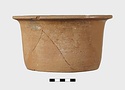
Lower part.
From a deep basin; flat bottom; rolled horizontal handle. Cooking ware, heavy fabric.
Cf. 1741, and for the incidence and dating of the shape, p. 212, note 3a ... Context ca. 450-425 B.C ... Cf. 1741, and for the incidence and dating of the shape, p. 212, note 3a. |
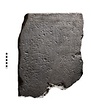
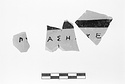
| Inscribed fragment.
Broken away on right side, cut away below.
In the bottom a rounded cutting dating from a reuse.
Five lines of the inscription preserved.
Hymettian marble. Found in Byzantine context ... Ca. 180 B.C ... In the bottom a rounded cutting dating from a reuse.
|
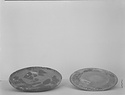
| Few missing fragments restored in plaster. Heavy base ring; floor nearly flat; vertical rim curving in slightly at top. Two small circles of rouletting on floor at center.
Glaze slightly worn. Pergamene ... February-April 1937 ... ADDENDA Suggested revised dating: ca. 100 B.C. or even earlier (cf. |
Broken all around except top and bottom.
From Square Peristyle.
Poros of Akti; fair work. Traces of fire (?). Imbedded in the foundation of the eastern of the two N.-S. walls in the west part of the Heliaia, ... 18 August 1961 ... -S. walls in the west part of the Heliaia, ca. 5.00m from its north end; a wall probably dating from the late fourth century B.C. |
Complete except for a few chips.
Low foot; rounded resting surface; convex underside. Very slight groove above foot. Convex wall. Rim concave on top, with ridge at inner edge. Thick, shiny red glaze, ... 325-300 ... Other concave-rim plates from Hellenistic contexts: 818, 819, and P 21010 (H--K 12--14), very crudely made, but possibly dating in 4th century; P 1092 and P 1093 (H 17:5), also possibly 4th century. |
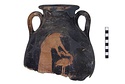
| Lower wall and base, and small chips in rim and wall missing. Mended from numerous fragments and partly restored in plaster.
A) Chiton-clad girl with short hair caresses a phallos-headed bird.
B) Similar ... 5 July 1935 ... Stoa cross cut, piers 1 and 2, Middle Stoa-Theseion; in bottom of pit to east of S.E. corner of 5th. c. monument base, possibly pre-dating that base. |
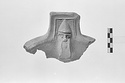
| Rectangular lug and beginning of wall. Long beard, conical cap; in field right and left of cap Α and Θ.
Coarse micaceous reddish clay.
In storage, ca. 16 others of similar type (pilos). P 22199a and ... 27 July 1964 ... P 22199a and P 10635 appear from the same mould, though first has no letters, and second has retouched beard; also a specimen with ΑΘ is P 7039; on dating see ΔΕ nb. p. 249. |
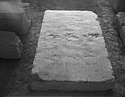
Inscribed boundary stone.
Intact, except for chips and wearings at back.
Rectangular cutting at top 0.145X0.065m. probably dating from block's reuse as doorsill.
All surfaces rough picked except for about ... 4th. century B.C ... Rectangular cutting at top 0.145X0.065m. probably dating from block's reuse as doorsill.
|
| Fragment from neck of amphora(?).
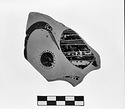
Decorated with water bird right; the wings of an animal (another water bird?), painted with purple and incisions to right, with a solid circle surrounded by dots as a ... 27 April, 5 May 1932 ... It is one of the latest Protoattic sherds from this area, dating probably in the last quarter of the 7th c. |
| The block is re-used and served originally perhaps as the plinth for a monument.
Its uninscribed face was scooped out in antiquity, apparently to lighten the stone. At either end of the left long edge ... 18 June 1939 ... At either end of the left long edge is a cutting for a hook clamp, dating possibly from an intermediate use.
|
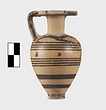
| Thick ring at the joint of the neck. Very little part of the tongues on the shoulder and of the Athena's crest. Athena is turned to left. The crest is outline with a red band; round it's base, at the point ... The use of red mineral makes a dating still in the fifth century certain (Beazley, Panathenian p. 454). |
Stroke polishing on neck.
Unglazed and handmade.
Small, unpainted votives are found in great quantities at many sanctuary sites. Only about 100 were saved from the dump on Hymettos, although the total ... 8th-7th c. B.C ... For fabric and dating, cf. P. Courbin, La ceramique Geometrique de l' Argolide, pp. 29ff., 70 ff. |
Bowl: Pergamene Sigillata?
About half of foot and most of floor preserved.
Spreading foot with four grooves in upper surface; broad, slightly beveled resting surface with four grooves; flat underside ... Context of 115-50 ... A somewhat similar form of foot is found on skyphoi of Pergamene sigillata dating to the second quarter of the 1st century (PF VI, nos. 12, 28--31, 34, pp. 213, 215, pl. 29, from skyphoi of Types S 3 and S 8, pp. 65, 69--70). |
Jug With Thin Neck.
Intact.
Raised base with flaring profile; concave underside. Pear-shaped body. Long, thin neck. Flaring rim with angular profile, concave to inside. Strap handle from shoulder to ... Context of 325-300 ... Two more, semiglazed like ours, come from 4th-century graves in the Kerameikos (Knigge 1966, nos. 151:2, 155:2, pp. 88--89, pl. 58, the latter found with a kantharos dating around 300 [ibid., no. 155:1]). The shape is therefore probably limited to the second half of the 4th century, with semiglazed examples dating in the last quarter. |
Cup Or Jug.
Fragment of shoulder and lower rim.
Low, rounded shoulder. Rim convex to outside, with groove at base.
Moldmade body: tops of small imbricate petals or leaves visible.
Rim pattern: jeweling ... Context of first half of 1st century ... Italian moldmade cups of the workshop of Sarius, from North Italy, dating in the first quarter of the 1st century after Christ (Dallemulle 1975, nos. 2--5, 7, pp. 279--282, figs. 6--8, pls. |
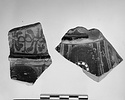
| Circles, separated by row of dots, on rim. Two running dogs on shoulder. Two groups of four narrow bands around upper part of body, with irregular dots between. Three bands around lower part. Bottom unpainted, ... 21 April 1932 ... The shape and type belong to Johansen's archaic style, type B, dating in the middle of the 7th c. |
Rim fragment from incurving bowl. Rim slightly grooved.
Waterbird to right in a panel with lattice-triangle above.
Light red clay with hard buff surface. Glazed black inside, dilute paint outside.
An ... 27 April 1932 ... An example was found at Sparta, with Subgeometric and Laconian I pottery, dating ca. 740-660 B.C. |
| Numerous fragments from body of vase, both joining and non-joining but none from base, mouth or handles. Of the athletes there remain the legs of three distance runners on joining fragments, one head much ... 380/79 B.C ... Of the one inscription remains the initial T; of the dating inscription remains
The reserved surfaces are carefully polished; the glaze for the most part is firm and glossy. |
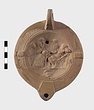
| Mended from many pieces; a few fragments of rim, nozzle and wall restored in plaster; chips missing.
Large lamp with double-pierced handle, double grooved above and below. Rim panelled, with stamped ovules ... 24 April 1948 ... From the floor of a house on the N.E. slope of the Hill of Nymphes, dating in 267 A.D. |
Small Plate With Projecting Rim: Rome Or Etruria.
Fragments of rim missing.
Angular ring foot; beveled resting surface; flat underside. Broad, projecting rim, curving down at edge and undercut on inside ... Context of ca. 275-210 ... For plates of similar size and shape see Morel 1965, no. 127, pp. 72--73, pls. 10, 47; Morel 1969, p. 84, fig. 14 = Morel 1981, Type 1323b, p. 106, pl. 14 (dated by Morel between 305 and 265), from the workshop of the Petites Estampilles, an atelier perhaps located in Rome and dating from the late 4th to the mid-3rd century. |
Vertical section of handle and over half of body, foot, and underside restored.
Low, flaring foot; flat resting surface; well-formed, slightly convex underside. Lower body very high and nearly straight ... Context of 150-110 ... For wreath with square bow see Leroux 1913, no. 17, pp. 21--22 (Eretria), no. 27, pp. 24--25 (Myrina), no. 33, pp. 26--27 (Olbia), nos. 66, 70, pp. 37--38, 40--41 (Cyrenaica); BCH 78, 1954, p. 221, fig. 5 (Delos, in context of mid-2nd century and slightly later); Tsakos 1994, p. 161, fig. 7 (Samos); PF II, F 11, p. 114, pl. 45 (Pergamon); AvP I, ii, p. 277, fig. a (Pergamon); AvP XI, ii, no. 101, p. 72, pl. 43:3 (Pergamon, in context dating after middle of 2nd century); Belin de Ballu 1972, p. 115, pl. |
| Several pieces, including chunks from sides and rim, missing. Flat bottom; straight sides; flat-topped projecting rim.
Orange-buff clay. Light slip. Surface much worn.
On side wall, just below rim, a ... 9-12 February 1937 ... The pottery with which this pot was found is a consistent group dating from the end of the 2nd and the beginning of the 1st c. |
|
|