|
|
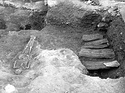
Crescent-shaped cutting in bedrock at 47/ΙΓ; on the north slope of the Areopagus, slightly to the west of the dromos of the Mycenaean Chamber Tomb.
Dimensions of cutting : max. diameter ca. 2.50m.; depth ... Ca. 500-450 B.C.
400-350 B.C ... Cutting |
Rectangular cutting at 58-60/ΚΘ-Λ, probably a plundered wall trench ... 350-290 B.C ... Rectangular cutting at 58-60/ΚΘ-Λ, probably a plundered wall trench. |
Early cutting beside Great Drain: 103-111/Λ-ΛΓ (= "Deep cutting" Pit at 107/ΛΑ).
Abandonment filling in channel for early drain; the fragment of a red figured bell krater, P 17000, probably to be dated ... Ca. 425-395 B.C ... Early cutting beside Great Drain: 103-111/Λ-ΛΓ (= "Deep cutting" Pit at 107/ΛΑ).
|
Well at 35/ΛH. In the northern part of the market square, north of the altar of Ares. Stony fill with late Geometric sherds. Not dug ... Late 8th century B.C ... Well Cutting |
Cutting in bedrock (Panathenaic Way Cut II, Cutting C1); loose gravelly filling over bedrock including a number of terracotta figurines. Lot ΠΑ 61? P 26458 is probably a slip. One fragment noted as from ... 4th c. B.C ... Cutting in Bedrock |
The almost complete red figure hydria set into this cutting suggests the possibility of a 5th c. burial put into a much earlier grave cutting; however, the remainder of the filling appears thoroughly disturbed ... 450-425 B.C- Late Roman disturbance ... The almost complete red figure hydria set into this cutting suggests the possibility of a 5th c. burial put into a much earlier grave cutting; however, the remainder of the filling appears thoroughly disturbed.
|
A circular cutting in bedrock ... Late 6th-early 5th c. B.C ... A circular cutting in bedrock. |
Perhaps originally a grave cutting ... Ca. 390-380 B.C ... Perhaps originally a grave cutting. |
Small deposit in earlier grave cutting. No bones or any other indication that the cutting had been reused as a grave ... Mid-5th c. B.C ... Small deposit in earlier grave cutting. No bones or any other indication that the cutting had been reused as a grave. |
Scanty dumped filling in an abandoned well cutting ... Ca. 425-420 B.C ... Scanty dumped filling in an abandoned well cutting. |
| Circular pit and irregular cutting north of it. Diam. of pit ca. 0.80m; Dimension of irregular cutting ca. 1.00x1.20m. The pit was dug into bedrock and filled with red earth which was packed with undisturbed ... Second half of 7th c. B.C ... Circular pit and irregular cutting north of it. Diam. of pit ca. 0.80m; Dimension of irregular cutting ca. 1.00x1.20m. ... The irregular cutting contained a similar filling but the pots were stacked, not dumped. |
Disturbed burial set into a cutting in hardpan. No lot ... 2nd half of 5th c. B.C ... Disturbed Burial Set into a Cutting in Hardpan |
Hole at 65/ΚΔ; small cutting in bedrock with scanty pottery ... 450-400 B.C ... Hole at 65/ΚΔ; small cutting in bedrock with scanty pottery. |
Pit at 48/ΚΕ; circular cutting in bedrock (diameter ca. 1m) ... Ca. 500-470 B.C. (?) ... Pit at 48/ΚΕ; circular cutting in bedrock (diameter ca. 1m). |
Cutting in stereo. Early 4th c. fill with some Hellenistic-Early Roman disturbance ... Ca. 400-375 B.C ... Cutting in Stereo at 86/ΣΤ-Ζ |
| Homer A. Thompson ... Grave XIII in notebook. Cutting in bedrock. One skeleton. Bones discarded. No offerings.
JP ... LH III/EPG (date uncertain) ... Grave XIII in notebook. Cutting in bedrock. |
Narrow trench in bedrock. Cf. Section Σ, p. 4358 (nb. XXII) same trench, same filling.
EV notes that the cutting probably.. to the "narrow cutting in bedrock". The filling seemed to be ca. 425-420 B.C ... Third Quarter to Last Quarter of 5th c. B.C ... EV notes that the cutting probably.. to the "narrow cutting in bedrock". |
Deposit in a cutting in bedrock on Kolonos Agoraios. Sherds in container Lot ΠΘ 4a ... Probably 4th c. B.C ... Deposit in a cutting in bedrock on Kolonos Agoraios. |
Grave 2.
Shallow cutting, 1.00x0.47m, in bedrock; possibly a child's burial, but no skeletal remains preserved ... Late 5th c. B.C ... Shallow cutting, 1.00x0.47m, in bedrock; possibly a child's burial, but no skeletal remains preserved. |
| This cutting was filled in at the time Road 6 was laid. Homogeneous dumped fill.
This deposit represents fill which was brought in at the time Road 6 at the west end of the Middle Stoa was laid to fill ... Ca. 480 B.C ... Bedrock cutting under Road 6 by Stoa Pier 1 |
Two narrow trenches at right angles to each other.
Small deposit in bedrock cutting Good black glaze ware ... 430-420 B.C ... Small deposit in bedrock cutting |
| Dorothy Burr Thompson ... Grave 12 in notebook. Cut in bedrock. (E.L. Smithson: Grave VII: PG) Few bones (discarded). Rectangular cutting in bedrock.
JP ... Early Protogeometric ... Rectangular cutting in bedrock.
|
Layer 7 in South Peristyle of court of Roman House Ε. Irregular cutting in bedrock with sand, gravel, fallen bedrock. Some burning ... 275-250 B.C ... Irregular cutting in bedrock with sand, gravel, fallen bedrock. |
Well at 69/ΚΗ (diameter 1m).
The well forms the south apse of the apsidal cutting south of the late Roman entrance porch ... Late 8th c. B.C ... The well forms the south apse of the apsidal cutting south of the late Roman entrance porch. |
Kernos Deposit (?): below floor of Building A, over and in cutting at 33/ΚΗ P 30162-P 30172 added on 4 May 1973 ... 4th c. B.C ... : below floor of Building A, over and in cutting at 33/ΚΗ |
| Eugene Vanderpool ... Grave (E.L. Smithson: Grave XXXVIII: PG)
Shallow oval cutting in natural bedrock lintel of Mycenaean chamber tomb O 7:5, containing a large two-handled cooking pot. Within, the unburned bones of a foetal ... Developed-Later Protogeometric ... Smithson: Grave XXXVIII: PG)
Shallow oval cutting in natural bedrock lintel of Mycenaean chamber tomb O 7:5, containing a large two-handled cooking pot. ... The upper part of the cutting and one side of the jar sheared away in Classical times |
Pocket in bedrock, 50/Λ (= Trench, 50-54/Λ), measuring 4.00x0.60m, 0.60-0.90m deep; possibly cutting for wall foundation Coins:
22 April 1932 #1 ... 330-300 B.C ... Pocket in bedrock, 50/Λ (= Trench, 50-54/Λ), measuring 4.00x0.60m, 0.60-0.90m deep; possibly cutting for wall foundation |
| Dorothy Burr Thompson ... Circular cutting. Grave 24 in notebook. In some records as Grave IV bis. Baby's bones: discarded. No offerings. Negs. KK 99, KK 100, X-61 ... LH III/EPG (date uncertain) ... Circular cutting. Grave 24 in notebook. |
Fillings in an irregular cutting, the context at one end is of the early 5th. c. and at the other end of the second half of the 5th. c ... Early 5th c. B.C ... Fillings in an irregular cutting, the context at one end is of the early 5th. c. and at the other end of the second half of the 5th. c. |
Rectangular cutting, not entirely preserved, west of underground drain. Contained good black glazed pottery, some stamped, and a little coarse ware, along with bits of bone and part of a skull ... Third quarter 5th c. B.C ... Rectangular cutting, not entirely preserved, west of underground drain. |
| Grave I in notebook = RSY Grave 2.
Inhumation burial in Cemetery on West Slope of Areopagus. Outline of grave disturbed by later cutting. Outstretched skeleton, probably of adult female. PD 731-a ... Late 8th century B.C ... Outline of grave disturbed by later cutting. Outstretched skeleton, probably of adult female. |
| Dorothy Burr Thompson ... Grave 26. In some records as Grave I ter. Bones discarded.
Notebook says: child bones (no skull), no offerings.
Circular cutting in bedrock, about 3m south of D 6:3. Neg. KK 234 ... LH III/EPG (date uncertain) ... Circular cutting in bedrock, about 3m south of D 6:3. |
Filling in a sizeable pit. The objects, along with the dimensions of the cutting from which they came, might suggest offerings in a disturbed grave but there was no evidence of skeletal remains ... Ca. 430-415 B.C ... The objects, along with the dimensions of the cutting from which they came, might suggest offerings in a disturbed grave but there was no evidence of skeletal remains. |
| Marcie Handler ... Fill within the drain from the basin on the west side of Roman Room B through Wall A.
After we removed the fill within the basin on the west side of Roman Room B (BZ XXVII p. 5325), we began excavating ... Late Roman ... After we removed the fill within the basin on the west side of Roman Room B (BZ XXVII p. 5325), we began excavating in the cutting on the east face of a conglomerate block that is part of Wall A. The cutting was semicircular, and the fill was silty and very hard-packed. The cutting is probably a drain that carried water from the basin through Wall A and onto the North-South Road. |
| Dorothy Burr Thompson ... Grave 14 in notebook. Cutting in bedrock. Cremation: bones in pit (E.L. Smithson: Grave XXIV: PG). Bones discarded.
[JP] Nb. says at 16-17/ΞΖ and 16/ΞΖ on cards and on deposit list.(SD) ... Early Geometric I ... Grave 14 in notebook. Cutting in bedrock. |
| Rodney S. Young ... Grave 19 (In some records as Grave VIII). No remains, no burned matter or traces of burning.
JP
A small cutting with a single offering. The pit may have been for a simple child/infant inhumation, with ... Early Protogeometric ... JP
A small cutting with a single offering. ... Another similar cutting, at right angles, probably from another burial. A further cutting, just to the south, roughly rectangular, oriented east-southeast to west-northwest, measured 0.95m in length, 0.53m wide, and 0.47m deep. |
| Shallow cutting into bedrock (L. 1.70m, W. 0.55m.) oriented north and south, head at south. Skeleton stretched out , with head on left side. Southern top edge of grave projects to form protective niche ... 750-725 B.C ... Shallow cutting into bedrock (L. 1.70m, W. 0.55m.) oriented north and south, head at south. |
Small compact deposit. Cutting. High proportion of good black glaze; 21 loom weights (19 pyramidal, 2 lentoid); a very large red-figured skyphos somewhat recalls the style of earlier work of the Dinos ... Ca. 430-420 B.C ... Small compact deposit. Cutting. |
| Grave 7 in notebook. Area disturbed in Roman times; outlines of the shaft had been obliterated.
The northwest end, however, was preserved in a cutting in the rock of the sloping hillside. This cutting, ... 750-700 B.C ... The northwest end, however, was preserved in a cutting in the rock of the sloping hillside. This cutting, 0.59m wide, extended to a total depth of 0.62m below the rock surface. ... The earlier burial, Grave XX, occupied the bottom of the cutting; the later, Grave XIX, rested on a filling of ash 0.38m above it. |
Red Figure Pocket in front of Retaining Wall at 74-77/ΛΖ-ΛΘ.
Pit , a large cutting in bedrock, irregular in outline, reaching a depth of ca. 1m; dumped filling of alternating layers-broken pottery fragments ... Ca. 430-410 B.C ... Pit , a large cutting in bedrock, irregular in outline, reaching a depth of ca. 1m; dumped filling of alternating layers-broken pottery fragments on quantity, figured, plain, glazed and coarse. |
|
|