|
|
S.W. of Archaic Temple : Pocket in bedrock. The pocket was cut through a red clay floor. 71 sherds.
Objects: loom weights; lamp.
Early ware: Gray Minyan; Mycenaean; Protogeometric-Late Geometric; Subgeometric; ... Early 6th c. B.C. and earlier ... Objects: loom weights; lamp.
Early ware: Gray Minyan; Mycenaean; Protogeometric-Late Geometric; Subgeometric; mottled glaze.
Archaic ware: black glaze; oinochoe; skyphos. Plain and banded : coarse ware; cooking stand; cooking pot fragments; hydriae. |
Fill in abandoned cistern, lower terrace adjacent yo the Eleusinion on the north.
Uncatalogued material: 189 sherds, 4 objects. Many kernoi fragments.
Objects : loom weights; lamp.
Early ware : Gray Minyan; ... Mid. 4th c. B.C ... Objects : loom weights; lamp.
Early ware : Gray Minyan; Protogeometric-late Geometric.
... Household : amphora; lekane; cooking ware; lopas; plain; coarse ware. |
Michael Laughy ... West and adjacent to Modern Wall 5, we excavated 12th-13th c. A.D. fill, in some places a half meter deep or more. The fill was remarkably uniform in content throughout. Typical pottery included: fine ... 12th-13th c. A.D ... Typical pottery included: fine sgraffito; slip painted ware; inscribed ware; plain glaze; brown and green glaze; polychrome glaze; Byzantine lamp fragments; coarse wares; and cooking wares. ... Lot T 131:
amphora toe; coarse handles, body sherds, rims, bases; cooking ware; combed ware; ridged ware; slip painted; inscribed sgraffito; Byzantine lamp; monochrome sgraffito; polychrome sgraffito; monochrome glaze; brown and green ware; plain glaze.
sherds: 1824
"classical black glaze": 38
Lot T 143:
fine sgraffito; slip painted; inscribed ware; plain glaze; brown and green glaze; polychrome glaze; Byzantine lamp fragments; coarse handles, rims, bases, body sherds; cooking ware; earlier finewares; ridged ware; combed ware; amphorae fragments; bone.
|
Well at 45/Θ (Skytha Well) near the north side of the market square. No period of use was distinguished, since it was impossible to clear the well to the bottom. The considerable quantity of dumped filling ... Ca. 460-440 B.C ... The considerable quantity of dumped filling included red-figure and black glaze, semi-glaze kitchen-ware, and coarse cooking ware and storage jars ... All black-glazed pieces from this well were kept; of the coarse ware only rims, handles and feet. |
North of Eleusinion: Fill in Room 3 of Roman Building. 614 sherds (6 miniature shapes, 20 intrusive sherds).
Objects : terracottas; loom weights; spindle whorls; disks; handmade tray; lamps.
Early ware ... First half of 6th c. B.C.-Mixed Fill to ca. 480 B.C ... Objects : terracottas; loom weights; spindle whorls; disks; handmade tray; lamps.
Early ware : Gray Minyan; Mycenaean; Protogeometric-Late Geometric; imitation Corinthian.
Archaic ware : black figure; amphora; column krater; dinos; skyphoi; black figure; lekythoi; lekanis; miniatures; saltcellars; cups; stemmed dishes.
Household: amphora; lekane; mottled black-glazed ware; cooking ware; coarse ware.
|
Michael Laughy ... Debris pit, located in Room 2 of ΒΘ East. Pit measures ca. 2.30 by 1.70m., and nearly a meter deep. The pottery from the pit dates ca. 10th-12th c. A.D. The fill of the pit consisted of soft, black charcoal ... 10th-12th c. A.D ... At the bottom of the pit, we discovered four nearly whole vessels: a water pitcher, cooking pot, coarse ware pot, and suspended lamp.
... Lot T 199:
coarse body sherds, handles, rims; base; amphora handle; combed ware; ridged ware; cooking ware; monochrome glaze; polychrome sgraffito (late Byz); monochrome sgraffito (12th - 13th c and 13th - 14th); monochrome with tripod still on sherd (13th c onwards); slip painted ware; green and brown glaze (Late Byzantine); slip painted (Early Modern)
(mostly 12th-14th c. A.D., but one suspicious piece Early Modern sherd, and one Turkish pipe)
sherds: 486
"classical black glaze": 17
Lot T 200:
coarse rims, handles; lamp fragments; Turkish pipe fragments; combed ware; ridged ware; cooking ware; Turkish imitation marbled ware; porcelain; monochrome glaze; inscribed sgraffito; slip painted.
|
Well at 15/ΙΕ = Pocket in side of Turkish Pit at 15/ΙΔ.
Shallow well on the lower slopes of the Acropolis, east of the Panathenaic Way, in the area later occupied by the Archaic Building.
Located 3.5m ... 700-675 B.C. with intrusions ... Imported Ware: Gray fabric; Corinthian; pale fabric; Protocorinthian skyphos.
Household: Unglazed; double-yoked handle for large amphora ("cow's head handle"); amphora; utility amphoras; storage amphoras; kados; spouted kados; cooking ware; cooking jug; cooking stand; brazier; cooking ware basin; oinochoe; hydriai; bowl, deep spouted; lekane; large basin; coarse ware basin; pithos; incised coarse ware.
Intrusions: Archaic ware; terra cotta figurine; blac figure; black glaze; lamp; Roman ware; Late wares: green glaze; yellow glaze; orange/brown glaze; green/white ware; grooved ware, white slip; incised wavy ware; white slip ware, amphora; globular jug; lamp; jug; unglazed plate; micaceous coarse ware; other coarse ware. |
| Shallow pit in bedrock on the upper terrace, ca. 3m. southeast of the Rocky Outcrop. Uncatalogued material: 46 sherds, 61 terracotta figurines and 4 objects.
Early ware : Neolithic; Gray Minyan; Mycenaean; ... Archaic with intrusions ... Coarse ware : cooking pots; transport jars.
Intrusions : Classical ware; black glaze bowl; jug.
Late Roman ware : combed ware; coarse ware; red-glazed. |
Pocket on the line of the early (Archaic) peribolos wall at entrance on the south side. Uncatalogued material: 215 sherds, 186 + frags. plemochoai and 4 objects.
Classical Ware : black glaze; mug; rilled-rim ... 3rd quarter 4th c. B.C ... Classical Ware : black glaze; mug; rilled-rim plate; lekythos; miniatures. Plemochoai : "cooking" type; plain type; miniature.
Household : pithos; coarse ware |
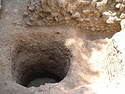
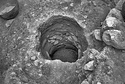
Well ΑΒ located on the lower terrace to the north of the sanctuary(diameter 1.10m). Foot-holes were cut into the shaft at intervals of ca. 0.40m. The fill consisted mostly of small stones, dug bedrock, ... Second quarter of the 6th century B.C ... Coarse ware and plain ware : SOS amphora; storage jar; lekane; coarse ware.
Imported ware : bucchero; Corinthian.
... Coarse ware-plain ware : amphora; lekane; pithos; cooking wares; unglazed; mottled black/brown-glazed ware; mottled red/brown-glazed ware; coarse ware. |
| The pit consists of an unlined, circular shaft measuring 1.10m. in diameter and at least 2.23m. in depth. The sides of the shaft have roughly cut hand-/foot-holds at irregular intervals and locations ... Late Roman to end of 4th c. A.D ... A.C. the fill yielded larger fragments of pots and a greater concentration of cooking ware, bones and ash. |
Mycenaean Well at Q/8-9;23/2-3.
Small pieces, few joins. From the lowest levels a few somewhat larger pieces, from jars suited to drawing and transporting water, but no characteristic POU fill.
Proportion ... LH IIIC ... Proportionately more coarse ware in upper levels; pithos fragments, cooking and pantry wares; four pieces (two cooking) are handmade, one burnished.
|
| Laura Gawlinski ... Circular pit uncovered in Early Building II, south of Room E latrine, adjacent to the preserved latrine floor surface. Continues beneath the latrine surface and the western scarp (unexcavated). Fill relatively ... Late 5th c. B.C ... Fill relatively loose with a large amount of ash and bones, much cooking ware.
Appears to be cut into surrounding harder fills. |
| A cave-in not long after the digging of this shaft destroyed its possible usefulness as a well and thereafter it was used as a dump. Two principle periods of such use were noted, and within these several ... Ca. 575-480 B.C ... This was sorted all together, and regrouped by "Kind', lettered under these numbers, as follows (6 tins).
a) Large black glaze amphora; other large pots.
b) Wine jars; black glaze.
c) Cooking ware.
d), e), f) Roof tiles, pithoi, tubs.
|
| "Room D" is the triangular area at L/15,16-2/10,12, NW of Wall 1, in E corner of basement of No.3. Hastings Street, bounded by the NE and SE walls of basement).
Bell-shaped vessel built of horizontally-laid ... 10th-11th c. A.D ... Yellow-glazed white ware; brown-glazed juglets and chafing-dish fragments; cooking pots and lids; columnar lamps; coarse wares with incised decoration including spirals, "fork-tine" marks, and a sherd with birds at a fountain. |
| James Artz Pirisino Daniele Kylindreas Miltiades ... Excavation in Room 3 of ΒΘ West revealed 5 ceramic vessels in a row against the eastern face of Wall 12. 3 complete vessels (ΒΘ 122, 124, and 125) were catalogued, along with the base of a plain glazed ... 9th-11th c. A.D ... The primary types of glazed Byzantine pottery found in the fill included green and brown painted ware, plain glaze ware, Constantinople white ware, and monochrome glaze.
... Plain glaze ware; Constantinople white ware; monochrome glaze; green and brown painted ware; combed ware; ridged ware; gouged ware; amphora toe; incised coarse ware; Roman lamp fragment and red wares; classical red and black glaze (including geometric, archaic, and classical); coarse base with strange shape, handle and neck close to base; coarse handles, bases, rims, and body sherds; micaceous body; cooking ware, including joining lid fragments; painted and unpainted plaster; roof and floor tile fragments; pithos lid, rim and body fragments; worked stone; stone revetment; bone; metal; glass |
| Well in Room 6 of Street Stoa U/2,U/3-13/15.
Associated with the building lying under the Roman Street Stoa. Its fills divided into 5 separate layers, with the bulk of finds belonging to Layer 1, the ... 14 June-21 August 1973 ... there would be many boxes of fine ware, followed by cooking ware, or mortars etc., but the entire fill seems to be of one date and joins were found between upper and lower boxes. ... An additional 212 tins were thrown; these included 46 tins of lekanis fragments, 50 tins of roof tiles, 87 tins of amphora fragments, 7 tins of mortar fragments, 2 tins of lopas fragments, 4 tins of eschara fragments, 4 tins of basins and tubs in fragments, and 11 tins of assorted coarse ware fragments. These objects were thrown back into the well. |
Well in Coletti Garden.
Diameter 1m. There were no traces of hand holes in its walls. At 5.2m depth below datum on the S-E side of the shaft, a small underground stream emptied into the well. The stratigraphy ... Ca. 425-400 B.C ... Utilitarian: fragments of lekanai, cooking pots, mortars, casseroles, jugs, all varieties of fabric and glaze, brazier fragments, gray ware amphorae, and painted roof tiles. |
|
|