|
|
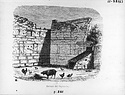
| Drawing of the tower at the south end of the Stoa. Cf. Agora XXIV, pl. 5, Tower W 5 ... This reference is not checked (SD) Horizontal (normal) ... 1862 |
Fillings below the courtyard floor of the Poros Enclosure west of the Areopagus. The lowest layer, over bedrock, is of the archaic period and may have accumulated on the spot before the start of building ... First half of 5th c. B.C. |
| North of House G (RSY=Pyre 13).
Concentration of artifacts, small pieces of bone, and burnt material in stratum, no pit discerned. The pyre is cut by the trench of a wall of a Roman house to north. It ... 290-250 B.C. |
Pit (Well?) under Building A, Room 2. Coins:
9 May 1949 #1-#2
11 May 1949 #4
12 May 1949 #3 (not a coin, bronze fragment in lotted metal tins ΠΠ 295). Estimated Grid
Remains of coloring matter found with ... Hellenistic-Early Roman ... Coins:
9 May 1949 #1-#2
11 May 1949 #4
12 May 1949 #3 (not a coin, bronze fragment in lotted metal tins ΠΠ 295) ... Estimated Grid
Remains of coloring matter found with 4th c. sherds. |
Well, unfinished?
The shallow depth, small diameter, lack of water and any use fill make it possible that this was not a well, although the character of the cutting is difficult to explain otherwise. The ... Ca. 440-420 B.C. |
Cistern System #1b: Shaft/manhole and gallery at 18-19/ΞΑ-ΞΓ.
Objects divided between the two features, shaft and gallery, according to deposit notebook list, not according to remarks on cards. 22 February ... Late 1st c. B.C.-early 1st c. A.D. |
According to the excavator " a pre-herulian filling dumped in to fill the cistern some few years after the Herulian destruction". Coins:
10 June 1936 #2-#6
11 June 1936 #1-#19
12 June 1936 #23-#27 P 11936 ... A.D. 267 to mid 3rd c ... P 11936 and L 2555 from passage between cisterns at 106/ΛΓ and 107/ΚΘ but not recored as part of deposit C 14:2, see nb.p. 3559. |
Cistern System #1e: Shaft at 11/ΞΑ.
Agora XXIX: "Well (not cistern shaft, as in Agora XII) ... Communicates with water system through small hole (see C 8:1) probably fortuitously. Single fill, mostly of ... 350-300 B.C ... Agora XXIX: "Well (not cistern shaft, as in Agora XII) ... Communicates with water system through small hole (see C 8:1) probably fortuitously. |
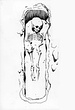
| Rodney S. Young ... Grave 8 in notebook. Bones discarded. Fragments of an iron pin found on the chest and a fragment of a Protogeometric krater base found beside the body were not inventoried.
JP
Unlined roughly rectangular ... LH III/EPG (date uncertain) |
Great Drain fills, including "packing over elliptical tiles" and "gravel fills". The central drain area covered by the sections below; other sections are with other deposits. Coins:
9 May 1947 #2-#5
16 ... 1st c. A.D. |
| Artifacts, burnt bone, ash, cinders and charcoal in pit in bedrock. The pyre lay directly under mosaic floor A. the deposit is not badly disturbed, however, and it is possible that it was laid immediately ... Early second quarter of 4th c. B.C. |
| James H. Oliver ... (E.L. Smithson: Grave IX: PG). Two children's skeletons one on top of the other. Cf. PD 329 for PD 430 for second skeleton, same deposit.
PG grave about 25m. SW of Cistern A at 46/ΜΔ.
[In some records, ... Developed Protogeometric |
| Rodney S. Young ... Grave 2 in notebook (E.L. Smithson: Grave XV: PG). Urn cremation (trench-and-hole), adult female.
JP
It consists of a roughly rectangular pit or trench cut into bedrock to a depth of 0.35m., measuring ... Late Protogeometric |
| Rodney S. Young ... Grave 19 (In some records as Grave VIII). No remains, no burned matter or traces of burning.
JP
A small cutting with a single offering. The pit may have been for a simple child/infant inhumation, with ... Early Protogeometric |
Roman well, stratified.
Finds from the earth (not recorded in a subdivision):
P 7995, P 8036, P 21834, SS 6338, IL 483, IL 486, BI 309, BI 310,
BI 314.
According to the excavator the shaft had been cleaned ... 2nd-4th c. A.D. |
| Rodney S. Young ... Grave 6 in notebook (E.L. Smithson: Grave XXII: PG). Bones discarded. Urn cremation (trench-and-hole).
JP
Roughly rectangular trench cut through hard earth into bedrock to a depth of about 0.35m, approximately ... Late Protogeometric |
House R, fill under drain tiles and fillings associated with house K in industrial area, including what was C 19:15, plus C 19:16 and
C 19:17.
a) House built as dwelling in second half of 5th.c.
b) Used ... Ca. 5th and 4th c. B.C ... House R, fill under drain tiles and fillings associated with house K in industrial area, including what was C 19:15, plus C 19:16 and
C 19:17.
a) House built as dwelling in second half of 5th.c.
b) Used as marble-workers' shop from beginning of 4th. c. to near middle of century. Rebuilt as an industrial establishment about middle of 4th. c.
c) Area built over in Hellenistic times.
... B.C. It is not always possible to distinguish between these two periods; the objects from both, mostly of the late 5th into the first half of the 4th c., have been listed together. |
Hellenistic-Early Roman fill over bedrock, along west side of Kolonos Agoraios. Consistent dumped filling; occasionally there is a late Roman fragment intruded from the filling above, but this seems not ... 26-29 February 1936
2-12 March 1936 |
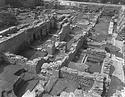
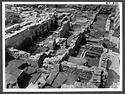
| General view of the "Street Stoa", Rooms 2 and 3 in right background, and Rooms A-G of the Late Roman Building in foreground ... Publication says from northeast (not east) (SD). southwest 1359 ... 20 Aug 1972 |
| General view of the "Street Stoa", Rooms 2 and 3 in right background, and Rooms A-G of the Late Roman Building in foreground ... Publication says from northeast (not east) (SD). southwest 1359 Horizontal (normal) ... 20 Aug 1972 |
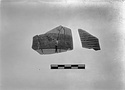
| Protocorinthian sherds from the 7th c. B.C ... AMS
The two sherds were not catalogued. Horizontal (normal) |
| Julian II. C., 9 (2). 10 (1). 14 (1). 19 (1). C. NOT (1). C., 41 (1). 43 (1). ? (2). C. NOT (1). C., 50. C., 38. C., 151. C., 13 (1). 14 (1). 15 (1). 16 (2). 19 (3). ? (2). C., 45 (1). 47 (3). ? (1). C., ... Agora 2 49 ... 355-360 A.D ... C. NOT (1) ... (2). C. NOT (1) ... (13). C. NOT (2) |
Not all coarse; few pieces dated early 3rd. c ... 2nd-1st B.C ... Not all coarse; few pieces dated early 3rd. c. |
"baskets" 1-5 Coins:
22 April 1937 #7
23 April 1937 #17-#18
24 April 1937 #1
coins from Dump:
28 May 1937 #31-#32 ADDENDA Top-early 4th. c. consistent with coins of Licinius and Maximinus in good condition ... post-Herulian |
Well at 32/ΣΤ ... Late 6th c. B.C. |
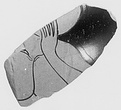
| Fragments from a column krater; a) and b) from one side, c) from the other, or from another pot.
a) The left shoulder of a discus thrower facing, the discus held up by his shoulder and his left hand ... June 1937 |
1 fragment of black glaze kylix base. Not found in labelling trays 4/40 S.Y ... Late 6th - Early 5th B.C. |
| Marble coffer fragment from Hephaisteion ... C. Edmundson ... Not numbered. Now inside the Temple at base pile. Fragile Torn Dirty Faded Paper Drafting Ink ... 1960 |
| Fragment of lower body, much mended; foot broken away. Many small fragments do not join. Streaky black glaze for some distance above foot; then bands.
Pink clay with bits. Grave XV = Grave 1. 2241, 2484 ... 9 June 1939 |
Eleusinion, north wall of the Temple of Triptolemos - Section B-B' (PD 2554
Eleusinion, fill between temple and west peribolos wall - Section C-C' (PD 2555)
Eleusinion, fill against north peribolos wall ... W.B. Dinsmoor, Jr. Richard C. A ... Copy of DA 436. Not scanned ... 1983 |
| Ionic capital ... Richard C. Anderson ... Drawn for L.S. Meritt Hesperia article. Original missing. Printed 11/6/1998.
Barletta (2017) - not used.
Original back from Princeton 2018 (not scanned). Drafting Film Printing Ink ... November 1995 |
| Looking east. S is Roman strosis, other symbols as above, except that C does not show ... AMS Horizontal (normal) ... S is Roman strosis, other symbols as above, except that C does not show. |
| Honorius. RIC, IX, p. 247, 30 c. Pearce, p. 83, 23. Pearce, p. 84, 25. Pearce, p. 83, 24. Pearce, p. 84, 27. Pearce, p. 84, 26. RIC, IX, p. 295, 69 e. RIC, IX, p. 295, 70 c. Pearce, p. 96, 57. RIC, IX, ... Agora 2 61 ... 393-400 A.D ... RIC, IX, p. 247, 30 c ... C. NOT ... C., 23 |
South Stoa II: eastern end of crepis/stylobate perspective to show letters on blocks ... Richard C. Anderson ... Perspective as found in 1959 (derived from photograph 82-60). Not to scale ... 1990 |
Heavy, thick foot. Reserved: outer face of foot, resting surface and center of stem inside; handle-panel not reserved. Glaze fired red to black, peeled and worn ... 525-500 B.C. |
| Amphora toe and neck profiles, SA 9 c, SA 324 ... Wrong (D)A-number on the actual plan.
Object number are not Agora numbers. (PK Dec 2017)
For M. Lawall |
| Ionic capital ... Richard C. Anderson ... Drawn for L.S. Meritt Hesperia article.
Barletta (2017) (not used).
Back from Princeton May 2018 ... December 1995 |
| Ionic capital ... Richard C. Anderson ... Drawn for L.S. Meritt Hesperia article.
Barletta (2017) (not used).
Back from Princeton May 2018 ... 1996 |
| Ionic capital ... Richard C. Anderson ... Drawn for L.S. Meritt Hesperia article.
Barletta (2017) (not used).
Back from Princeton May 2018 ... November 1995 |
Plain downward curved rim. On rim, a running spiral.
Brownish glaze; inside not glazed. From tin. Protoattic pit. Leica, 7-425 PD 415 ... March-April 1936 |
|
|

.png.icon.jpg)


.png.icon.jpg)