|
|
Similar to P 10973 (ΠΘ 2893) f., but very much smaller. About half preserved, with the attachments of one handle. Four stamped palmettes around a ring of eggs at the center of the floor. Scraped groove ... 18 May-4 June 1937 ... Hesperia 18 (1949), no. C 39, p. 323. |
Medallion depicting 10-petalled rosette.
Good glaze.
Cf. Agora XXII, nos. 303, 304. Cistern. Leica PD 315 ... 1932 ... Hesperia 3 (1934), no. C 39. |
| Fragment from lower end of stroter of usual form. Green impurity in marble. good work.
Inscribed on underside: ΔΙΓ.
Pentelic marble. Found at L/6-12/9 (Fall 2016). From burnt debris in S.W. corner of cryptoporticus ... 1934 ... Hesperia 19 (1950), pl. 39 c. |
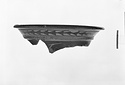
Rim from stemmed krater, dark dark brown on buff.
ADDENDA 2018: Single sherd to a medium krater with everted rim. No other features are preserved. The exterior features a wide band below the rim. The ... LH IIIC Early ... Hesperia 8 (1939), p. 362, fig. 39,c. |
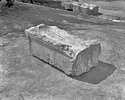
A small one nearly square.
Sides slightly concave. Irregular depression in top; small sloping circular depression in bottom. Well.
Mixed 4th, 3rd, 2nd c. B.C. Leica, 2-243 ... 18 April 1932 |
Seven joining fragments preserve full height and one handle attachment. A single white band above foot, a double one below handle. In handle zone, an ivy wreath, leaves reserved, stems and berries in added ... 25-26 May 1940 ... Hesperia 39 (1970), p. 211, under no. C 2. |
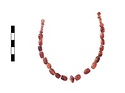
| A series of twenty-nine carnelian beads of various sizes and shapes, all intact.
The eight smallest are roughly cut and rounded. Eighteen have an elongated elliptical shape, each one slightly different ... 24 July 1998 ... Hesperia 72 (2003), p. 271, no. 48 c,d,e, fig. 39. |
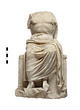
| Two joining fragments; head and arms missing, minor fractures. The attachment hole for the head, and the lower half of the iron pin in it, preserved on the upper surface of the neck.
A male figure draped ... 16 May 1938 ... Agora XXIV, p. 41, pl. 39 c. |
| a) Fragments of rim. Almost half of the diameter preserved in seven joining fragments. Moulded rim. Band of leaves, with narrow strip of tongue pattern below. The scene appears to be a horse race, with ... 3 July 1968 ... Hesperia 39 (1970), p. 211, no. C 3, pl. 56. |
Two joining fragments from rim and upper wall. Thick, almost vertical wall. Around top of wall an ivy wreath with tendrils in white paint, leaves in applied clay. Below, two white bands.
Firm black glaze ... July 1965 ... Hesperia 39 (1970), p. 211, no. C 2, pl. 56. |
| Rim broken off, but bottom part of channel preserved on one end. Much worked down through various periods of reuse. Sides straight, flaring out at top. Anathyrosis on two edges. Pair of pry holes on one ... July 1967 ... Hesperia 37 (1968), p. 39, fig. 1, pl. 5 c. |
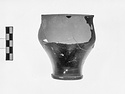
| Handle, parts of rim and body missing. Black glaze very worn on inside and missing on outside in area of handle. Underside of base decorated by two concentric circles around central dot.
Cf. Agora XII, ... 31 July 1989 ... Small bone found inside cup stored with pottery of Layer VIII-C, Bucket 39, p. 4287, pottery lot S 1221 ... Layer VIII-C, bucket 39. |
| Dancing nude male figure, advancing to the right; over his bent left arm hangs a long flowing garment; behind is part of another draped figure.
Attic clay; inside, black glaze mottled with red.
Joins P ... 22 June 1931 ... Hesperia Suppl. 10 (1956), p. 39, under no. 152.
... Part of another sash is preserved in the field above.
b) Lower part of a woman moving right; she wears a peplos; see P 74.
c) Lower part of seated male figure to left; he is seated on his himation.
d) Drapery.
e) Lower part of garment and foot of woman, left. |
| The handles broken off and mended; otherwise intact. Flaring ring foot, grooved halfway up; rounded body and flat, slightly projecting rim, spouted at the front. Upstanding rolled handles. Glazed to handle ... 30 April 1940 ... Hesperia 20 (1951), pl. 39 c-1 (Grave 8). |
Intact except for small chip from foot. High flaring foot and sharply curved body with downturned rim inside. No handle. Glaze to shoulder, which is reserved and decorated with a dot row between narrow ... 30 April 1940 ... Hesperia 20 (1951), pl. 39 c-2 (Grave 8). |
Broken off: the head of the herm and the upper part of the boy squatting beside it.
Rectangular base for herm and boy; the herm set askew. Cistern. Leica ... April 1938 ... Hesperia 21 (1952), pp. 126, 144; p. 162, pl. 39, no. 48 c. |
All of floor preserved, about one-third of rim and less than one-half of one handle. Four joining fragments. Low, lightly moulded foot set off from the wall by a ridge. Concentric ridges inside foot. Reserved: ... 3 July 1968 ... Hesperia 39 (1970), p. 211, no. C 4, fig. 18, pl. 56. |
| Fragments of inscribed block.
List of names; possibly the list of those who lost their lives at Syracuse.
Fragment Η 419 a), broken away above, below, and to the left. The right side has anathyrosis ... Late 5th. century B.C ... Fragment ΒΒ 39 c), back preserved.
... a) (Η 419) 59/ΚΔ
a) (Η 419) K 6
b) (ΗΗ 245) T 17
c) (ΒΒ 39) Q 21 ... a) (Η 419), found in a modern foundation wall, immediately south of the altar of Twelve Gods.
b) (ΗΗ 245), found in a Byzantine wall in the Church of Christ, in the area north of the Eleusinion.
c) (ΒΒ 39), found in the wall of the modern house 648/7, west of the Panathenaic Way. |
| In the center, alternating tongues of red and black with white dots between the tips; above, a frieze with traces of a warrior with shield, the hind legs of a horse, and the feet of a second figure.
... 4 June 1931 |
| Complete. Broken in two.
Originally folded in two. Inscription on both sides.
Well. 1335 Leica, 87-64, 87-66 2258-4 (37) ... 2-3 July 1971 ... Hesperia 42 (1973), p. 177, pl. 39 c. |
Discus of kylix foot only preserved.
Scratched on underside:
Good black glaze. Outer edge and resting surface reserved. Well east of Stoa room 2 (= ΘΡΑ well). Leica PD 1133-10(F 39) ... January-February 1950 |
| Nearly flat; if from a pot, then from an extremely large one. Ridges; one ornamented with incised diagonals to make a cable pattern, the other with impressed circles. Impressed circles in rows between ... 17 March-1 April 1936 ... Hesperia Suppl. 2 (1939), no. C 164, p. 190, fig. 39. |
A few small pieces missing from floor and rim. Shape similar to P 16485 (ΓΓ 940), but smaller, and the foot very much broader beneath.
Good black glaze; reserved, a band just above the lower edge of ... May, June 1939 ... Hesperia 39 (1970), p. 211, under C 1. |
| Four fragments of statue.
Fragment a) broken all around. Part of a human body with something in contact with it.
Greenish yellow clay containing dark grit, surfaced with a film of firm clay, the surface ... 14 June 1936 ... Hesperia 39 (1970), p. 135, pl. 35, nos. C 1 - C 4. |
| About one-quarter preserved; the center missing. Slightly domed lid with plain projecting rim flanged below at inner edge. Above, around the rim, one-half laurel wreath; on the lid, two women in chiton ... 14 August 1947 |
Two joining fragments give full height and part of floor; center of floor not preserved.
Carefully finished surface, plain polished; no trace of glaze. Stuccoed pit, strosis 4, box 29. Beginning of 4th ... 26 March 1937 |
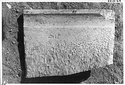
| Joint surface preserved at right end; the bed of a roughly cut rebate (?) at top; a more carefully cut notch at upper left corner; other edges broken. Front face finished with toothed chisel.
In face of ... April 1949 ... Hesperia 39 (1970), p. 267, pl. 65 ... Hesperia 19 (1950), pl. 103 c ... Agora XIV, p. 91, pl. 49 c. |
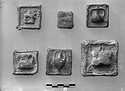
| An inscribed, square one.
In relief on the upper surface an amphora.
Cf. IL 39. Cistern.
1st c. B.C. Leica, 5-298 ... 11 May 1935 ... In relief on the upper surface an amphora.
Cf. IL 39 ... Cistern.
1st c. B.C. |
Fragments of one handle, rim and body missing; restored in plaster. Shape similar to P 16140 (Δ 716): a deep bowl with slightly out-turned lip faintly offset inside. Rising horizontal handles and profiled ... 18 April 1932 |
Neck and part of shoulder complete with one handle and both attachments of the other; mended from several pieces.
Micaceous clay; burned grey.
Circular stamp on neck below rolled rim; small round-bodied ... 22 July 1947 |
From the base of a black glazed oinochoe. Miltos outside.
Incised:
Three joining sherds of the base, frags. b and c (added later?) make up three-quarters of foot. Not mentioned in Agora XXI. (Nov. 2017) ... 29 May 1936 |
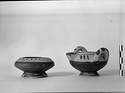
One nozzle missing.
Large lamp with two nozzles set opposite each other.
Base ring, separated by groove from wall; flat insloping rim. Central tube.
Black glaze except for reserved tops of nozzles, bottom ... 23 March 1937 ... Hesperia 39 (1970), p. 212, no. C 5. |
Over half of rim and wall preserved with a small piece of base attached; strengthened with plaster. Faint rouletting on rim. No stamped decoration preserved.
Late Roman C. Cf. H-I 7-8:1. Burnt layer ... 1964 |
| a) Two joining rim sherds, b) four joining base sherds, apparently from the same vessel. Hayes form 3B variant: upright rim, rouletted; low tilted foot. 'Rosette' stamps (4 peltae and central ring) on ... 17-23 May 1938
6-9 May 1938, 10-11 June 1938 (Frag. c) |
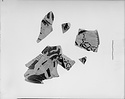
From the side of a large closed vase, unglazed inside. On outside; two draped figures, facing left, one behind the other. The background figure is a man; that in the foregrand probably a man also, although ... 10-11 April 1934 |
| Complete except for chips.
Circular mold with round thickened edge.
ADDENDA: C. Grandjouan: Possibly for pot emblema. Much worn. Cistern. Coroplast 's dump.
4th c. B.C. fill. Leica, XXXIV-65, 81-39-30, ... 15 April 1938 ... ADDENDA: C. Grandjouan: Possibly for pot emblema. ... Coroplast 's dump.
4th c. B.C. fill ... Leica, XXXIV-65, 81-39-30, XXXIV-55 |
Half of base and one nozzle preserved in two joining fragments.
Very snub-nosed nozzle. Central tube. Raised foot. Two grooves on lower body. Reserved top of nozzle and outside edge of foot.
Good black ... 3 July 1968 ... Hesperia 39 (1970), pp. 211-212, no. C 5, pl. 56, fig. 18. |
Fragment of a roof cover tile.
Coarse dull buff clay with large bits; slipped, buff, inside. Well F, early 5th. c. Leica PD 1864 ... 19 June 1935 |
Very slightly chipped and worn.
The goddess is seated on a simple backed throne, dressed in a chiton and wearing a polos. Her hair hangs to her shoulders. In her right hand she holds a patera, in her left ... |
Lower edge preserved.
Rear legs of horse.
For architectural decoration.
Clean reddish-buff clay. Pit; 4th. century B. C. context. 5496 Leica ... 12 April 1955 |
|
|