|
|
All three from different pots, but one example of archaic mending.
Orange buff clay. Oscar Broneer, Nb. No. 5.
Aglaurion, ca. 14m. 76 ... 7-10 July 1937 ... AP 3007 c ... AP 3007 c |
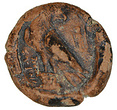
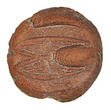
| Obverse: eagle standing left, head thrown back.
In field to right, a draped female figure erect, Demeter or Artemis (?), a tall torch (?) in either hand. In field to left, a branch and an inscription ... 18 June 1937 ... Agora X, p. 129, pl. 32, no. C 19 c. |
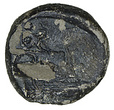
| Stamped.
Obverse: a nude figure seated, knees drawn up, on the prow of a ship.
Reverse: plain.
Black glaze.
Gray clay. Red Hellenistic fill. Leica ... 25 April 1934 ... Agora X, p. 128, pl. 32, no. C 15 c. |
| From same series as A 2837 and A 2838, but not inscribed. Complete save for minor abrasions. Heavily weathered.
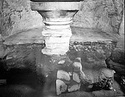
Anathyrosis on both lateral edges. In bottom a dowel cutting 0.48m. from left edge (no possibility ... 1959 ... PD 2006 c |
| Complete except for chips. Shaft has twenty flutes.
Pentelic marble. Catalogued May 1971. A letter of 1985, attached to the card, says the capital was being moved to the South Slope of Acropolis to the ... 4th c. B.C. (?) ... 4th c. B.C. (?). |
Three-fourths of rim and wall missing; underside, half of foot, and parts of wall restored.
Flaring foot; broad, flat resting surface. Wall strongly convex, with flare at top. Shiny black glaze.
Similar: ... 200-175 ... G 6:2 (Group C) |
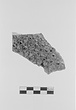
| Two joining fragments preserving small portion of body of large closed vessel. Misfired to the point of vitrification with numerous bubbles and blisters on exterior. Catalogued September 1996, JKP. Tholos ... 4 June 1938 ... Tholos trench U, Pit in alley, layer (c). |
| On one side, letters in raised characters; on other side an uncertain represantation, in relief.
Soft reddish clay. Civic Offices, westernmost room, surface of floor. Hellenistic or later context. Leica ... 15 May 1953 ... Agora X, no. C 3. |
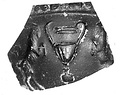
| Pellet of fine buff clay stamped on both sides.
Obverse: bearded male head to left, female head to right, lion's head above, eangle below.
Reverse: kantharos.
Black glaze on reverse only.
Very fine work ... 11 September 1953 ... Agora XX, no C 7. |
Broken all around. Part of abacus and one volute preserved. Upper corner of plain Ionic capital. Somewhat crude workmanship. Chisel marks visible.
Bluish Hymettian marble. Upper fill of Apse. Room 3, Roman ... 25 July 1970 ... Agora XXIV, pl. 42 c. |
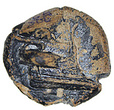
| Clay disk with the prow of a ship in relief.
Attic clay, black glaze.
Resembles a coin type. Cxt: Area I 10(VG)* small fig sitting at front of prow 271 Leica ... Late Roman (?) ... Agora X, no. C 15a. |
| Small clay seal.
The object is shaped like a small Greek coin save that only one side is struck. The insect appears to be a locust. To its right is atiny many-branched twig.
Impression of winged insect; ... 12 March 1932 ... Agora X, no. C 21. |
| Terracotta seal impression with ship.
Greyish-buff clay; thin black glaze.
A vessel with high-built stern and elaborate rigging seems to be proceeding left. Dim: Th 0.003*
Msc: F G 13 on [ ... ](VG)* Mixed ... 2 April 1932 ... Agora X, no. C 15b. |
Mended from many pieces; one handle and two small pieces of wall missing; restored in plaster. Flat bottom, rounded wall drawn in slightly below; slightly projecting lip; two horizontal strap handles ... 15 April 1939 ... Skyphos: Type C |
Mended from many pieces, several pieces missing, including the one handle, half of the other and half foot; restored in plaster. Substantial ring foot; thick rim with concave profile.
Handle inside, handle ... January-February 1950 ... Skyphos: Type C |
Most of body missing.
Rounded body; single groove around convex rim. Central hole for insertion of support. Groove around top of base.
Clay: fine buff; worn black glaze inside and out. Assembly Place, ... 1932 ... Type VII c |
Almost straight sides. Short, stubby nozzle. Single wide groove around rim. Central hole for support on stand (upper part broken off).
Clay: fine reddish, black glaze (worn) except on bottom and in groove ... 07/07/1936 ... Type VII c |
| Right knee of a kouros of the Sounion type, about one and half life-size.
Broken above and below, the breaks slanting up to the back.
Island marble.
Part of the same statue are:
S 287 (Θ 146), S 530 ( ... Ca. 600-590 B.C ... Part of the same statue are:
S 287 (Θ 146), S 530 ( Ο 294), S 1677 (Κ 1621), S 1276 c (Θ 1928), S 1908 (Ζ 2086). |
The neck preserved to its original height over one-half of its circumference. Gently concave in profile. Around its middle runs a garland of ivy leavs c arefully rendered in thinned clay. Just under the ... 1932 ... Hesperia 3 (1934), no. C 14. |
| Four pieces; the original bottom is preserved on a); b) (mended from two pieces) is a corner piece; otherwise the decorated surfaces only preserved, nothing of the top.
Alternating pattern of a narrow ... 24 June 1935 ... P.H. a) 0.12, b) ca. 0.10; L. a) 0.145, b) 0.24; Th. a) 0.103; Max. Dim. c) 0.09, d) 0.11 |
| Fragment preserves part of bottom and start of leaves.
Inscribed on bearing surface in letters varying in height: Κ Η Ο Θ C.
Pentelic marble.
Odeion series.
ADDENDA From round free standing column of ... 23 July 1946 ... Hesperia 19 (1950), pl. 35 c. |
Part of only one decorated face preserved, with a rosette in a looped circle. The adjacent face is plain and has a hole for attachment.
From a column similar to A 2561 (ΗΑ 106).
Byzantine.
Pentelic marble ... Byzantine ... Agora XX, p. 16, no. C. |
| Mended from many pieces; small parts of rim and sides restored in plaster.
Broad rim sloping slightly down; the outer face beveled, the underside forming a continuos curve with a light collar around the ... April 1951 ... Hesperia 21 (1952), pl. 21 c. |
| Two non-joining fragments of molded wall socle.
a) Top, bottom and front preserved; left end broken; right end and back worked down with single point probably in late times. In top a trace of a pour channel ... July 1948 ... Hesperia 19 (1950), pl. 45 c. |
| Fragment from lower end of stroter of usual form. Green impurity in marble. good work.
Inscribed on underside: ΔΙΓ.
Pentelic marble. Found at L/6-12/9 (Fall 2016). From burnt debris in S.W. corner of cryptoporticus ... 1934 ... Hesperia 19 (1950), pl. 39 c. |
Restored in plaster. False base ring set off from the side wall by a shallow groove. On the inside, about 0.01m. below the lip the glaze has been scratched from the bottom of a shallow groove.
Thin black ... 1932 ... Hesperia 3 (1934), no. C 7. |
Rim fragment with double spirals combined with egg and dart pattern in upper zone.
Good fabric. Cistern. Leica PD 315 ... 1932 ... Hesperia 3 (1934), no. C 32. |
| Rim fragment with double spirals combined with leaves in upper zone. Below, goats rampant with krater between. Cistern. Leica, 99-20-1(2,3,4,5) PD 315 ... 1932 ... Hesperia 3 (1934), no. C 36. |
Fragment from the medallion; partly filled by a small 8-petalled flower, around which runs a single band of veined leaves. From these rise tall petals with vine tendrils and leaves between them. Cistern ... 1932 ... Hesperia 3 (1934), no. C 38. |
Wall fragment depicts two rampant goats before krater above which is a mask in the center. Birds above and a second mask to the left.
Firm black glaze. Cistern. Leica PD 316 ... 1932 ... Hesperia 3 (1934), no. C 46. |
Lip fragment with a single shallow groove on the rim.
Coarse clay with bits; gray-green as if from burning. Traces of a cream slip. Cistern. Leica PD 350 ... 1932 ... Hesperia 3 (1934), no. C 63. |
Fragment of single twisted handle surmounted by rotelles.
Gritty red clay.
Cf. Agora XXXIII, no. 581. Cistern. Leica, 4-326 ... 1932 ... Hesperia 3 (1934), no. C 71. |
Flat bottom, a well-curved side wall, and a steep rim with a very slight ledge to receive the lid.
Gritty red clay blackened by fire on the outside.
Cf. Agora XXXIII, no. 651. Cistern. Leica, 4-326 PD ... 1932 ... Hesperia 3 (1934), no. C 73. |
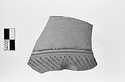
| Fragment of shoulder which is bordered by two wheel-run grooves. Within the grooves are oblique lines of punctured dots produced by pressing into the soft clay the teeth of a short length of comb. Another ... 1932 ... Hesperia 3 (1934), no. C 79. |
Only the middle of the floor preserved, which rested on a false base ring formed by the downward continuation of the side walls. Around the outside are shallow corrugations run on the wheel. On the floor, ... 1932 ... Hesperia 3 (1934), no. C 12. |
| Two rim fragments. Pattern of rosettes and leaves in upper zone.
Good fabric; the glaze almost completely flaked. Cistern. Leica PD 315 ... 1932 ... Hesperia 3 (1934), no. C 30. |
Fragment from near rim with egg and dart pattern in upper zone; Eros below.
Good fabric. Cistern. Leica PD 315 ... 1932 ... Hesperia 3 (1934), no. C 33. |
Fragment from near rim with bands of ribbed leaves on wall.
Good glaze and fabric. Cistern. Leica PD 315 ... 1932 ... Hesperia 3 (1934), no. C 34. |
Fragment from near rim with arec flowers above double spiral and leaves.
Good fabric. Cistern. Leica PD 315 ... 1932 ... Hesperia 3 (1934), no. C 35. |
Medallion fragment centered with a double rosette and surrounded by a rich band of fronds with buds springing up between them.
The glaze fired to a deep red over the medallion and the middle of the floor ... 1932 ... Hesperia 3 (1934), no. C 40. |
|
|