|
|
| Thyrsos. Finished Byzantine Building, Room X. Κ̣ρί[νις]
thyrsos
[Θ]α̣[σίων] (inv) Leica ... 11 June 1938 ... Byzantine Building, Room X. |
The lower part of a face from a tragic (?) mask with pierced eyes.
White paint inside, with traces on outside.
Red clay. Byzantine Building, room XX.
Late Roman to Early Byzantine fill. Leica ... 16 May 1938 ... Byzantine Building, room XX.
Late Roman to Early Byzantine fill. |
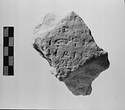
Inscribed fragment.
Broken all around and behind.
Citation.
Hymettian marble. Found in Byzantine context, below the floor of the room XVIII, of a Byzantine building, east of the Stoa of Zeus. Leica ... Ca. 200 B.C ... Found in Byzantine context, below the floor of the room XVIII, of a Byzantine building, east of the Stoa of Zeus. |
| Perhaps part of a door jamb.
The back is smooth, the front rough-picked, with a curved molding of crosses and degenerate palmettes.
Byzantine.
Pentelic marble. Lying on the floor in the passage of the ... Byzantine ... The back is smooth, the front rough-picked, with a curved molding of crosses and degenerate palmettes.
Byzantine.
Pentelic marble ... Lying on the floor in the passage of the burned Byzantine building. |
Face and front part of head preserved.
Mold was heavily incised for features. Clay covered with white paint.
Coarse red clay. Byzantine Building, room xxi, below floor 1. Leica ... 12 February 1934 ... Byzantine Building, room xxi, below floor 1. |
Face only preserved.
Mold was deeply incised for features.
White engobe.
Coarse red clay. Byzantine Building, room xxvii, below floor 4. Cf. coins nos. 3, 4 for the day. Leica ... 12 February 1934 ... Byzantine Building, room xxvii, below floor 4. |
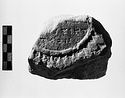
Inscribed fragment.
Inscribed face only preserved.
Ten lines of the inscription preserved.
Pentelic marble. Found in a wall of a Byzantine building, south of the altar of the Twelve Gods. Leica ... 20 May 1938 ... Found in a wall of a Byzantine building, south of the altar of the Twelve Gods. |
| Clay mostly fired grey.
Impression broken away right, incomplete all round otherwise; thyrsos(?). Par: SS 05544* Finished Byzantine Building, room XVIII, from black earth. Late Roman context. Θά[σιον] ... 26 June 1933 ... Byzantine Building, room XVIII, from black earth. |
Inscribed fragment.
Broken all around and behind.
Honorary monument or decree (?).
Seven lines of the inscription preserved.
Bluish-white marble. Found in Byzantine context, under the floor of a Byzantine ... 3-5 May 1934 ... Found in Byzantine context, under the floor of a Byzantine building, room xviii, east of the Stoa of Zeus. |
| Inscribed fragment.
Broken all around and behind.
Part of six lines of the inscription preserved.
Pentelic marble. Found just below the floor of a Byzantine building (room xxi), east of the Stoa of Zeus ... Ca. 158 B.C ... Found just below the floor of a Byzantine building (room xxi), east of the Stoa of Zeus. |
Rosette on discus; herringbone on rim.
Solid handle, triple grooved above, double below.
On the bottom, two concentric grooves.
Type XXVIII of Corinth collection. Byzantine Building, Room xxvii, west ... 10 February 1934 ... Byzantine Building, Room xxvii, west part, just below floor 4. |
Fragment from the shoulder of a closed pot. Upper part of a bearded male figure, draped, moving right, carrying a bier?
Buff clay; red on beard and hair. Debris in Byzantine Building, Room 3. Leica ... 16 April 1936 ... Debris in Byzantine Building, Room 3. |
| Inscribed fragment.
Inscribed face only preserved.
Six letters remain.
Poros. Found built into a bench in a Byzantine building, east of the southern part of the Stoa of Zeus. Leica, 87-1-13, 87-1-14 ... 5 May 1938 ... Found built into a bench in a Byzantine building, east of the southern part of the Stoa of Zeus. |
| Inscribed fragment of grave stele.
Bottom and apex of pediment broken away; otherwise complete.
Two lines of the inscription preserved.
Pentelic marble. Found in the paving of a Byzantine building, south ... 4 April 1938 ... Found in the paving of a Byzantine building, south of the Eleusinion. |
About half the base and a bit of the side wall preserved, with the signature inside a single groove.
Type XVIII of Corinth collection.
Byzantine Building, room xxvii, below floor 5. Cf. coin, ii. 12.34, ... 12 February 1934 ... Byzantine Building, room xxvii, below floor 5. |
Nozzle and handle broken away.
Rosette on discus; on the rim, debased grape leaves and tendrils.
Reverse, plain.
Type XXVIII of Corinth collection. Byzantine Building, room xxvii, below floor 4. Cf. coin, ... 12 February 1934 ... Byzantine Building, room xxvii, below floor 4. |
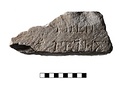
| Device. Rdg: dev poss a long spread wing(VG)*Par: =Kthsi(= on
numerous stps in Pridik 1917, but only the kind w/ 2 names
and no dev(VG)* Finished Byzantine Building, Room XXV. Θασι[---]
device Απ[---] ... 30 May 1938 ... Byzantine Building, Room XXV. |
| Inscribed fragment.
Inscribed face and smooth left side preserved.
One line of the inscription preserved.
Island marble. Found in a wall of a Byzantine building over the area of the late Roman Building, ... 31 May 1938 ... Found in a wall of a Byzantine building over the area of the late Roman Building, east of the central part of the Stoa of Zeus. |
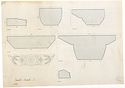
A virtually square capital carved with seven petaled palmettes on the face and leaves at the corners. A square dowel hole irregularly placed on top.
A rosette above the palmette is preserved on only one ... Byzantine ... A small round dowel hole underneath and a small incised cross at one side.
Byzantine.
Pentelic marble ... Built against the southerly cross-wall of the upper Byzantine Building, in Trench 7. |
| Inscribed fragment.
Broken all around and behind.
Four lines of the inscription preserved.
Pentelic marble. Found under the floor of the Byzantine building, room xx, east of the Stoa of Zeus; 2nd.-3rd ... 28 March 1934 ... Found under the floor of the Byzantine building, room xx, east of the Stoa of Zeus; 2nd.-3rd. centuries A.D. context. |
| Inscribed fragment.
Broken all around and behind.
Remains of three lines of letters, within a conventional wreath.
Hymettian marble. Found just below the floor of a Byzantine building (room xxi), east ... 12 February 1934 ... Found just below the floor of a Byzantine building (room xxi), east of the Stoa of Zeus. |
Discus and handle broken away.
On the rim, herringbone pattern. The reverse almond-shaped, bounded by a double groove, enclosing the signature "KY".
Type XXVIII of Corinth collection. Byzantine Building, ... 8 March 1934 ... Byzantine Building, room xviii, lowest black filling in plundered foundation pit. |
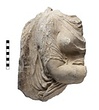
| Broken behind; smooth-picked at left where the side is preserved.
Of the relief is preserved the right arm and bosom of a seated woman, wearing a chiton with buttoned sleeves.
Pentelic marble. Byzantine ... 22 April 1936 ... Byzantine Building I, wall F. |
Flat profile.
Coarse micaceous clay, fired buff inside with a pale yellow wash outside; distinct,
rather thick slip.
Retrograde.
Thasian(?). Stored wit "άγνωστα".
Class: Th?*
Dim: W 0.044* Byzantine ... 12 May 1934 ... Byzantine Building, room xviii, lowest layer above classical floor. |
Columnar grave monument.
Broken at the top, a small portion of the ring preserved.
Hymettian marble. Found around with stones just east of the second west wall of the Byzantine building, at surface, northwest ... 3 May 1934 ... Found around with stones just east of the second west wall of the Byzantine building, at surface, northwest of the church of St. |
Inscribed fragment.
Inscribed face only preserved.
List of Ephebic names.
Five lines of the inscription preserved.
Pentelic marble. Found in late context just above ground level of Byzantine building, ... Beginning of 3rd. century A.D ... Found in late context just above ground level of Byzantine building, over the foundation of the northern part of the Stoa of Zeus. |
Inscribed fragment.
Inscribed face, rough picked back (?) and a small bit of the right side preserved.
One line of the inscription preserved.
Pentelic marble. Found in a wall of a Byzantine building, east ... 1 June 1938 ... Found in a wall of a Byzantine building, east of the central part of the Stoa of Zeus. |
Inscribed fragment.
Inscribed face and smooth dressed top preserved.
Citation from decree.
Six lines of the inscription preserved, three within wreath.
Hymettian marble. Found in a wall of a Byzantine ... 4 June 1938 ... Found in a wall of a Byzantine building, east of the central part of the Stoa of Zeus. |
Rear part and bottom only preserved.
On discus, rosette; rim, plain; handle, solid.
On reverse, within two circular grooves, the signature "A".
Thin red wash.
Red clay.
Type XXVIII of Corinth collection ... 24 February 1934 ... Byzantine Building, room xxviii between floors 4 and 5. |
Complete but somewhat rubbed. The mold for the top part.
On the discus, head of Helios; on the rim a continuous band of small circles.
Coarse red clay, fired to yellow in places on the surface.
For lamp ... 29 March 1934 ... Byzantine Building, room xx, between floors 2 and 3; late Roman-Byzantine context. |
Curve fragment.
Much worn impression, an edge partly broken away; garlanded boukranion.
Cf. Dumont (1872), p. 184, no. 254 (incomplete). Par: Dumont 1871, p184 nr 254 (incomplete)* Byzantine building, ... 8 April 1933 ... Byzantine building, room IX, firm filling over classical floor. |
| A square impost block, carved on the beveled edge with trefoil ornament in the corners, cross with circles in the center, with two crosses in diamonds with dotted triangles as filling ornaments on either ... Byzantine ... Rough-picked beneath; smooth-picked on top, with a dowel on one side, to which the design is adapted as a series of diminishing triangles.
Byzantine.
Marble ... Resting on earth in the filed Room of the upper Byzantine Building. |
Mended from several pieces; bits missing.
Cross on discus; impressed circles on rim. Pointed knob handle. Flat bottom with two almond-shaped grooves enclosing several stamped circles.
Crumbly red clay ... 10 February 1934 ... Byzantine Building, Room xxvii, northeast corner, between floors 2 and three. |
Nozzle broken away.
On discus, rosette; on rim, two grooves; handle solid, three grooves above, two below.
On reverse, within two almond-shaped lines a "C".
Thin red glaze.
Red clay.
Type XXVIII of Corinth ... 13 February 1934 ... South of Byzantine Building, room xviii, below its ground level. |
Part of top only remains.
On discus, a dog to right, with head turned back.
Two filling holes and an air hole. Herringbone on rim.
Unglazed.
Buff clay.
Type XXVIII of Corinth collection. Byzantine Building, ... 9 March 1934 ... Byzantine Building, room xviii, from lowest black filling in pillaged foundation pit. |
Half of nozzle and part of bottom missing.
Convex sides.
Herringbone on rim.
Whirling rosette on discus.
Solid handle, grooved above and below.
On reverse, double bounding line and small circles.
Unglazed ... 22 April 1933 ... Byzantine Building, Room VI, below top of Roman wall. |
| Inscribed fragment.
Broken at left, right, bottom and possibly on top; back face dressed with pointed chisel.
Honors Tiberius Claudius as benefactor of the city.
Parts of two lines of the inscription preserved ... 16 March 1933 ... Found over the floor of Byzantine building, northwest of the Temple of Ares. |
| Inscribed fragment.
Inscribed face and smoothly dressed right side preserved.
Five lines of the inscription preserved, trace of another above (?).
Pentelic marble.
ADDENDA Joins to I 5709. Found in a ... 19 May 1938 ... Found in a wall of a Byzantine building, south of the altar of the Twelve Gods. |
Discus, deeply concave, plain; on the rim, vine pattern. The handle solid.
On the reverse, double almond-shaped bounding groove, punctuated by tiny circles and enclosing a palm branch.
Unglazed.
Red clay ... 8 March 1934 ... Byzantine Building, room xviii, lowest black filling in plundered foundation pit; coins. |
Front part broken away.
On the discus, the head of Helios; the rim plain; the handle solid, plain.
On the reverse, a single circular groove.
Unglazed.
Light red clay, very soft.
Type XXVIII of Corinth ... 6 March 1934 ... Byzantine Building, room xviii, southest part of room, between floors 3 and 4. |
|
|