|
|
Part of rim, side and bottom preserved.
Herringbone on rim; on the bottom, within two concentric grooves, a much damaged signature.
Type XXVII of Corinth collection.
Burned area. Leica PD 1375-17 ... 5-6 April 1933 ... Burned area. |
A: mask, facing.
Small circular countermark, perhaps a herm, lower right.
B: illegible stamp.
Cf. IL 1162 (Z 1752), for same type. Entered as coin no. 14, for the day. Trench I, center. Burned area. Leica ... 5 April 1933 ... Trench I, center. Burned area. |
Intact.
Wavy lines on rim, shell on discus; solid grooved handle; almond-shaped reverse, with double concentric grooves enclosing two stamped circles.
Purplish wash.
Light red clay.
Type XXVIII of Corinth ... 11 June 1936 ... In burned area, with bones. |
Small deep filling hole framed by raised ring.
Three raised rings edge the plain discus.
On the rim, six pairs of pellets. Pierced handle triangular nozzle.
Unglazed. Traces of burning at nozzle.
Buff ... 5 April 1933 ... Burned area. Trench I at 19/ΛΘ. |
Handle broken away.
Pattern of alternating grapes and leaves on rim.
Discus with rays, triangular nozzle.
On the reverse, incised circle and signature:"ΕΥΚΛΕΙΔΟΥ".
Unglazed. Slight traces of burning at ... 6 April 1933 ... Burned area. Trench I at 20/ΛΣΤ. |
Nozzle broken away and handle chipped.
Sunken discus decorated with narrow rays, raised rings around filling hole and edge of discus, a pattern of grapes and vine leaves alternating around the rim.
Semi-pierced ... 5 April 1933 ... Burned area. Trench I at 21/Μ. |
Gray clay, burned.
Letters incised left to right with a blunt point. ΑΠ- Altar area. ΑΠ- ... Gray clay, burned.
Letters incised left to right with a blunt point. ... Altar area. |
Grayish clay, probably burned.
Letters incised retrograde on inside of rim. -Διό[ς--] Altar area. -Διό[ς--] ... Grayish clay, probably burned.
Letters incised retrograde on inside of rim. ... Altar area. |
Lid missing.
Flaring ring foot. Jutting ledge at top of wall. Burned and peeled. The only reserved area possible to detect is a zone above the foot, decorated with rays ... Ca. 525 B.C ... Jutting ledge at top of wall. Burned and peeled. The only reserved area possible to detect is a zone above the foot, decorated with rays. |
From the openwork stand of an open bowl, painted inside. Lines at the top and sides, wavy line within. On the panel an ostrich-like bird, its neck extended downward, probably to peck. Disturbed area over ... 1934 ... Disturbed area over burned building. |
| Pierced hub. Burned fill. Store in ziplock polyethylene bag and in area with 40% r.h. or lower.
Wear cotton or latex gloves when handling. Leica, 5-297 ... 10 June 1935 ... Burned fill ... Store in ziplock polyethylene bag and in area with 40% r.h. or lower.
|
| Fragment from shoulder.
Decorated with lines, dots and maeander.
Burned.
Developed style. Geometric area, outside house; from beside wall A-A and pit F. Leica, 3-21 PD 382 ... 25-26 April 1932 ... Decorated with lines, dots and maeander.
Burned.
Developed style ... Geometric area, outside house; from beside wall A-A and pit F. |
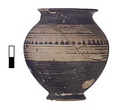
| Globular body; out-turned rim; no handles.
Glazed for 0.006m. within edge of rim inside, and over outside except for shoulder band reserved for pattern, and on rising undersurface of base.
Clay light ... 19 March 1932 ... By Greek wall and burned geometric area. |
| Two rim fragments of wide-mouthed household jar.
Two wavy lines incised horizontally.
Surface burned gray.
Household Ware. Lot ΣΤ ?. Geometric area outside house. Leica, VII-91, 3-52 PD 396 ... 1932 ... Surface burned gray.
Household Ware ... Geometric area outside house. |
Lion crouching right, raised on a base.
One large fragment and four small ones preserved; broken away on top, and in front; the entire back has gone except for the haunches. About half the base is left ... 5 April 1933 ... Trench I (18-22/ΛΑ-ΜΣΤ), in the burned area. |
Gray clay, probably burned; mended from two pieces.
Left to right. -ΙΕΕ-
The second letter could be a sigma with the second bar coming on the line of the break. Altar area. -ΙΕΕ- ... Gray clay, probably burned; mended from two pieces.
... Altar area. |
| Pyxis lid with flattened knob.
Decorated with star and filling dots.
Much burned.
Developed style. Truncated knob unusual. Geometric area, outside house; from beside wall A-A and pit F. Leica, 3-21 ... 18 May 1932 ... Decorated with star and filling dots.
Much burned.
Developed style. ... Geometric area, outside house; from beside wall A-A and pit F. |
Mould for the left side of a ram's head with curling horn. For a rhyton.
Clay reddish, hard. Burned? From a disturbed area to the north of the retaining wall of the Assembly Place III ... Early fifth century B.C. ? ... Clay reddish, hard. Burned? ... From a disturbed area to the north of the retaining wall of the Assembly Place III. |
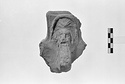
| One corner of lug chipped. Bearded head with projecting beard; flame-like hair surrounded by an oval frame.
Coarse micaceous clay, roughly molded. Partly burned. Stoa, Area South 3, north side, hard earth, ... 26 February 1953 ... Partly burned ... Stoa, Area South 3, north side, hard earth, layer II. |
Discus and upper back part with handle preserved.
Pierced grooved handle; dots on rim; Athena Promachos on discus, left.
Same type as L 4442 (OO 506). Transitional.
Gray clay burned gray-brown.
Type XXVII ... 10 April 1948 ... Gray clay burned gray-brown.
... Hypocaust area; furnace dump. |
Relief fragment preserving the mid-part of a draped female figure. Broken all around, part of the pot preserved at back.
Yellowish faience, burned.
A Hellenistic queen? Cf. P 18692 (Komos cistern) ... 18 March 1953 ... Yellowish faience, burned.
A Hellenistic queen? ... Stoa, area north 4, martyra, near strosis d. |
| Inscribed fragment.
Broken at bottom only; badly chipped and burned.
At top a heavy moulding on all four sides; apparently a small altar.
Three lines of the inscription preserved.
Pentelic marble. Found ... 19 March 1936 ... Broken at bottom only; badly chipped and burned.
At top a heavy moulding on all four sides; apparently a small altar.
... Found in late context, over the area of the northeast corner of the Eleusinion. |
| Fragment from neck only. The forelegs of a lion moving right. Diamonds, zigzag lines and floral ornaments in field. Incision for interior details of the beast.
Glaze red to black; clay in part stained ... 28 April 1938 ... Glaze red to black; clay in part stained or burned gray ... Tholos trench V, area of road, layer e. |
Lower half at front missing; mended from two pieces.
On rim, wavy lines.
On discus, rosette.
Solid handle, double grooved above and below; two large impressed circles at the bottom.
On the reverse, double ... 13 April 1933 ... Pinkish-buff clay, but fired or burned gray on top.
... Northeast area; disturbed deposit. |
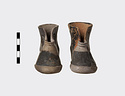
| A pair, right and left; small bits of both shoes missing and restored. Some pieces burned some not. High shoes without tongues, to cover the ankles (and more); two eye-shaped holes for laces at each side ... 8-10, 12 April 1948 ... Some pieces burned some not. High shoes without tongues, to cover the ankles (and more); two eye-shaped holes for laces at each side. ... Entirely covered outside with black glaze, except for soles and decorated area above instep. ... Clay buff where not burned, gray where burned.
|
Two fragments of a deep-bodied bowl with plain keeled rim, very slightly tilted inward. A hole pierced through the rim.
Coppery red glaze inside and out.
ADDENDA Lower part added from ΠΘ tin 69 [JWH, ... 27-29 January 1936 ... Russian sites (possibly from the Propontis-Bithynia area). JWH 1964 ... Burned Roman deposit and shaft. |
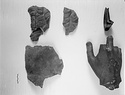
| a) Preserves part of the body.
b) Preserves part of the hip.
c) Is a large right hand, the thumb almost entirely preserved, the rest of the fingers broken off.
In the Autumn of 1935, I. Bakoulis, going ... 10-12 April 1934 ... Various places in the area, in the burned deposit on the floor of the Burned Building. |
Base of pointed pyxis.
Decorated with zigzags and tooth pattern.
Much burned. It does not belong to P 1638, but to another like it. Cf. JHS 51 (1931), pl. VI; CVA Athens, pl. I:8; AM 43 (1918), pl. I:6 ... 18 May 1932 ... Decorated with zigzags and tooth pattern.
Much burned. It does not belong to P 1638, but to another like it. ... Geometric area, outside house; from beside wall A-A and pit F. |
Fragment of lower wall with start of cul. Clay a bit gray (burned[?]). Max. dim. 0.063.
On wall, laurel wreath to right with fruit. On cul, tongue pattern.
At the very top there is a little bit of reserve ... Probably last quarter of the 5th century B.C ... Clay a bit gray (burned[?]). Max. dim. 0.063.
... The black glaze to the right indicates the handle area. White: laurel wreath.
|
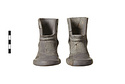
| Shoes similar to P 19249 (ΟΟ 616), but somewhat larger and more fragmentary; all the fragments badly burned. Two pairs of triangular lace holes on each shoe; the decorated area (incised and reserved) over ... 8-10, 12 April 1948 ... Shoes similar to P 19249 (ΟΟ 616), but somewhat larger and more fragmentary; all the fragments badly burned. Two pairs of triangular lace holes on each shoe; the decorated area (incised and reserved) over the instep larger and rounded at the bottom; the seam not indicated on the inner sides; at the level of the upper lace holes a reserved zone decorated with two lines around the back below the top. ... A rectangular area over the instep reserved and incised with parallel verticals; the front of the shoes, above and below the eye holes, finished off with a double roll. Entirely covered outside with black glaze, except for soles and decorated area above instep. |
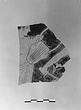
Two non-joining fragments, a of body, b of shoulder. Burned (clay is gray). Max. dim. a) 0.064, b) 0.035. H. A. Thompson, Hesperia 16, 1947, pl. 47:3.
Fragment a shows the lower legs and feet of a man ... Ca. 410 B.C ... Two non-joining fragments, a of body, b of shoulder. Burned (clay is gray). ... Fragment b preserves more ribbing, and to the left of it, a plain black area that is probably part of a figured panel. |
Fragment of domed lid with start of knob area at top (ridge), part of rim and brim, separated from the lid by a raised ridge. Glazed on underside except for two pairs of reserved lines on lid and one at ... Late 5th century B.C ... Fragment of domed lid with start of knob area at top (ridge), part of rim and brim, separated from the lid by a raised ridge. ... Much of the glaze fired grayish (not burned). Max. dim. 0.119; est. diam. at brim 0.17.
|
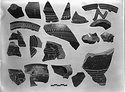
Six non-joining fragments, a of rim, neck, shoulder, and start of one handle column, b + d of shoulder with swelling for handle root and part of wall, c, f, and g of wall. Glaze dull in places on outside; ... Ca. 480 B.C ... Glaze dull in places on outside; a bit abraded on topside of rim. Burned slightly on Side A. ... This is very likely what the small reserved area at the bottom of fragment c represents. |
|
|