|
|
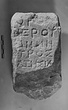
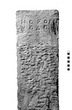
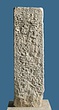
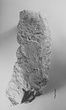
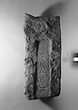
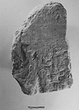
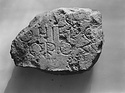
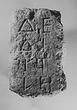
Inscribed boundary stone.
Stone roughly broken on all sides; inscription complete with two lines.
A dark gray to black quartzy stone, with large white veins.
Dark gray marble. Found in late context, in ... 4th. century B.C ... Inscribed boundary stone.
Stone roughly broken on all sides; inscription complete with two lines.
A dark gray to black quartzy stone, with large white veins.
|
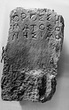
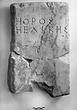
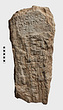
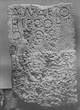
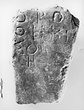
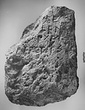
Inscribed grave boundary stone.
Lower part left rough for setting.
Inscription entirely preserved and back, left side, and top (?) of stone.
Nineteen letters remain.
Hymettian marble. Found in modern context ... Before middle of 4th. century B.C ... Inscribed grave boundary stone.
Lower part left rough for setting.
Inscription entirely preserved and back, left side, and top (?) of stone.
Nineteen letters remain.
|
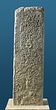
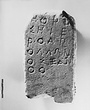
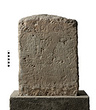
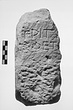
Inscribed boundary stone.
Complete save minor chips.
Roughly worked, except inscribed surface which is dressed with toothed chisel.
Pentelic marble. Found in marble dump southeast of the Market Square, ... 13 October 1947 ... Boundary Stone |
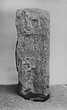
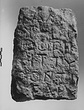
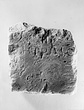
Inscribed boundary stone.
Rectangular slab, broken off at top and bottom; roughly finished.
The inscription on the upper part of the front face; the beginning broken off.
Limestone. Found in water channel ... 13 October 1947 ... Inscribed boundary stone.
Rectangular slab, broken off at top and bottom; roughly finished.
|
Inscribed boundary stone.
Intact, except for chips and wearings at back.
Rectangular cutting at top 0.145X0.065m. probably dating from block's reuse as doorsill.
All surfaces rough picked except for about ... 4th. century B.C ... Inscribed boundary stone.
Intact, except for chips and wearings at back.
... All surfaces rough picked except for about one-third of the face, which bears the inscription.
Boundary stone for sacred way along which the Pythais proceeded to Delphi.
|
| Small inscribed boundary stone.
Broken at the bottom, and chipped at the top.
Sanctuary of Demeter Azesia.
Most of five lines of the inscription preserved.
Hymettian marble. Found in a modern wall, over ... 4th. century B.C ... Small inscribed boundary stone.
Broken at the bottom, and chipped at the top.
|
| Inscribed boundary stone.
Unbroken except a chip from upper left front corner. Rough picked all around.
At the top of the front face a smooth band, with the inscription.
Four letters remain.
Pentelic ... Ca. 450 B.C ... Inscribed boundary stone.
Unbroken except a chip from upper left front corner. |
Inscribed fragment.
Top, left side and back preserved; also part of bottom.
Top of surface of stone finished smoothly, until 0.160m. from the top; below that left rough, for insertion into ground.
Boundary ... 8 February 1936 ... Top of surface of stone finished smoothly, until 0.160m. from the top; below that left rough, for insertion into ground.
Boundary stone of "the ancestral highway".
|
| Inscribed boundary stone.
Broken away above, below and behind.
Sides and inscribed surface roughly dressed.
The sacred house of Athena Polias.
Poros. Found in the wall of the modern house 637β/2 (637b/2), ... 4 December 1934 ... Inscribed boundary stone.
Broken away above, below and behind.
|
| Inscribed boundary stone.
Complete save minor fractures.
Roughly triangular in section. The inscribed face slightly convex.
The lower 0.10m. rough for insertion into ground.
Traces of red paint in all ... Early 4th. century B.C ... Inscribed boundary stone.
Complete save minor fractures.
|
| Inscribed boundary stone.
Chip missing from near bottom; otherwise complete.
Tall rectangular stele, rough picked on all sides.
At top of front face a panel has been dressed smooth with a claw chisel and ... 1 July 1977 ... Inscribed boundary stone.
Chip missing from near bottom; otherwise complete.
|
| Inscribed boundary stone.
Face smooth 0.10m. down from top.
Rough picked on top, sides and below 0.10m. on face.
"O" for genitive "OY", "H" for aspirate; tailed "rho".
Letter spacing: 0.026m.
Pentelic ... 2 September 1966 ... Boundary Stone |
| Inscribed boundary stone.
Mended from five fragments.
Broken at left side and bottom only; but the left side may represent original state of the stone, and a bit of bottom seems to be preserved.
Below ... Ca. 400 B.C ... Inscribed boundary stone.
Mended from five fragments.
Broken at left side and bottom only; but the left side may represent original state of the stone, and a bit of bottom seems to be preserved.
|
| Inscribed Agora boundary stone.
Top worn smooth by traffic. Corners broken.
Inscription written retrograde across top and along left side. Inscription does not cover corners, a fact perhaps indicating ... 27 July 1967 ... Boundary Stone |
| Inscribed boundary stone of Agora.
The corners of its upper are much rubbed. All surfaces were roughly picked.
On the broad face that looks norheast, a band was smoothed with a toothed chisel across the ... 27 February 1938 ... Inscribed boundary stone of Agora.
... One line of the inscription preserved, around top and right side of stone.
Coarse-grained white marble, with bluish streaks. |
| Inscribed boundary stone of Kerameikos.
Left in place when section was filled.
A roughly-trimmed block; its front face picked to be visible in its upper part; the top of the front face dressed with a toothed ... March 1939 ... Boundary Stone |
Inscribed boundary marker.
Complete (?).
Roughly worked cuble, perhaps a wall block. Smoother area on face where inscribed rasura at bottom suggests more than one period.
Hard gray stone with lighter yellowish-brown ... April 1975 ... Inscribed boundary marker.
Complete (?).
... Hard gray stone with lighter yellowish-brown veins. |
Inscribed fragment.
Right side with chisel marks preserved; elsewhere broken.
Face very rough.
Boundary for grave lot.
Four letters remain and traces of fifth.
Pentelic marble. Found in the wall of a modern ... 4th. century B.C ... Boundary Stone |
An unworked stone probably complete except for upper left edge of inscribed face.
For private property.
Five lines of the inscription preserved.
Hymettian (?) marble. Found at surface, north of the Odeion ... 4th. century B.C ... Boundary Stone |
| Impossible to be certain whether stone complete.
Rough, rectangular slab with inscription on upper face in area smoothed to receive letters.
Rough piece of gray schist.
ADDENDA Belongs with I 7461, I ... 14 June 1973 ... Boundary Stone |
| Impossible to be certain whether stone complete.
Two lines of the inscription preserved. Area of inscription worked roughly smooth. Line of horizontal marks made by pointed tool down front and back.
Rough ... 14 June 1973 ... Boundary Stone |
| Complete save minor fractures.
A rough stone pillar of which only the upper 0.33m. is dressed on front and sides.
The inscription occupies only the upper 0.155m. of the face.
Four lines of the inscription ... 15 May 1940 ... Boundary Stone |
Inscribed fragment.
In two pieces; lower half found in box 4 of well.
Tool marks on front and back.
Rough piece of gray schist.
ADDENDA Same type of rough cut rectangular stone with inscription on top ... 14 June 1973 ... Boundary Stone |
| Inscribed block.
Broken away at left and below, and in back.
Hymettian marble. Found in the wall of the modern house 637/18, northeast of the Eponymous Heroes; actually section Ε. Leica, XXXI-15 ... 4th. century B.C ... Boundary Stone |
| Broken at the bottom.
The whole surface is left rough, only the inscribed part of the front face preserved.
Sanctuary of the Anakion.
Poros. Found in the wall of the modern house 637/15, over the southeastern ... Ca. 450 B.C ... Boundary Stone |
Broken away at right.
All surfaces rough except a narrow band at the top of one face, on which is the inscription.
Pentelic marble. Found in modern context at surface, east of the northern part of the ... 4th. century B.C ... Boundary Stone |
| Chipped all around; back and bottom broken off, but the inscription complete.
Sanctuary of Apollo Xanthos. Found in Hellenistic context, in the channel of a well outside the Market Square, to the southwest ... Ca. 400 B.C ... Boundary Stone |
| Broken at bottom and left side; preserved surfaces all rough picked, save for a recessed, more finely picked band, on which is the inscription.
Perhaps sanctuary of Herakles Alexikakos.
Pentelic marble ... Mid. 5th. century B.C ... Boundary Stone |
| Intact. Found in situ in the southwest corner of the small shrine with naiskos and round altar west of the ancient road and partly under the modern street. Removed from its position by some unauthorized ... 27 October 1965 ... Boundary stone |
| Broken away at upper right, corner and perhaps below; otherwise intact.
Whole very roughly worked.
Fifteen letters preserved.
Hymettian marble. Found in modern context at surface, east of the Odeion. Leica, ... 4th.-3rd. centuries B.C ... Boundary Stone |
| Apparently complete.
Along bottom of front face a rough slightly projecting surface at level for setting into ground.
Limestone or hard gray poros. Brought in 1947; length and thickness cannot be measured ... 27 May 1947 ... Boundary Stone |
| Fragment of boundary stone.
Broken below, behind and to the left.
Trittys boundary stone of Thorikos and some unknown deme (cf. Hippothontis).
Poros. Found in the wall of the modern house 637/14, over ... 13 October 1934 ... Boundary Stone Fragment |
| Inscribed fragment.
Inscribed face only preserved; much battered.
Boundary stone for private property.
Hymettian marble. Found in a marble dump, in the area of the northwestern part of the Odeion. Leica, ... 1 February 1935 ... Inscribed face only preserved; much battered.
Boundary stone for private property.
|
| Inscribed fragment of boundary stone.
Right edge of inscribed face worn away.
Original sides at bottom and right, also left, below last line of inscription. Therefore there is room for two more letters ... Early 5th. century B.C ... Inscribed fragment of boundary stone.
Right edge of inscribed face worn away.
... Trittys boundary stone for Pallene (Antiohis).
|
| Inscribed fragment.
Back preserved.
Trittys boundary stone of Sphettos.
Two lines of the inscription preserved.
Pentelic marble. Found in a wall of the modern house 641/13, south of the Market Square ... 5th. century B.C ... Boundary Stone Fragment |
| Inscribed fragment.
Top, bottom, sides and back rough, possibly all original (though battered at edges).
Boundary stone of the Metroon.
Pentelic marble. Found in modern context, to the east of the southern ... 400-350 B.C ... Boundary Stone Fragment |
Inscribed fragment of grave boundary stone.
Inscribed face only preserved.
Four letters remain, and traces of two others, above.
Pentelic marble. Found in the wall of the modern house 645α/17 (645a/17) ... 4th. century B.C ... Boundary Stone Fragment |
Inscribed fragment.
Top, right side and back preserved.
Boundary stone for trittys of Phrearrioi (Leontis).
Four lines of the inscription preserved.
Poros. Found in wall of the modern house 648/10 southeast ... 17 September 1938 ... Top, right side and back preserved.
Boundary stone for trittys of Phrearrioi (Leontis).
|
| Inscribed fragment.
Parts of top, both sides and back preserved; bottom broken off.
Boundary stone of the Nymphaeum.
Three lines of the inscription preserved.
Poros. Found in modern or late Turkish wall ... First half of 5th. century B.C ... Parts of top, both sides and back preserved; bottom broken off.
Boundary stone of the Nymphaeum.
|
| Inscribed fragment.
Broken on all sides.
Boundary stone of Pedieis.
Four lines of the inscription preserved, with two letters in each.
Poros. Found in the wall of the modern house 637/7, over the southern ... 5th. century B.C ... Broken on all sides.
Boundary stone of Pedieis.
|
|
|