|
|
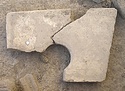
| Two joining fragments, preserving ca. three quarters of seat.
Total width 0.750m; total length 0.50m. Smooth-finished top surface, front and back; rough-worked sides and surface inside the keyhole cutting ... 18 July 2003 ... Two joining fragments, preserving ca. three quarters of seat.
Total width 0.750m; total length 0.50m. ... Bevel around keyhole. Seat block may originally have been two joined pieces.
|
Body, mainly lower part, and base. Glaze fired greenish in places; abraded in lower right of figured zone. P.H. 0.092; diam. 0.087.
Woolworking. On the left is a woman (left hand with distaff, right free, ... Ca. 430 B.C ... Behind her is a rectangular object that looks like a block seat. Below, egg pattern with dots. |
Broken and mended. Much of the glaze and the white ground have abraded. Drawing very faint. H. 0.23; diam. at shoulder 0.071.
Youth at tomb. The youth, dressed in a himation, sits to right on a block ... Ca. 430-420 B.C.? ... The youth, dressed in a himation, sits to right on a block seat, holding a box. |
Wall fragment. Much of the drawing is very faint. Part of the glaze below the figures fired brownish; some abrasion. Max. dim. 0.146.
Youth seated to right (on what is unclear, perhaps a block seat; it ... Ca. 430-420 B.C.? ... Youth seated to right (on what is unclear, perhaps a block seat; it does not appear to be the steps of a stele), another facing. |
Mended with missing pieces of the body restored in plaster and painted. Glaze abraded in places. Rest. H. 0.09; diam. of rim 0.129.
A (illustrated), symposion. A man with a himation around his legs and ... Late 5th century B.C ... He faces a nude youth (lower legs, a little of body missing), who sits on a block seat, holding a stick in his right hand. |
Two non-joining fragments, a of lower wall and all of ring base, b of rim and start of wall. On underside of floor, two concentric circles with central dot. P.H. a) 0.08; diam. of base 0.086; max. dim ... Late 5th century B.C ... He faces another (head missing), who sits on a block seat holding a staff in his right hand, his left resting on his hip. |
| Inscribed fragment of a marble seat (?).
Some of right side and top preserved.
Inscription on smoothed area of front face; area round about stippled.
Hymettian marble. Found in marble pile, near south ... September 1953 |
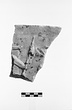
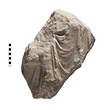
| Relief surface, original top and rough-picked back preserved.
Left arm and shoulder of seated figure holding a long staff. Behind figure, rectangular back of seat or throne. Trace of another figure at ... 2 April 1938 |
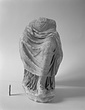
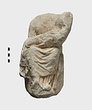
| Lower half of a draped figure seated on a solid square seat. Broken at waist.
Folds of drapery indicated by shallow, carefully cut lines. Edges and corner much battered.
Pentelic marble. Built into modern ... Early 5th c. B.C. |
Fragment preserving the knob, much of the lid with downturned rim. Glazed on underside. Glaze on top side fired reddish brown. Est. diam. 0.20.
The fragment shows from left to right: head and shoulders ... Second quarter of the 4th century B.C ... He faces a woman who sits on a block seat, a himation around her hips and legs and a sakkos on her head. |
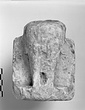
| Broken off above the waist.
The figure wears a thin chiton with overhang and has an himation across the knees. She is seated, with the left foot advanced, upon a cushioned seat, which is hollowed out at ... 28 February 1933 |
| Demeter seated, holding Kore on her lap. Both heads missing, upper parts of bodies badly weathered.
Both figures wear chiton and himation; Kore's right arm rests on Demeter's shoulder. Demeter sits on ... 12 October 1949 |
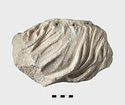
| Apparently only a portion of the front surface is preserved.
To the left the remains of a seated figure; chair seat with folds of drapery from its far and right sides. To the right a drapery indicating ... 2 February 1932 |
| Seems to be a fragment from the right thigh of a seated figure. Under surface is a curved joint surface carefully dressed with fine claw chisel as if the figure and seat were in separate pieces. Otherwise ... Ca. 430-410 B.C. |
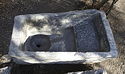
| Complete.
The tub is apparently made from a re-used block. It is broken away at the back. Running lengthwise through the under surface is a channel, possibly an indication of an abortive attempt to split ... 1939 ... The tub is apparently made from a re-used block. It is broken away at the back. Running lengthwise through the under surface is a channel, possibly an indication of an abortive attempt to split the block in two before it was made over into a tub.
... The inside of the tub is hollowed out into three levels: a seat at back, 0.16m. below rim; a floor in front of seat, 0.34m. below rim; and a round basin sunk through this floor to a depth of 0.415m. below rim. |
Profile complete. Mended with the missing pieces restored in plaster and painted, notably most of one side of the bowl, about half of the other, both handles. H. 0.077; rest. diam. at rim 0.185; diam ... Ca. 500 B.C ... I, woman, seated to left on a stool, her feet resting on a block, holding up a mirror in her right hand. ... At the left, a foot to right, then the folds of the himation of a man or youth to right leaning on a stick, facing one who sits on an okladias (drapery, one foot drawn back; part of seat and one leg of okladias). |
|
|