|
|
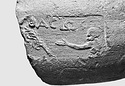
| Upper part of man with outstretched arm. Msc: selection from reverse type of coins of Alexandria(VG)* Finished Late fill. Θασίω[ν]
branch, Zeus Olympios
Ἄ̣μ̣φ̣[ανδρος] Leica ... 14 May 1936 ... Msc: selection from reverse type of coins of Alexandria(VG)* |
Mended from two fragments; broken below collar; nose missing. Eyes bored. Mold made with careful join; remains of glaze inside, at mouth end.
Cf. BMC Lamps, pl. VI, no. 85 and Alexandria Museum no. 6502 ... 5 May 1932 ... VI, no. 85 and Alexandria Museum no. 6502. |
Foot missing.
Scraped groove at bottom of wall. Upper wall flares slight- ly. The two vertical handles are double rope handles, knotted near rim, with shouldering.
Earlier than any of the Agora examples, ... Ca. 325 B.C ... Earlier than any of the Agora examples, Alexandria inv. 16084: Breccia, Sciatbi, p. 66, 175 and pl. 55, 112. |
Both handles and foot missing.
Ribbed lower wall, pointed; flaring rim. Scraped line on lower wall just above junction of lower wall and foot.
Also ribbed but slightly later, Brussels A 1713: CVA 3(3) ... Ca. 350 B.C ... Also ribbed but slightly later, Brussels A 1713: CVA 3(3) pl. 3(138) 17; Alexandria, from the Hadra cemetery: Bull. soc. arch. |
Fragment of a right hand, including three fingers clasping some object.
Hollow moulded.
Fine pale buff clay, self slipped. From Odeion of Perikles; found by J. Travlos in the course of his exploration ... 1951 ... George of Alexandria, in a context of the 5th. century A.D. with some of 3rd. |
Broken, burned, and chipped; the handle and most of the left side missing.
A raised edge around a ribbed top; two ridges around filling hole continuing along top of nozzle. Simulated ring foot.
Remains ... 21 February 1936 ... ADDENDA Compare an example in the Benaki Collection, Alexandria (photo in Agora volume). |
| A round flat one.
On the top bordered by a pair of incised grooves, a satyr head (mask) right.
On the underside, the number 9, scratched bilingually. For a number of somewhat similar tickets from Alexandria, ... 5 April 1948 ... For a number of somewhat similar tickets from Alexandria, see Collection L. |
| Broken at top and right.
Slightly less than half of mold for circular plaque. Circle of dots as frame. Lower part of figure moving right (described from positive), holding large fringed object, perhaps ... 4 March 1952 ... Lower part of figure moving right (described from positive), holding large fringed object, perhaps a fish; presumably Isis Pelagia, holding her fringed Egyptian himation as a sail (of Roman coin of Alexandria). Very thin wind-blown drapery behind legs of figure. |
| Intact but slightly chipped. Flaring lip, wide ribbon handle, gently curving walls, wide flat base. Completely glazed except for reserved resting surface which has glazed outer ring and also has in center ... 11 March 1969 ... Purchased in Alexandria, Egypt. |
Many fragments; restored in plaster. Shape as P 8976 (Ι 950), but body elongated, lip broad and horizontal.
Red gritty clay, very roughly finished; buff slip, inside and out, covered on outside except ... 28 April-11 May 1933 ... Similar pot from Alexandria, Breccia (1912), Necropoli di Sciatbi, pl. |
| Mended from several pieces, section through rim and wall preserved, with part of bottom and two feet. Sides largely missing. Restored in plaster. Round-bodied bowl; vertical rim inset; flaring lip. Three ... 5 March 1937 ... Similar vessels from Samaria, Alexandria [JWH]. |
Calyx-cup.
Upper body, bottom, and some relief attachments missing; lower body partly restored.
Two glazed grooves at top of lower body; below this, alternating applied satyr heads and lozenges, all ... Context of 300-275 ... IV:1; Pfrommer 1987, KaB A 2, p. 213, pl. 45:d (Alexandria); and, in faïence, Wallis 1898, p. 52, fig. 110. |
Fish-plate.
Foot and floor preserved.
Ring foot, convex to exterior; flat resting surface; convex underside.
Pronounced ridge around depression. Side of depression undercut, mound in center. Four radiating ... Context of 325-200, with late Hellenistic disturbance ... IV:3 (Alexandria). For the profile of the depression cf. |
From the wall of a large open vase. Outside, elaborate painted decoration: an ivy garland (white); hanging from it, two broad dark red streamers and a white leaf; over painting in thinned glaze on the ... 11 May 1938 ... Cf. fragment in Benaki Collection, Alexandria.
Probably non-attic, not S. |
Triton?
Head, left arm, right forearm, left wing, most of right wing, lower back, spout, and chalice missing.
Well-muscled male torso with wings growing from shoulders.
On preserved section of right ... 200-175 ... Adriani 1939, no. 2, p. 355, fig. 2 on p. 353 (Alexandria); Δελτ 23, 1968, B1 1 [1969], p. 66, pl. 34:β (Athens). |
Plakettenvase: Crete Or Alexandria.
Broken all around.
Fragment of wall of large closed vessel, probably amphora or hydria; traces of ribbing at left and right edges of fragment. Nike with left leg forward ... 310-275 ... Plakettenvase: Crete Or Alexandria.
Broken all around.
|
Handles missing.
Slender body on disc foot; tall slightly spreading neck with heavy angular rim. Hard fairly clean red clay, gray at sur- faces. Decoration in red and white for bands on neck, shoulder ... Context ca. 375-350 B.C ... A distant imitation comes from Alexandria, 15895: Breccia, Sciatbi, pl. 43, 59. |
Deep Bowl: Gnathia Ware.
Single wall fragment, broken all around; inner surface pitted.
Large, open vase with nearly vertical wall. At top, an ivy vine with white stem and dot rosettes, yellow sponged ... Early 3rd century ... Green attributes the piece tentatively to the Alexandria Group. |
Fragment of shoulder.
Shoulder slightly convex. Decoration in brown glaze: broad band at angle with two narrow bands above; tendrils of ivy(?) garland on shoulder. Hard, friable, light red fabric (2.5YR ... Grapevines are also known but are much less common: Antioch IV, i, p. 28, fig. 8:18; CVA, Stuttgart 1 [Germany 26], pl. 40 [1252]:1, 2 (Alexandria). |
|
|