|
|
Rim fragment. Max. dim. 0.042.
On rim, ivy with berries, the leaves reserved. White: vines; berries.
Same as Akropolis 523 (Langlotz, pl. 41) ... Probably third quarter of the 5th century B.C ... Same as Akropolis 523 (Langlotz, pl. 41). |
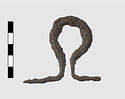
| Four joining fragments broken in removal from grave.
Loop circular in section; prongs, square in section.
Possibly used as handle for wooden object. Reasonably convincing traces of wood on prongs.
20.4gr ... 29 June 1949 ... I (1915), Appendix, p. 27, fig. 25 λ, for another example of an iron loop or hasp, from the Akropolis, which is slightly smaller than ours. |
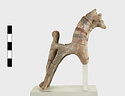
| Four horses with driver figurine.
Forelegs missing; mended from many fragments.
The driver leans against the long hind legs of the central horses and rests his hands on their backs. The driver stands on ... 31 March 1932 ... See also JdI 14 (1899), p. 122, fig. 26, for similar pieces found in Eleusis, on Athenian Akropolis and at Menidi. |
Wall fragment. Max. dim. 0.046.
Woman or youth (lower part of face, left shoulder with chiton), probably moving to left, looking back. The hand of a pursuer grasps folds of the chiton. Relief contour: ... Ca. 470 B.C ... For Kephalos, see Akropolis 469 a (ARV2 559, 144). |
Lagynos.
Most of underside, one-third of foot, half of body, and all of handle and mouth missing. Body partly restored.
Molded ring foot; flat resting surface. Lower wall straight, flaring out to meet ... Context of 115-86 ... A nearly identical piece comes from a cistern on the south slope of the Akropolis with Sullan debris and a few later pieces (Vogeikoff 1993, D 40, p. 140, fig. 84, pl. 216 [inv. 1959-NAK-436]).
|
Two non-joining wall fragments, a with start of return, unglazed on inside. Max. dim. a) 0.104, b) 0.024. LIMC IV, 1988, p. 929, no. 5, s.v. Erechtheus.
Athena and Hephaistos. Fragment a preserves Athena ... Ca. 470-460 B.C ... Compare the two deities on the cup in Athens by Euphronios, Athens, N.M. 15214 = Akropolis 176 (ARV2 17, 18; Addenda 153; Euphronios, cat. no. 44). |
Fragment of torus mouth, neck, and start of shoulder, part of body on each side. Neck glazed on inside. Glaze misfired reddish brown; abraded in places, especially on mouth and on Boreas. P.H. 0.14; diam ... Ca. 460 B.C ... The presence of the olive tree indicates that the representation on this side of the vase takes place on the Akropolis (Weil, p. 85; Kron, p. 81), and the position of Erechtheus' right hand with the palm outward suggests that he has already heard the bad news.
|
Ten non-joining wall fragments, three (a, e, and g) of flaring rim, flat on top. Bands of glaze on inside. Glaze has a slightly greenish cast on c, f, and j. Est. diam. of rim at outer edge 0.25; P.H ... Ca. 510 B.C ... The two names that appear on vases by Euthymides are Megakles on the Bonn hydria, 70 (ARV2 28, 12; Addenda 156) and Leagros (without kalos) on the fragmentary cup from the Akropolis, 211 (ARV2 29, 20). |
|
|