|
|
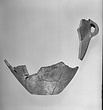
Lower half of body, all of torus foot, start of handle B/A. Strengthened with plaster. Thin reddish glaze on inside. Misfired reddish in places on outside. Pitted here and there. P.H. 0.035. R. R. Holloway, ... Ca. 440-430 B.C ... For a fuller kitharode scene than 8, see London, B.M. ... Although said by Holloway to be by the Peleus Painter himself (Hesperia 35, 1966, p. 83; Archaeology 19, 1966, p. 115), 8 seems closer to his manner. ... PE 19) with the judge on Side B of 8. The drawing of the Agora figure is much sketchier by comparison. |
One handle, most of upper body, and part of lower body restored.
Glazed groove in resting surface, the inner edge of which is scraped; concave underside with nipple. Low, concave stem. Slightly rising, ... 325-300 ... Agora XXIX, no. 8 |
Ring foot. Flaring rim, rounded; strap handles. Added red: two lines at level of lower attachment of handles, one line inside mouth. Glaze worn and peeled ... 480-450 B.C ... Agora XII, no. 8 |
Part of rim and wall restored in plaster and painted. On underside of floor, circle with central dot. H. 0.087; diam. at rim 0.10. J. McK. Camp, Gods and Heroes in the Athenian Agora (Agora Picture Book ... Second quarter of the 5th century B.C. |
Wall fragment. Max. dim. 0.043.
Athlete (most of filleted head, torso, left arm, start of right, a little of left thigh) running to right. Dilute glaze: muscles. White (mostly flaked): fillet.
Followers ... Ca. 460 B.C. |
Wall fragment with start of base. P.H. 0.03; max. dim. 0.096; Agora XXI, p. 33, F 46, pl. 12.
A bit of the figured decoration remains, but it is difficult to know what it is, perhaps a large stone(?) ... Ca. 500 B.C. |
Fragment of outturned mouth and wall. Glaze abraded on rim. Reserved line on inside at junction of mouth and body. Est. diam. of mouth 0.12; P.H. 0.05. H. A. Thompson, Hesperia 17, 1948, pp. 185--186, ... Ca. 500 B.C. |
Mended with missing pieces restored in plaster and painted, mainly the rim and part of the wall directly below. Glaze misfired on outside; much of it has flaked (especially the contour line) and abraded ... Ca. 500 B.C. |
Wall fragment with start of mouth. Max. dim. 0.04.
Outstretched right hand and tattooed forearm of figure to left. Below, just above the break:
retrograde. Relief contour. Dilute glaze: tattoo. Red:inscription ... Ca. 500 B.C. |
Wall fragment with start of base. Greenish glaze on inside. Max. dim. 0.059. H. A. Thompson, Hesperia 6, 1937, p. 13, fig. 6.
Symposion. Outstretched left foot and lower leg of a figure reclining to left ... Ca. 500 B.C. |
Wall fragment with start of mouth. Max. dim. 0.062. H. A. Thompson, Hesperia 17, 1948, pl. 66:2.
Man (left hand, legs missing) to right, leaning on a stick, his right hand on his hip. He wears a himation; ... Ca. 500 B.C. |
Rim and wall fragment. Max. dim. 0.057.
Youth (head, start of shoulders with a little bit of drapery) probably standing frontally, head turned to left. Above, ivy wreath. Relief contour: profile and nape ... Ca. 410-400 B.C. |
Wall fragment with ring base. Decorated on underside with circle and dot. P.H. 0.032; diam. of base 0.08. L. Talcott, Hesperia 5, 1936, pl. 335, fig. 2.
Athlete (lower legs) to left. On the far left, ... Ca. 480-470 B.C. |
Wall fragment. Glaze has a greenish cast on outside near top.
Streaky glaze on inside, partly misfired red. Max. dim. 0.07.
Satyr (beard, left arm, a bit of torso, most of bent right leg with right forearm ... Ca. 500 B.C. |
Wall fragment. Max. dim. 0.047.
Eros (top of head, tips of wings, hands, and legs missing) flying to right, holding a lyre (ends of arms, crosspiece missing). Around his head is a reserved fillet. Relief ... Probably mid-5th century B.C. |
Wall fragment. Max. dim. 0.048.
Winged figure (most of face, left shoulder, wing) frontal. On the right, hand and drapery of a figure to left. White (partly flaked): wing ... Probably late third quarter of the 5th century B.C. |
Wall fragment with part of outturned rim. Glaze on outside fired greenish in many places. P.H. 0.098; diam. of rim 0.091. M. Farnsworth, Archaeology 12, 1959, p. 245, fig. 4.
Youth (left foot missing) ... Ca. 430-420 B.C. |
Wall fragment with start of return. Glaze on outside fired greenish. Max. dim. 0.087. R. S. Young, Hesperia 20, 1951, pl. 79:2.
Man or youth (legs, part of drapery) seated to right, facing a youth standing ... Ca. 420-400 B.C. |
Handle and part of rim missing.
Grooved resting surface; pointed underside. Shiny brown glaze, black above stacking line outside. Graffito ΑΜ on underside ... 300-290 ... Agora XII, no. 763, p. 290, figs. 8, 22. |
Both handles missing.
Flaring ring foot, with short stem above; strap handles. Reserved: resting surface and short stem. An ivy pattern in added clay and white(?) paint, leaves and berries alternating ... Ca. 425 B.C. |
| Three fragments, mended from many. The shape is probably biconical.
a) Most of the base and lower wall.
b) Part of the upper wall with one handle.
c) Part of the wall.
Other non-joining fragments, perhaps ... 10-15 June 1937 ... Agora XIII, no. 8. |
Flaring ring foot; horseshoe handles. Reserved: underside with glazed circle, band and dot; edge of foot; zone above foot decorated with lines; handle-panels; inside of rim. Added red: two lines below ... 470-460 B.C. |
Disc-shaped foot; flat resting surface rising at the center. Neck inset from shoulder. Reserved: under foot and edge of foot, neck, shoulder with black petals and black strokes on neck. The clay is badly ... Ca. 470 B.C. |
Pieces of rim missing.
Vertical foot with angle at top; beveled resting surface, its inner side scraped; nippled underside at slight angle to inner face of foot.
Scraped groove at base of wall. Upper ... 290-275 |
Two non-joining fragments; profile complete.
Low ring foot. Plain rim rounded on top; raised ridge on wall outside. Decoration inside: central palmette, six linked palmettes, enclosed ovules, linked palmettes, ... 430-420 B.C. |
| Globular.
Slightly flattened top and bottom.
Darker and less translucent than J 6. Χάνδρα από αμέθυστο. Προέρχεται από διαταραγμένη ταφή Μυκηναϊκών χρόνων, νότια του ναού του ’ρεως. In sifting earth from ... 15 May 1933 ... Agora XIII, p. 193, pl. 41, no. VIII 8. |
Fabric, surfaces and painted decoration as 1625; spur at rim very sharp ... Context ca. 340-310 B.C. |
Bulbous body on flaring ring foot; trefoil mouth restored. Rolled handle, flattened at attachments. Light red clay; remains of light buff surfacing.
The rolled handle might suggest that this is a remote ... Context ca. 340-310 B.C. |
One spur and pieces of rim and upper body restored.
Reserved resting surface with no groove; conical underside.
Tapering stem. Upper body tapering. Rim not thickened. Rising spurs with nearly parallel ... 300-290 |
Part of one handle restored; chips missing.
Glazed groove in resting surface; concave underside; no scraped groove between moldings of foot. High, thin, cylindrical stem. Pointed lower body. Handles rise ... Ca. 275 |
P 18575 a, b
Bowl (b) mended from sixteen fragments, lid (a) from two fragments; partially restored.
Widely flaring foot, flat with string marks underneath. Deep body.
Wide flange with lid projecting ... 300-270 |
Small part of lower neck and upper shoulder preserved.
Neck: vertical ribbon visible beside handle attachment; part of rectangular pattern of dots, with thick stem above. Shoulder: as 410, with cross ... 270-250 |
Disc foot with two mouldings at the edge. Straight stem. Rim flanged to receive a lid. Neck slightly offset from body. The handles are double tubes, vertically pierced for string. Reserved: the lower moulding, ... Ca. 500 B.C. |
Disc foot, slightly concave beneath. Two mouldings at the edge of the foot. Concave stem, short neck, torus mouth flanged to receive a lid. The handles are double tubes, verti- cally pierced for string ... 500-480 B.C. |
Disc foot slightly concave beneath. Three mouldings at edge of foot. Concave stem. Vertical strap handles joining the rim with shouldering. Slightly offset neck; flaring rim, overhanging. Reserved: the ... 500-480 B.C. |
Two-thirds of rim and half of wall restored.
Grooved resting surface; nippled underside. Reserved line at junction of foot and body. Thin wall. Four palmettes within rouletting.
Mottled brown and red ... 300-285 ... Agora XII, no. 837, p. 296, fig. 8 |
Wall fragment of stand with projecting moulding at top. Glaze scratched and abraded. P.H. 0.092. Agora XXI, pl. 30: G 8.
Woman (head with sakkos) to right. Above, egg pattern. On top of rim, tongues(?) ... Early 4th century B.C ... P.H. 0.092. Agora XXI, pl. 30: G 8.
|
Torus ring foot; horseshoe handles. Reserved: underside with two circles and dot, resting surface and outer face of foot, handle-panels. Glaze peeled in parts; traces of stacking line.
Also with reserved ... 500-480 B.C. |
Torus ring foot; horseshoe handles. Scraped line at junction of wall and foot. Reserved: underside with circle and dot, and resting surface. Glaze peeled in parts.
Contemporary, P 21290 N 7:3 Hesperia, ... 470-460 B.C. |
| Fine buff clay, slightly micaceous. Nb. No. 3. Trench A, Assembly Place; filling of Period III. ΘΑΣΙΟΝ ΔΑΜΑΣΤΗΣ ΘΡΑΣΙΠΠΟΣ 437 ... 13 Mar 1931 |
|
|