|
|
Tip of one handle, half of foot, and part of upper and lower wall restored.
Flat resting surface; conical underside; no groove between moldings of heavy foot. Low stem. Horizontal spurs with parallel ... 325-300 ... Agora XXIX, no. 4 |
Mended with the missing pieces restored in plaster and painted, notably much of the lower part of the body and most of the floor. Glaze abraded and misfired on mouth; abraded on neck on Side B. Rest. H ... Ca. 460-450 B.C ... Agora XXX, no. 4 |
Ring foot. Echinoid mouth inset from neck and flat on top. Double ridge at junction of neck and wall. Inside of mouth and neck has a concave-convex curve. Strap handles. Reserved: flat top of mouth. Heavy ... Ca. 500 B.C ... Agora XII, no. 4 |
Lower part of body, most of ring base. Thin, brownish black glaze on inside. P.H. 0.07; P.W. 0.102.
From lower right corner of panel: child (lower legs, feet) to left. Below, egg pattern with dots. Reserved ... Probably late third quarter of the 5th century B.C. |
Mended with the missing pieces restored in plaster and painted, notably much of the figured part. Glaze has abraded in many places. The panel is not placed exactly opposite the handle but slightly to the ... Mid-5th century B.C. |
Part of rim missing.
Straight sides. Top of lid slightly concave at center. Shiny brownish black glaze outside only. Graffito on top: \Delta\epig\char'104\char'104\char'104\char'104.
If, as Lang suggests, ... 300-240 ... If, as Lang suggests, 14 drachmas was the weight of the empty pyxis, the pyxis to which this lid belonged should have weighed between 39.5 and 42.3 grams (using the range of 4.2--4.4 for the Solonian drachma; see Agora X, p. 4). But 1249, slightly smaller in diameter and lacking a few chips, weighs 51.3 grams, suggesting that the body for 1250 would have weighed more than 14 drachmas. |
Parts of body restored, including center of floor.
Vertical rim with groove below on one side. Very micaceous fabric; thin black glaze inside, on top of rim, and in two bands at greatest diameter.
Similar ... 300-275 ... Similar in shape but unglazed and much smaller: P 7390 (Agora XII, no. 86, p. 242, pl. 4 [E 3:1]). |
Mended from twenty-eight fragments, with chips of neck and part of belly missing; slight traces of burning.
Rounded bottom. Lower wall pared. Possibly a light slip on surface.
Very hard household fabric, ... 325-300 |
P 19055 a, b
Body (b) mended from ten fragments, lid (a) from thirteen fragments, with most of bottom of body and small parts of lid restored; burning on bottom of body.
Bottom nearly flat. Upper wall ... 325-300 |
Horseshoe-shaped, open below and at side. Horizontal rolled handle at back; rising spurs at open ends of rim; two holes in wall.
For somewhat earlier versions see, e.g., P 8396 D 11:5 Agora, VIII, pl ... Context ca. 575-540 B.C ... For somewhat earlier versions see, e.g., P 8396 D 11:5 Agora, VIII, pl. 11, 211; J.H.S., LXXXII, 1962, pl. V, 4, left; and references, Agora, VIII, p. 103 under 624. |
Small piece of rim and fragment of wall missing.
Low, broad foot; wide, flat resting surface; slightly convex underside. Straight wall, but plate warped. Nearly horizontal rim does not project. Metallic ... 300-275 |
About one-third of rim missing.
Flat resting surface; pointed underside. Convex wall with groove at one-third height, flaring at top. Lip undercut on inside. Slight nipple at center of floor. Dull to ... 150-110 |
Bottom missing.
Irregularly profiled shoulder. Low vertical rim with groove on outer face. Glazed inside, and two lines on shoulder.
A later example, P 6326 E 14:1, is similarly banded ... 320-300 B.C. |
Ring foot. Triangular handle. Totally glazed. Dipped. Fired mottled red and black.
Similar, P 13537 O 18:2 ... 325-310 B.C. |
Flat underside, reserved. The pot had been used for mixing colors, as cinnabar is still present on the inside.
Similar, P 10921 B 13:5; contemporary, P 10986 B 15:1 Hesperia, XVIII, 1949, p. 330, 70 ... 425-400 B.C. |
Streaky glaze.
Similar, P 16007 F 19:4 ... Ca. 475 B.C. |
Satyr.
Bottom, with most of emblem.
Cup rests on ridge with another ridge within it; nippled underside. Conical profile, with five grooves preserved on exterior.
Emblem within two scraped grooves with ... 240-200 |
One handle, half of lower body, and parts of rim and upper body restored.
Scraped groove between moldings of foot; flat resting surface; pointed underside. Offset at base of body. Ivy-leaf thumb rest ... 275-250 |
Part of wall, one handle and base.
Flat bottom; slightly concave wall. Strap handle rises from near bottom. Base reserved; glaze dull and uneven ... First half of 6th c. B.C. |
The upper part only preserved; the lower part made up in plaster, much as 1450.
Flaring rim marked off by a light groove below; sloping shoulder; thick strap handles. Wheelmade of cooking ware, heavy ... Context ca. 435-425 B.C. |
Fillet at junction of stem and foot. Reserved: outer face of foot, resting surface, center of stem inside with circle and dot, handle-panels. Thickened rim. Added red on fillet. Glaze fired gray in parts ... 525-500 B.C. |
| Nb. No. 1. Trench A, Assembly Place; filling of Period III. ΘΑΣΙΩΝ
ΠΟ[Σ]ΙΔΕΙΟΣ 62 ... Late 5th and first half of 4th century BC |
Fragment of lower body.
On bottom, single almond-shaped groove with large palm branch and stamped circles.
Unglazed.
Pale red clay.
Type XXVIII of Corinth collection. Center cut. 147 Leica ... 5 June 1931 |
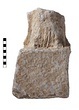
| Fragment with lower part of draped figure standing on rough, high base.
The figure is broken off above the knees; rough-picked on bottom, back and front of base; sides broken, surface damaged.
Only traces ... 24 April 1931 |
Parts of wall and rim restored.
Grooved resting surface; nearly flat underside with slight nipple.
Heavy wall. Shiny black glaze.
Similar: P 2530 (Agora XII, no. 839, p. 296, pl. 33 [F 16:1, lower fill]), ... 325-300 |
No scraped groove on top of foot.
Similar, from the same deposit, P 5127, small, and P 16006 F 19:4. A fragmentary specimen was recognized in N 7:3, P 21880 Hesperia, XXII, 1953, p. 76, 32 ... Ca. 460 B.C. |
Deep Bowl: Gnathia Ware.
Single wall fragment, broken all around; inner surface pitted.
Large, open vase with nearly vertical wall. At top, an ivy vine with white stem and dot rosettes, yellow sponged ... Early 3rd century |
Most of rim and large part of wall restored.
Slightly concave resting surface; nippled underside. Scraped groove at junction of foot and body. Shiny black glaze, brown stacking circle; miltos ... 300-275 |
Wall and rim partly restored.
Flat resting surface; pointed underside. Dull black glaze, peeling ... 290-275 |
Half of upper body and part of one spout preserved.
High upper body. Two scraped grooves at junction of upper and lower body. Spiral wave pattern running right on upper body, with dolphins above; olive(?) ... 225-200 |
Kylix base. Careless letters, M instead of N at beginning of father's name. Black glaze. Inscribed on bottom. Oscar Broneer, Nb. No. 4. 175 88-397 ... 29 May 1937 |
Three-fourths of rim and wall missing; underside, half of foot, and parts of wall restored.
Flaring foot; broad, flat resting surface. Wall strongly convex, with flare at top. Shiny black glaze.
Similar: ... 200-175 |
Collar rim squared off on top; shallow spout; strap handles at sides, at back a triple reel lug. Coarse brown clay with considerable mica and black and white grit; traces of brown surfacing; mouldmade ... Context ca. 420-400 B.C. |
Handles and parts of wall and foot restored.
Underside and resting surface as 150. Shiny black glaze.
Cf. P 26109 (Agora XII, no. 352, p. 260, fig. 4, pl. 17 [F 17:3, lower fill]) ... Ca. 325 ... P 26109 (Agora XII, no. 352, p. 260, fig. 4, pl. 17 [F 17:3, lower fill]). |
Slight nipple on underside. Glazed inside and out. Re- served: resting surface and junction of foot and wall.
Similar but still shallower, P 1836 G 13:4 Hesperia, III, 1934, p. 318, fig. 4, A 18 ... 375-350 B.C. |
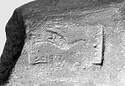
Inscribed fragment of columnar grave monument.
Portion of upper part, with ring and top surface inscribed.
Hymettian marble. Found in a wall of the modern house 631/22, east of the south end of the Metroon ... 25 May 1931 |
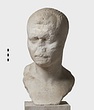
| Nose broken away, a deep score in the forehead; surface much rubbed. Eyes, mouth, chin and ears damaged.
Portrait of a man of mature years; the head turned slightly to the left, the hair close-cut and ... Middle of 1st c. B.C ... Agora I, no. 4, pp. 15-16, pl. 4. |
Front part of crude head.
Details indicated by roughly gouged lines.
Traces of red and white paint. Mold made; hollow.
Buff clay.
Cf. T 20. 90 Leica ... 15 June 1931 |
Part of lower wall missing.
Beveled resting surface. Otherwise shape as 257.
Comic-mask thumb rests: slave with receding hair and round mouth trumpet. Olive garland running left with white wavy line ... 225-210 |
Fragment of rim.
Dolphin leaping right, with bunch of grapes at right; spiral wave pattern running right, filled in with white below; one line and row of dots. Shiny black glaze.
Ptolemy Group ... 280-260 |
|
|