|
|
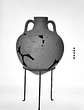
On rim, wavy lines.
Plain discus, with central filling hole.
Handle solid, triple grooved above, double below; two impressed circles at junction with discus.
On bottom, double almond-shaped grooves, within ... 19 February 1932 |
| In fine preservation.
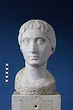
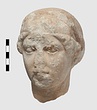
A portrait of a middle aged woman (Faustina the Younger ?) with rather severe features and with hair parted in the center and drawn down in waves to a chignon in the back, below which ... Ca. 162-166 A.D. |
Two animals in moderately high relief, on a heavy plaque.
Above, left, a spotted dog (?); below, a bird, eagle (?).
Late Roman.
ADDENDA: Part of scene: person with snakes, animals in field, Mithraic ... 7 February 1936 |
Body only preserved. The shape similar to P 12868 (Ψ 360), but more pointed.
On shoulder, a dipinto in black:
Pink clay. Light slip.
ADDENDA P 12868: Rather small concave foot; egg-shaped body; narrow ... 16 May 1938 |
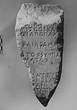
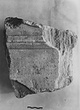
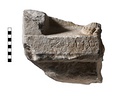
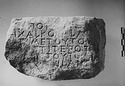
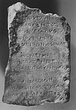
| Inscribed fragment of monument of naiskos type.
Background cut back deeply for high relief, none of which, however, remains.
The inscription is on the epistyle.
Pentelic marble.
ADDENDA Probably part ... 30 May 1949 |
| Irregular fragment from side wall of medium-sized closed pot, preserving about one-quarter of circumference of neatly cut hole.
On exterior, wide swirl of dull light orange glaze about hole and dripping ... (1934) |
Four non-joining fragments, d of rim, a of wall with start of rim, b -- c of wall. Reserved band on inside at rim, another 0.093 below rim. Glaze a bit abraded on rim. Max. dim. a) 0.072, b) 0.061, c) ... Ca. 430-420 B.C. |
Rim of stemmed krater.
Buff monochrome.
ADDENDA 2018: Single sherd to a krater with short, everted rim. There is no decoration. There are no traces of use-wear or burning.
Furumark Shape: 9 Cf. slip ... LH IIIC Early |
Rim of a stemmed krater, buff monochrome.
ADDENDA 2018: Single sherd to a small, undecorated krater with everted rim. No other features are preserved.
The interior and exterior are coated in a thick, ... LH IIIA-B |
Wall fragment. Thin reddish brown glaze on inside. Max. dim. 0.044.
Part of figure (drapery), to right, perhaps seated.
672 is Meidian. Cf. the drapery of Hygeia on Florence 81948 (ARV2 1312, 1; Paralip ... Late 5th century B.C ... Cf. the drapery of Hygeia on Florence 81948 (ARV2 1312, 1; Paralip. 477, 1; Addenda 361; Burn, Meidias Painter, p. 97, cat. no. ... E 224 (ARV2 1313, 5; Paralip. 477, 5; Addenda 362; Burn, pl. 9:b); the seated woman opposite a youth on Naples Stg. 311 (ARV2 1314, 17; Burn, pl. 10:b); and the woman who is Gaia or Attica on Cleveland 82.142 (Burn, pl. 11). |
Rim of stemmed krater. Red on buff.
ADDENDA 2018: Single sherd to a krater with short, almost flaring rim. The lip is painted monochrome. There is a thick band below the rim. The handle zone is decorated ... LH IIIB-C |
| a) Fragment from wall preserving start of offset rim. Part of head, left shoulder and breast, and left hand holding a pyxis lid(?) of a woman seated(?) facing right, draped in a chiton with thin, fine ... 15-26 May 1936 |
Rim from stemmed krater, dark dark brown on buff.
ADDENDA 2018: Single sherd to a medium krater with everted rim. No other features are preserved. The exterior features a wide band below the rim. The ... LH IIIC Early |
Side of stemmed krater. Wide flat handle from rim to widest part of body.
Monochrome buff.
ADDENDA 2018: Two joining sherds to a small krater with everted rim and horizontal strap handle. There is no ... LH IIIC Early |
Rim sherd from stemmed krater, lemon buff.
Faint traces of design in orange glaze.
ADDENDA 2018: Single sherd to a small krater with rounded rim. There are no other features preserved. The exterior ... LH IIIC Middle |
Rim of stemmed krater, orange red on buff.
ADDENDA 2018: Single sherd to a medium krater with everted rim. No other features are preserved. The exterior decoration consists of a dotted lip with a medium ... LH IIIC Middle-Late |
Fragment of rim and body of an open bowl. Stub of vertical handle preserved at rim. Body decorated with a group of vertical zigzag lines between dots.
Pale clay. Creamy buff slip. Dull black glaze on ... 4 April 1932 ... Dull black glaze on rim and for design.
ADDENDA Agora Sample no. 362. |
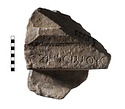
| Inscribed fragment.
Broken on all sides except inscribed face.
Athena Promachos inscription.
Pentelic marble.
ADDENDA with I 2228.
Cf. EM 6680. Found in the wall of the modern house 645/2, west of the ... 5th. century B.C. |
| Inscribed fragment from upper right hand corner of pediment-topped stele.
Rough picked back, and sloping top surface; chiseled right side, preserved; face broken away at corner, and along right side of ... 327/6 B.C. |
| Inscribed fragment.
Fragment from the lower left corner of a grave monument carved in high relief.
Part of a sandalled foot is preserved. Inscribed on a smoothed band below.
Pentelic marble.
ADDENDA Probably ... 31 May 1949 ... Pentelic marble.
ADDENDA Probably part of the same monument as I 6194 (ΣΑ 362), but no possibility of a join. |
| Inscribed fragment.
Smooth dressed top preserved, badly weathered; elsewhere broken.
Top, whose plane is not perpendicular to the face, is perhaps not original.
Accounts for statue of Athena Promachos ... 5th. century B.C. |
| Fragment from wall of large coarse amphora, broken all around.
Incised vertically on outside:
Additional graffiti on shoulder: on P 15345 (other shoulder).
Reddish very micaceous clay.
ADDENDA Became ... 11 May 1939 |
| Fragment of inscribed stele.
Part of right side preserved; otherwise broken.
Inventory of platters given by the prytanies and listed by archons.
Archons: Molon (362/1 B.C.), Nikophemos and Dynniketos (370/369 ... 350 B.C ... Archons: Molon (362/1 B.C.), Nikophemos and Dynniketos (370/369 B.C.) and Phrasikleides.
... Hymettian marble.
ADDENDA Belongs with I 7475. |
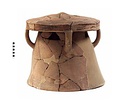
| Lid and about a quarter to a third of stand preserved; restored in plaster.
This curious object consists of an umbrella-like cover, with a wide vertical rim which overhangs the bluntly conical stand attached ... 28 May-16 June 1938 ... No traces of smoke or burning.
ADDENDA
Fuller description of A 957 and A 958, with references (by A.W. ... The openings are too small for lighting and probably for ventilation (cf. the Haubenziegel from Pompeii illustrated by Durm (1905), p. 333, fig. 362 (Bauk. D. Etr. |
Floor fragment with start of stem. Part of surface pitted. Max. dim. 0.082. H. A. Thompson, Hesperia 23, 1954, pl. 15:d.
I, symposiast (head, shoulders, upper part of left arm, both legs from the knee ... Ca. 500 B.C ... For a symposiast with a stick, but not holding it, see Göttingen, no no. by the Antiphon Painter (Paralip. 362, 9 ter; Addenda 218); Berlin 2286 by the Triptolemos Painter (ARV2 365, 59; Addenda 223); two by the Foundry Painter: Kassel T 664 (ARV2 401, 10 bis; Paralip. 370, 10 bis) and Christchurch, N.Z., Univ. of Canterbury 17 (ARV2 403, 34; Paralip. 370, 34); two by the Painter of the Paris Gigantomachy: Toronto 357 (ARV2 419, 34) and Seattle 20.35 (ARV2 420, 62); Munich 2646 by Douris (ARV2 437, 128; Paralip. 375, 128; Addenda 239; Buitron-Oliver, Douris, p. 83, cat. no. 173, pl. 96). |
| Broken at neck and at back of hair; most of forehead, nose, mouth and chin battered and missing. At the back, a bit of the original surface preserved at the top of the neck suggests a freestanding statue ... 20 May 1947 ... Drilled and set with bronze dowel cemented with plaster 1956.
ADDENDA Originally attributed to the Nike Parapet but probably to be assigned to the Temple of Ares, cf. ... Leica, XXVII-69, XXVII-70, XL-11, 85-361, 85-362, 85-363, color slide |
Wall fragment with thin matte glaze on inside. Thickens slightly at top. Max. dim. 0.094.
Youth (forehead, much of legs missing) standing to right, looking back, a himation draped around his waist and ... Ca. 410 B.C ... The initiate and the bakchos are similar to the ones on the fragmentary stamnos in Boston by the Painter of the Carlsruhe Paris (Boston, M.F.A. 03.842: ARV2 1315, 2; Paralip. 477, 2; Addenda 362; Burn, Meidias Painter, p. 101, cat. no. |
Eight non-joining wall fragments, a and b with rim and strengthened with plaster. Band on inside at rim, a narrower one 0.068 below rim. Glaze fired red on inside, slightly misfired below figures on outside ... Ca. 460-450 B.C ... Paul Getty Museum 83.AE.362, 84.AE.80, and 86.AE.385: Eros hovers between Helen and Menelaos, who has dropped his sword (LIMC IV, p. 544, no. 277 [the accession number is incorrectly given as 85.AE.385.2], pl. 341; D. ... The Chicago Painter: Brauron, no no.: here Eros flies toward Menelaos, holding a phiale (ARV2 631, 42; Addenda 272). Polygnotos, Malibu, the J. ... Manner of the Niobid Painter (ARV2 609, 12; Addenda 268). |
|
|