|
|
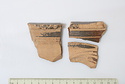
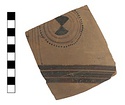
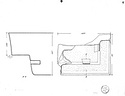
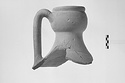
Fragment of inset lip and start of bowl. Max. dim. 0.069.
On exterior, lozenge pattern, each reserved lozenge decorated with a lozenge and dot drawn in dilute glaze.
The lozenge pattern on the exterior ... Ca. 430-420 B.C ... Marlay Painter: Los Angeles 50.8.33 = A 5933.50.39 (ARV2 1279, 48; Addenda 357); Naples 2621 (ARV2 1279, 49); Oxford 1965.113 (ARV2 1279, 50; Paralip. 472, 50); Los Angeles 50.8.32 = A 5933.50.38 (ARV2 1279, 51; Addenda 357); and Laon 37.1064 (ARV2 1279, 51 bis; Addenda 357). |
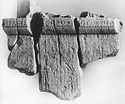
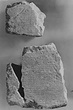
| Inscribed fragment.
Inscribed face, left side, possibly rough picked back preserved.
Stoichedon, except line 1.
Pentelic marble.
ADDENDA Joins with IG I2, no. 144. Found in a modern pit, west of the East ... 5th. century B.C. |
Wall fragment from near handle with a conical protuberance (mastos[?]). Max. dim. 0.091.
Palmette (ends of fronds).
For a similar protuberance, but as a pair, see the bell-krater, New York, M.M.A. 07.286.81 ... Probably third quarter of the 5th century B.C. |
Fragment from lower wall of small closed pot. Preserved are most of forequarters of two opposed sphinxes, with a dot between and rays below. Purple for breast and shoulders of sphinxes. Coarse incision ... 23 May-3 June 1938 |
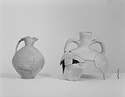
From an amphora similar to P 14505 (ΓΓ 25), but smaller and of somewhat finer fabric. Part of the neck, lip and shoulder preserved.
ADDENDA P 14505: Very squat spherical body and vertical neck flaring ... 24 February 1939 |
| Mouth, neck and shoulder, and one handle only preserved. A narrow-necked amphora with plain straight lip, very slightly thickened.
On shoulder, dipinto in dull black:
Under one handle, dipinto in light ... 14 April 1937 |
| Rim from a krater.
Dark dark brown on buff.
ADDENDA 2018: Two joining sherds to a large krater with horizontal flat rim. No other features are preserved.
The exterior decoration includes a painted ... LH IIIB-C |
Fragment from krater, brown on buff.
ADDENDA 2018: Single sherd to a large krater. No other features are preserved.
The exterior decoration consists of a running spiral with papyrus fill.
The interior ... 19, 20 May 1937;
9-11 June 1937;
2-5 April 1938 |
Dark dark brown on buff. Mostly flaked off rim of a krater.
ADDENDA 2018: Single sherd to a large krater with rounded rim flattened on top. The rim slopes outwards.
The exterior decoration consists ... LH IIIB-LH IIIC |
From of a krater, brown on buff.
ADDENDA 2018: Single sherd to a medium krater. No features are preserved.
The exterior decoration consists of a medium band running below the handle zone and running ... LH IIIC Early-Middle |
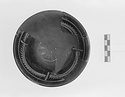
| Mended from several fragments. Some of rim, body and bottom missing; restored in plaster. Shape as P 16223 (ΕΕ 399). Around inside of body, inverted yellow garlands with pendent drops; a white dot at the ... 12-15 May 1939 |
Rim from krater, brown on buff.
ADDENDA 2018: Single sherd to a medium krater with flat rim. No other features are preserved.
The exterior decoration consists of a painted lip and a medium band below ... LH IIIB-C |
From a krater, brown on buff.
ADDENDA 2018: Single sherd to a large krater. No features are preserved.
The exterior is panelled with a central triglyph flanked by filled antithetic spirals with rosette ... LH IIIC Middle |
From a krater, red on buff.
ADDENDA 2018: Single sherd to a krater with no other features preserved. T
he exterior decoration consists of a band of uncertain width running beneath the handle zone. The ... LH IIIB-C |
From a krater, red on buff.
ADDENDA 2018: Single sherd to a krater with no other features preserved.
The exterior decoration consists of a medium rim band with a spiralform motif, possible some sort ... LH IIIC Early-Middle |
Part of a krater, brown on buff.
ADDENDA 2018: Seven sherds mended into four fragments of a large krater. No other features are preserved.
The exterior features three medium bands running below the ... LH IIIC Middle |
Rim of a krater, red on buff.
ADDENDA 2018: Single sherd to a medium krater with short everted rim. No other features are preserved.
The exterior features stemmed bowl banding at the rim and running ... LH IIIC Early |
| Bands, parallel lines, concentric circles, dots and double axe patterns. Brown on buff.
ADDENDA 2018: Single body sherd to a medium krater. No features are preserved.
The exterior decoration consists ... LH IIIC Middle |
| A corner fragment. The plinth was set down ca. half its height in the top of the die. The exposed upper face flares out in a very gentle curve. On either side of the corner on the concealed vertical face ... 1959, 2 June 1964 |
From a krater, dark dark brown on buff.
ADDENDA 2018: Three non-joining sherds to the same krater with a plastic band with incised decoration, but no other preserved features.
The exterior features ... LH IIIC Middle |
Two fragments probably from the same vase; both broken all around. From an open vase. The inside is covered with brown glaze on which are two horizontal bands of white paint (of different width on the ... 3 May 1934 |
| Late Roman C plate fragment mended from four pieces; none of rim or center of plate preserved, and about one-third of the decorated band lacking. Low ring foot.
Gritty light red clay, gray at core; covered ... 28 April 1932 |
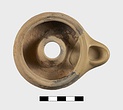
| Nozzle and part of rim missing.
Open socket. Bevelled base. Concave sides sloping inward. Grooved rim. Signs of burning.
Inside, remains of metallic brown glaze; on outside, traces of glaze wash (?).
Gritty ... July 1952 |
| Neck and one handle preserved. Thick neck, rather short, flaring at shoulder, bulbous at top; plain rolled rim. Mouth oval, the sides pressed in by the attachment of the handles.
Incised on one side ... 15 May 1939 |
| Inscribed fragment.
Catalogue of ships.
Fragment ΟΕ 199a (a), mended from two pieces.
Inscribed faces only preserved.
Fragment ΑΑ 29 (c), a non-joining fragment, mended from two pieces, whoch preserves ... Ca. 357/6 B.C ... Bluish pentelic marble.
ADDENDA These fragments belong to a copy of IG II2, no. 1611, ca. 357/6 B.C., a catalogue of ships and their paraphernalia (other fragments, now in Epigraphical Museum, found in Piraeous.
|
Wall fragment with start of shoulder. Some of the glaze flaked. P.H. 0.09.
Youth (a little of his left shoulder, lower legs, and feet missing) stands to left, looking back. He is dressed in a himation, ... Ca. 470 B.C ... This should probably be added to Beazley's Group of Side-Palmette Lekythoi (ARV2 301--303; Paralip. 356--357; Addenda 211--212). |
Wall fragment. Glaze rather dull. LIMC III, 1986, p. 771, no. 230, s.v. Eos.
Eos and Kephalos or Tithonos: outstretched left arm of Eos to right, adorned with a bracelet, a bit of the sleeve of her chiton ... Ca. 490-480 B.C ... The composition of 210 was probably similar to these two: Saint-Germaine-en-Laye, 7565, by the Alkimachos Painter, which shows Kephalos (ARV2 529, 8; Addenda 254); Boston, M.F.A. 03.816, the namepiece of the Tithonos Painter (ARV2 309, 1; Paralip. 357, 1; Addenda 213). |
Floor fragment with start of stem. Part of surface pitted. Max. dim. 0.082. H. A. Thompson, Hesperia 23, 1954, pl. 15:d.
I, symposiast (head, shoulders, upper part of left arm, both legs from the knee ... Ca. 500 B.C ... For a symposiast with a stick, but not holding it, see Göttingen, no no. by the Antiphon Painter (Paralip. 362, 9 ter; Addenda 218); Berlin 2286 by the Triptolemos Painter (ARV2 365, 59; Addenda 223); two by the Foundry Painter: Kassel T 664 (ARV2 401, 10 bis; Paralip. 370, 10 bis) and Christchurch, N.Z., Univ. of Canterbury 17 (ARV2 403, 34; Paralip. 370, 34); two by the Painter of the Paris Gigantomachy: Toronto 357 (ARV2 419, 34) and Seattle 20.35 (ARV2 420, 62); Munich 2646 by Douris (ARV2 437, 128; Paralip. 375, 128; Addenda 239; Buitron-Oliver, Douris, p. 83, cat. no. 173, pl. 96). |
Two non-joining fragments, a of wall with start of return, b of handle, round in section. Thin glaze on inside of a. Surface pitted. Max. dim. a) 0.059, b) 0.115. Prange, Niobidenmaler, p. 216, cat. no ... Ca. 450-440 B.C ... Perhaps similar in composition to that on side A of a pelike in the manner of the Niobid Painter once in the Athens Market (ARV2 610, 25), now in a Berlin private collection (Paralip. 396, 25; Addenda 268; Prange, Niobidenmaler, p. 213, cat. no. ... This is an odd gesture that I have not been able to parallel with a figure wearing a petasos, but compare the warrior on a lekythos by the Terpaulos Painter who puts his hand to the visor of his helmet (Agrigento 23: ARV2 308, 5; Paralip. 357, 5; Addenda 212).
|
Fragment of torus mouth, neck, and start of shoulder, part of body on each side. Neck glazed on inside. Glaze misfired reddish brown; abraded in places, especially on mouth and on Boreas. P.H. 0.14; diam ... Ca. 460 B.C ... E 59; Becker, Formen attischer Peliken, p. 82, cat. no. 235; Kaempf-Dimitriadou, Liebe der Götter, p. 106, cat. no. 357; K. Neuser, Anemoi: Studien zur Darstellung der Winde und Windgottheiten in der Antike, Rome 1982, p. 62, cat. no. ... The composition on each side of 36 was probably a simpler version of those on the pelike in the Villa Giulia signed by Hermonax (ARV2 485, 33; Paralip. 379, 33; Addenda 248). Beazley (ARV2 486, 34) suggested that the woman on Side B of 36 is either Herse or Aglauros, most likely on the strength of two representations of this subject where their names are inscribed, both by the Oreithyia Painter: Berlin 2165 (ARV2 496, 1; Paralip. 380, 1) and Munich 2345 (ARV2 496, 2; Paralip. 380, 2; Addenda 250; Reeder, Pandora, p. 40, figs. 2--3 and p. 75, fig. 2). |
|
|