|
|
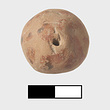
| Roughly spherical ball, pierced off center.
Decorated with irregular blobs of brown and red glaze.
Pinkish buff clay.
ADDENDA: Not a spindle whorl. Dimova February 2019. Finished Geometric well. Leica ... 26 March 1936 |
Base, and body and head fragments missing.
Traces of white slip.
Red clay.
ADDENDA: Same mold as T 252. Well.
4th c. A.D. Leica ... 16-21 May 1937 ... Red clay.
ADDENDA: Same mold as T 252. |
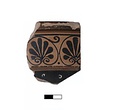
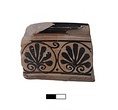
Three non-joining fragments: P 22490 of rim and start of wall; P 30996 of rim; P 13366 of wall and cul with stub of handle. Reserved line at top of rim on inside. Max. dim. P 13366: 0.105, P 22490: 0.083, ... Ca. 500-490 B.C ... Encircled palmettes in black glaze on both the rim below the torus and on the cul of 252 do not seem to have a parallel on either black-figured or red-figured calyx-kraters. For black glazed palmettes on the rims of red-figured calyx-kraters, see the following: two by the Kleophrades Painter decorated early in his career: Louvre G 48 + New York, M.M.A. 1978.429.1:a--v: there one-half of the rim has horizontal black-glazed palmettes, the other half, upright palmettes in reserve (ARV2 185, 33; Paralip. 340, 33; Addenda 187) and Tarquinia RC 4196, up-and-down palmettes (ARV2 185, 35; Paralip. 340, 35; Addenda 187); two by the Eucharides Painter, both drawn horizontally and also early in his career: Louvre G 47 (ARV2 227, 11; Addenda 199) and Louvre G 163 (ARV2 227, 12; Paralip. 347, 12; Addenda 199). 252 is closest to Louvre G 48. ... For the net pattern on the cul, though not reduced to a dot band as on 252, see Copenhagen, N.M. inv. 13365 by the Kleophrades Painter (ARV2 185,32; Paralip. 340, 32; Addenda 187) and Louvre G 47 by the Eucharides Painter; also Louvre CA 5950 (above, sub 249). |
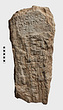
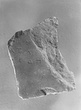
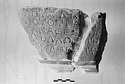
| Impossible to be certain whether stone complete.
Rough, rectangular slab with inscription on upper face in area smoothed to receive letters.
Rough piece of gray schist.
ADDENDA Belongs with I 7461, I ... 14 June 1973 |
Inscribed fragment.
Inscribed face only preserved.
Archon list.
Six lines of the inscription preserved.
Hymettian marble.
ADDENDA Joins above to EM 8046 d (IG II2, no. 1706 d).
Transferred to the Epigraphical ... 221/0 B.C. |
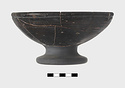
| Profile, rim, preserved.
ADDENDA: From "USE" deposit of Well A?
Date: 490-480. Carl Roebuck, Nb. No. 7.
Well A. 358 ... 13 May 1938 |
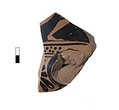
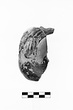
Plump leg of child riding on something: scales dolphin (?).
Only right thigh and calf and part of the animal (?) on which child rides, remain.
Traces of paint (?).
Coarse gray-brown clay.
ADDENDA Other ... 7 June 1951 |
| Fragment of calyx krater with one handle attachment.
In the handle zone, part of a palmette and a double row of dots, black. Above, part of the legs and one foot of a figure, nude, running or falling ... 6 June 1938 |
| Circumscribed black figure palmettes on rim zone.
Inscribed: on wall just below rim, in white paint, the inscription broken at both sides.
Cf. The ornament used by Euthymides on the Munich amphora, Pfuhl ... June 1952 |
| Inscribed fragment.
Inscribed face only preserved.
Parts of nine letters remain.
Hymettian marble.
ADDENDA I 3687 belongs. Found in the foundation of the modern house Q, about 20.00m. southwest of the ... 6 April 1935 |
Wall fragment. Max. dim. 0.06.
Horse (top of neck and mane, ear, forelock, a bit of forehead and cheek), probably a mount, to right. Preliminary sketch. Relief contour. Dilute glaze: muscles. White: studs ... Ca. 440-430 B.C ... See the team on Ferrara 1685 = T.308 by the Painter of Bologna 228 (ARV2 511, 5; Paralip. 382, 5; Addenda 252). |
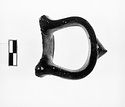
| Wishbone handle and a small part of rim. Slightly horseshoe-shaped handle with a pointed knob added as thumb-rest. Flange for lid.
Black glaze.
ADDENDA Cf. Agora XII, no. 1244 for the "wishbone" and ... 19 July 1950 |
| Rim fragment of a calyx(?) krater.
Black figure, vertical circumscribed palmettes (seven plump petals), no relief line.
Good black glaze within.
Cf. AJA 50 (1946), pp. 93 ff.
ADDENDA Red figure ... 24 May-9 June 1954 |
Wall fragment of stand with part of black band on inside. Glaze flaked here and there. Max. dim. 0.082. LIMC II, 1984, p. 200, no. 85, s.v. Apollon.
Apollo. The fragment preserves the chin, neck, long ... Ca. 460-450 B.C ... The figure of Apollo probably looked very much like the representation on the column-krater in Ferrara 1685 = T.308, by the Painter of Bologna 228 (ARV2 511, 5; Paralip. 382, 5; Addenda 252). |
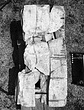
Inscribed fragment.
Inscribed face and smooth dressed right side only preserved.
Letters careless between carefully and deeply cut guide-lines.
Dedication of the year of Sosigenes.
Five lines of the inscription ... 172/1 B.C. (?) |
| Inscribed fragment of a circular monument.
Inscribed face only preserved.
Below the inscription the surface is recessed with an elaborate moulding.
Five lines of the inscription preserved.
Pentelic marble ... 18 December 1936 |
Late Roman Red Ware plate rim and wall with part of floor preserved. Flat floor, low ring foot, low wall and flat everted lip.
Rather coarse, reddish clay; dull red glaze, wash inside.
ADDENDA Added ... 1947 |
| Inscribed fragment. Theophilos monument.
Inscribed face and bottom surface dressed fairly smooth, preserved.
Receding mouldings below the inscription.
Two lines of the inscription preserved.
Pentelic marble ... Ca. 150 B.C. |
Inscribed fragment with parts of two fascia.
Lower edge and surface preserved; other edges broken; the division between the fascia strongly marked by a groove.
Inscribed with one line on each fascia.
Pentelic ... 1st. century B.C ... Pentelic marble.
ADDENDA Belongs to I 30 and I 1181, to which it has been joined ... 252 |
Inscribed fragment.
The top smooth, perhaps original; otherwise broken.
Base of Theophilos.
Two lines of the inscription preserved.
Pentelic marble.
ADDENDA Theophilos of Basaiea, honored by Attalos II, ... Ca. 150 B.C. |
| Part of P 1646.
From horizontal brace of large kalathos (or possibly splaying cut-out stand).
Glazed within; cut-out faces reserved. Exterior: band of receding lozenges, dotted, the background solid-filled; ... 19 May 1932 ... Dull black glaze mostly lost.
ADDENDA Part of P 1646, under which it now goes. ... Leica, 84-252 |
| Joins P 26027.
Rim fragment from openwork kalathos.
Decorated with false spiral and bars on rim. Glazed inside.
Developed style. Cf. an example from the Isis grave, CVA Athens, I, pl. 6:10.
ADDENDA Joins ... 27 April, 5 May 1932 ... Cf. an example from the Isis grave, CVA Athens, I, pl. 6:10.
ADDENDA Joins P 26027 and many other sherds from pyre H 16:6. ... Leica, 3-21, 84-252 |
| Horizontal brace from mid-body. Probably from one of the pots inventoried as P 1645 a-h (other non-joining pieces from this brace and other parts of the vase in bag in Box 165).
Glazed on inside, but ... 27 April-5 May 1932 ... Black-brown to tannish glaze, dull, adherent, little worn.
ADDENDA Three more fragments added ... Leica, 84-252 |
| Mended from several fragments, one piece not joining. Fragment of curved neck of heavy pot, rhyton(?). Domed partition across one end, pierced with large hole next to inner side of neck. Other end decorated ... May 1947 ... Very poor black glaze over all; traces of white paint.
ADDENDA Rhyton terminating in sea monster (triton?). ... PD 901-252 |
Two non-joining fragments, P 4811 of rim with start of wall, P 3445 of wall. Narrow band on inside of P 4811 (at rim), another 0.065 below rim. Glaze fired red except for palmette ornament on P 4811 and ... Ca. 460 B.C ... For the ornament, cf. the rims of two calyx-kraters: Vienna 1102 (ARV2 504, 5; Addenda 252) and Bologna 288 (ARV2 504, 6). |
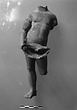
| Nude standing youth, complete except for head, left arm, and left leg below knee. Projection at inside of right heel broken away.
The figure, elaborately modelled, stands on his right foot, with right ... 14 May 1936 ... XXIV-XXV of Corinth collection.
ADDENDA Cf. T 1452 (X 625) ... Leica, LXVIII-87, LXVIII-88, 6-251, 6-252 |
Wall fragment. Max. dim. 0.12. Schwarz, Triptolemos, p. 37, cat. no. V 49, pl. 8:14; Hayashi, Triptolemosbildes, p. 136, cat. no. 37, pl. 5:1 (wrongly called a calyx-krater); Langridge, "Eucharides Painter," ... Ca. 490-480 B.C ... The composition on 289 may have looked much like the one on Louvre G 187, the namepiece of the Triptolemos Painter (ARV2 361, 2; Paralip. 364, 2; Addenda 222; Denoyelle, Chefs-d'oeuvre . . . ... Several representations of the subject, including 289 and Louvre G 187, that depict the serpent alongside the wheel of the seat predate the play, thus indicating that the version with the snakes is not an invention of the playwright (see Pearson, p. 240, note 1): Athens Art Market by the Theseus Painter (Haspels, ABL p. 252, no. 64; snakes are present, according to Raubitschek, Hesperia Suppl. ... E 140 by Makron (ARV2 459, 3; Paralip. 377, 3; Addenda 243).
The Eucharides Painter (ARV1 154, 15; ARV2 227, 16: wrongly called a calyx-krater: the wall is convex, not flaring). |
|
|